PRE 14A: Preliminary proxy statement not related to a contested matter or merger/acquisition
Published on April 16, 2026
UNITED STATES
SECURITIES AND EXCHANGE COMMISSION
Washington, DC 20549
(Rule 14a-101)
INFORMATION REQUIRED IN PROXY STATEMENT
SCHEDULE 14A INFORMATION
Proxy Statement Pursuant to Section 14(a) of the Securities
Exchange Act of 1934 (Amendment No. )
Filed by the Registrant ☒
Filed by a Party other than the Registrant ☐
Check the appropriate box:
☒ | Preliminary Proxy Statement |
☐ | Confidential, for Use of the Commission Only (as permitted by Rule 14a-6(e)(2)) |
☐ | Definitive Proxy Statement |
☐ | Definitive Additional Materials |
☐ | Soliciting Material under §240.14a-12 |
(Name of Registrant as Specified in its Charter)
(Name of Person(s) Filing Proxy Statement, if Other Than the Registrant)
Payment of Filing Fee (Check the appropriate box):
☒ | No fee required. |
☐ | Fee paid previously with preliminary materials. |
☐ | Fee computed on table in exhibit required by Item 25(b) per Exchange Act Rules 14a-6(i)(1) and 0-11. |
AERSALE CORPORATION
9850 NW 41st St., Suite 400
Doral, Florida 33178
April [27], 2026
To Our Stockholders:
You are cordially invited to attend the 2026 Annual Meeting of Stockholders (the “Annual Meeting”) of AerSale Corporation at 10:30 a.m. Eastern time on Thursday, June 11, 2026. The Annual Meeting will be a completely virtual meeting, which will be conducted via live webcast.
The accompanying Notice of Annual Meeting and Proxy Statement describe the matters to be presented at the Annual Meeting. Please see the section called “Who can attend the Annual Meeting?” on page 4 of the Proxy Statement for more information about how to attend the meeting online.
Whether or not you attend the Annual Meeting online, it is important that your shares be represented and voted at the Annual Meeting. Therefore, I urge you to promptly vote and submit your proxy by phone, via the Internet, or, if you received paper copies of these materials, by signing, dating, and returning the enclosed proxy card in the enclosed envelope, which requires no postage if mailed in the United States. If you have previously received our Notice of Internet Availability of Proxy Materials, then instructions regarding how you can vote are contained in that notice. If you have received a proxy card, then instructions regarding how you can vote are contained on the proxy card. If you decide to attend the Annual Meeting, you will be able to vote online, even if you have previously submitted your proxy.
Thank you for your support.
Sincerely,
/s/ Nicolas Finazzo
Nicolas Finazzo
Chairman and Chief Executive Officer
TABLE OF CONTENTS

AERSALE CORPORATION
9850 NW 41st St., Suite 400
Doral, Florida 33178
NOTICE OF ANNUAL MEETING OF STOCKHOLDERS TO BE HELD THURSDAY, JUNE 11, 2026
The Annual Meeting of Stockholders (the “Annual Meeting”) of AerSale Corporation, a Delaware corporation (the “Company”), will be held at 10:30 a.m. Eastern time on Thursday, June 11, 2026. The Annual Meeting will be a completely virtual meeting, which will be conducted via live webcast. You will be able to attend the Annual Meeting online and submit your questions during the meeting. In order to attend the virtual meeting, you will need to register for the meeting at www.virtualshareholdermeeting.com/ASLE2026 using your 16-digit control number included in your Notice of Internet Availability of Proxy Materials, on your proxy card, or in the instructions that accompanied your proxy materials. Once you have registered, you will be given a unique link to our meeting portal where you can access the Annual Meeting on the meeting day and vote during the meeting.
The Annual Meeting will be held for the following purposes:
Proposal 1: | | To elect each of the seven nominees named in the accompanying proxy statement to our Board of Directors to serve until the 2027 Annual Meeting of Stockholders, and until their respective successors shall have been duly elected and qualified; |
Proposal 2: | To approve, on an advisory basis, compensation of our named executive officers; | |
Proposal 3: | To approve the redomestication of the Company from Delaware to Texas, by conversion; and | |
Proposal 4: | To ratify the appointment of Grant Thornton LLP as our independent registered public accounting firm for the fiscal year ending December 31, 2026. |
Holders of record of our common stock as of the close of business on April 21, 2026 are entitled to notice of and to vote at the Annual Meeting, or any continuation, postponement, or adjournment of the Annual Meeting. A complete list of such stockholders will be open to the examination of any stockholder at our principal executive offices at 9850 NW 41st St., Suite 400, Doral, Florida 33178 for a period of ten days prior to the Annual Meeting. The list of these stockholders will also be available on the bottom of your screen during the Annual Meeting after entering the 16-digit control number included on your Notice of Internet Availability of Proxy Materials, on your proxy card, or on the instructions that accompanied your proxy materials. The Annual Meeting may be continued or adjourned from time to time without notice other than by announcement at the Annual Meeting.
It is important that your shares be represented regardless of the number of shares you may hold. Whether or not you plan to attend the Annual Meeting online, we urge you to vote your shares via the toll-free telephone number or over the Internet, as described in the accompanying materials. If you received a copy of the proxy card by mail, you may sign, date, and mail the proxy card in the enclosed return envelope. Promptly voting your shares will ensure the presence of a quorum at the Annual Meeting and will save us the expense of further solicitation. Submitting your proxy now will not prevent you from voting your shares at the Annual Meeting if you desire to do so, as your proxy is revocable at your option.
By Order of the Board of Directors
/s/ Paul A. Hechenberger
Paul A. Hechenberger
AerSale, Inc. | i
Senior Vice President, General Counsel and Corporate Secretary
Doral, Florida
April [27], 2026
AerSale, Inc. | ii
Forward-looking Statements
This proxy statement contains forward-looking statements. We intend such forward-looking statements to be covered by the safe harbor provisions for forward-looking statements contained in Section 27A of the Securities Act of 1933, as amended (the “Securities Act”), and Section 21E of the Securities Exchange Act of 1934, as amended (the “Securities Act”). All statements other than statements of historical facts contained in this proxy statement, including statements regarding our environmental, social and sustainability plans, goals and programs and the ability to launch new services and products or to profitably expand into new markets, may constitute forward-looking statements. In some cases, you can identify forward-looking statements by terms such as “may,” “will,” “should,” “expect,” “plan,” “anticipate,” “could,” “intend,” “target,” “project,” “contemplate,” “believe,” “estimate,” “predict,” “potential”, or “continue” or the negative of these terms or other similar expressions. The forward-looking statements in this proxy statement reflect management’s current expectations and are inherently uncertain. These forward-looking statements speak only as of the date of this proxy statement and are subject to a number of important factors that could cause actual results to differ materially from those in the forward-looking statements, including the factors described in our Annual Report on Form 10-K for the year ended December 31, 2025 that accompanies this proxy statement and in any of our subsequent filings with the Securities and Exchange Commission (the “SEC”).
AerSale, Inc. | iii
PROXY STATEMENT |
AERSALE CORPORATION
9850 NW 41st St., Suite 400
Doral, Florida 33178
This proxy statement is furnished in connection with the solicitation by the Board of Directors of the Company (the “Board” or the “Board of Directors”) of proxies to be voted at our Annual Meeting of Stockholders to be held on Thursday, June 11, 2026 (the “Annual Meeting”), at 10:30 a.m. Eastern time, and at any continuation, postponement, or adjournment of the Annual Meeting. The Annual Meeting will be a completely virtual meeting, which will be conducted via live webcast. You will be able to attend the Annual Meeting online and submit your questions during the meeting. In order to attend the virtual meeting, you will need to register for the meeting at www.virtualshareholdermeeting.com/ASLE2026 using your 16-digit control number included in your Notice of Internet Availability of Proxy Materials (the “Internet Notice”), on your proxy card, or in the instructions that accompanied your proxy materials. Once you have registered, you will be given a unique link to our meeting portal where you can access the Annual Meeting on the meeting day, and vote during the meeting
Holders of record of shares of our common stock as of the close of business on April 21, 2026 (the “Record Date”) will be entitled to notice of and to vote at the Annual Meeting and any continuation, postponement, or adjournment of the Annual Meeting. As of the Record Date, there were [47,252,829] shares of common stock outstanding and entitled to vote at the Annual Meeting. Each share of common stock is entitled to one vote on any matter presented to stockholders at the Annual Meeting.
This proxy statement and the Company’s Annual Report to Stockholders for the year ended December 31, 2025 (the “2025 Annual Report”) will be released on or about April [27], 2026, to our stockholders on the Record Date.
In this proxy statement, “AerSale”, the “Company”, “we”, “us”, and “our” refer to AerSale Corporation and its consolidated subsidiaries.

IMPORTANT NOTICE REGARDING THE AVAILABILITY OF PROXY MATERIALS FOR THE ANNUAL MEETING OF STOCKHOLDERS TO BE HELD ON THURSDAY, JUNE 11, 2026
This Proxy Statement and the 2025 Annual Report are available at www.proxyvote.com
AerSale, Inc. | 1
Proposals
At the Annual Meeting, our stockholders will be asked:
| ● | To elect Nicolas Finazzo, Robert B. Nichols, Lt. General Judith Fedder, Andrew Levy, Thomas Mullins, Carol DiBattiste and Thomas Mitchell as directors to serve until the 2027 Annual Meeting of Stockholders, and until their respective successors shall have been duly elected and qualified; |
| ● | To approve, on an advisory basis, compensation of our named executive officers; |
| ● | To approve the redomestication of the Company from Delaware to Texas, by conversion; |
| ● | To ratify the appointment of Grant Thornton LLP as our independent registered public accounting firm for the fiscal year ending December 31, 2026; and |
| ● | To transact such other business as may properly come before the Annual Meeting or any continuation, postponement, or adjournment of the Annual Meeting. |
We know of no other business that will be presented at the Annual Meeting. If any other matter properly comes before the stockholders for a vote at the Annual Meeting, however, the proxy holders named on the Company’s proxy card will vote your shares in accordance with their best judgment.
Recommendations of the Board
The Board of Directors recommends that you vote your shares as indicated below. If you return a properly completed proxy card, or vote your shares by telephone or Internet, your shares of common stock will be voted on your behalf as you direct. If not otherwise specified, the shares of common stock represented by proxies will be voted, and the Board of Directors recommends that you vote:
| ● | FOR the election of Nicolas Finazzo, Robert B. Nichols, Lt. General Judith Fedder, Andrew Levy, Thomas Mullins, Carol DiBattiste and Thomas Mitchell to serve as directors until the 2027 Annual Meeting of Stockholders, and until their respective successors shall have been duly elected and qualified; |
| ● | FOR the approval of, on an advisory basis, compensation of our named executive officers; |
| ● | FOR the approval of the redomestication of the Company from Delaware to Texas, by conversion; and |
| ● | FOR the ratification of the appointment of Grant Thornton LLP as our independent registered public accounting firm for the fiscal year ending December 31, 2026. |
AerSale, Inc. | 2
Information About This Proxy Statement
Why you received this proxy statement. You are viewing or have received these proxy materials because AerSale’s Board of Directors is soliciting your proxy to vote your shares at the Annual Meeting. This proxy statement includes information that we are required to provide you under the rules of the SEC and that is designed to assist you in voting your shares.
Notice of Internet Availability of Proxy Materials. As permitted by SEC rules, AerSale is making this proxy statement and its 2025 Annual Report available to its stockholders electronically via the Internet. On or about April [27], 2026, we mailed to our stockholders the Internet Notice containing instructions on how to access this proxy statement and our 2025 Annual Report and vote online. If you received an Internet Notice by mail, you will not receive a printed copy of the proxy materials in the mail unless you specifically request them. Instead, the Internet Notice instructs you on how to access and review all of the important information contained in the proxy statement and 2025 Annual Report. The Internet Notice also instructs you on how you may submit your proxy over the Internet. If you received an Internet Notice by mail and would like to receive a printed copy of our proxy materials, you should follow the instructions for requesting such materials contained on the Internet Notice.
Printed Copies of Our Proxy Materials. If you received printed copies of our proxy materials, then instructions regarding how you can vote are contained on the proxy card included in the materials.
Householding. The SEC’s rules permit us to deliver a single set of proxy materials to one address shared by two or more of our stockholders. This delivery method is referred to as “householding” and can result in significant cost savings. To take advantage of this opportunity, we have delivered only one set of proxy materials to multiple stockholders who share an address, unless we received contrary instructions from the impacted stockholders prior to the mailing date. We agree to deliver promptly, upon written or oral request, a separate copy of the proxy materials, as requested, to any stockholder at the shared address to which a single copy of those documents was delivered. If you prefer to receive separate copies of the proxy materials, contact Broadridge Financial Solutions, Inc. at 1-866-540-7095 or in writing to Broadridge Financial Solutions, Inc., Attention: Householding Department, 51 Mercedes Way, Edgewood, New York 11717.
If you are currently a stockholder sharing an address with another stockholder and wish to receive only one copy of future proxy materials for your household, please contact Broadridge at the above phone number or address.
AerSale, Inc. | 3
QUESTIONS AND ANSWERS ABOUT THE ANNUAL MEETING OF STOCKHOLDERS |
Who is entitled to vote at the Annual Meeting?
The Record Date for the Annual Meeting is April 21, 2026. You are entitled to vote at the Annual Meeting only if you were a stockholder of record at the close of business on that date. Each outstanding share of common stock is entitled to one vote for all matters before the Annual Meeting. At the close of business on the Record Date, there were [47,252,829] shares of common stock outstanding and entitled to vote at the Annual Meeting.
What is the difference between being a “record holder” and holding shares in “street name”?
A record holder holds shares in his or her name. Shares held in “street name” means shares that are held in the name of a bank or broker on a person’s behalf.
Am I entitled to vote if my shares are held in “street name”?
Yes. If your shares are held by a bank or a brokerage firm, you are considered the “beneficial owner” of those shares held in “street name.” If your shares are held in street name, these proxy materials are being provided to you by your bank or brokerage firm, along with a voting instruction card if you received printed copies of our proxy materials. As the beneficial owner, you have the right to direct your bank or brokerage firm how to vote your shares, and the bank or brokerage firm is required to vote your shares in accordance with your instructions. If your shares are not registered in your own name and you would like to vote your shares at the Annual Meeting, you should contact your broker or other nominee to obtain your 16-digit control number or otherwise vote through the broker or nominee.
How many shares must be present to hold the Annual Meeting?
A quorum must be present at the Annual Meeting for any business to be conducted. The presence at the Annual Meeting, in person virtually online or by proxy, of the holders of a majority of the issued and outstanding shares of common stock entitled to vote on the Record Date will constitute a quorum.
Who can attend the Annual Meeting?
AerSale is holding the Annual Meeting entirely online this year. You may attend and participate in the Annual Meeting by visiting the following website www.virtualshareholdermeeting.com/ASLE2026.
To attend and participate in the Annual Meeting, you will need the 16-digit control number included in your Internet Notice, on your proxy card, or on the instructions that accompanied your proxy materials. If your shares are held in “street name,” you should contact your bank or broker to obtain your 16-digit control number or otherwise vote through the bank or broker. If you lose your 16-digit control number, you may join the Annual Meeting as a “Guest” but you will not be able to vote, ask questions, or access the list of stockholders as of the Record Date. The meeting webcast will begin promptly at 10:30 a.m. Eastern time. We encourage you to access the meeting prior to the start time. Online check-in will begin at 10:15 a.m. Eastern time, and you should allow ample time for the check-in procedures.
What if a quorum is not present at the Annual Meeting?
If a quorum is not present at the scheduled time of the Annual Meeting, the Chairperson of the Annual Meeting is authorized by our Amended and Restated Bylaws, as amended, to adjourn the meeting.
What does it mean if I receive more than one Internet Notice or more than one set of proxy materials?
It means that your shares are held in more than one account at the transfer agent and/or with banks or brokers. Please vote all of your shares. To ensure that all your shares are voted, for each Internet Notice or set of proxy materials, please submit your proxy by phone, via the Internet, or, if you received printed copies of the proxy materials, by signing, dating, and returning the enclosed proxy card in the enclosed envelope.
How do I vote?
Stockholders of Record. If you are a stockholder of record, you may vote:
| ● | by Internet — You can vote over the Internet at www.proxyvote.com by following the instructions on the Internet Notice or proxy card; |
| ● | by Telephone — You can vote by telephone by calling 1-800-690-6903 and following the instructions on the proxy card; |
AerSale, Inc. | 4
| ● | by Mail — You can vote by mail by signing, dating, and mailing the proxy card if provided to you; or |
| ● | Electronically at the Annual Meeting — If you attend the Annual Meeting online, you will need the 16-digit control number included in your Internet Notice, on your proxy card, or on the instructions that accompanied your proxy materials to vote electronically during the meeting. |
Internet and telephone voting facilities for stockholders of record will be available 24 hours a day and will close at 11:59 p.m., Eastern time, on June 10, 2026. To participate in the Annual Meeting, including voting via the Internet or telephone, you will need the 16-digit control number included on your Internet Notice, on your proxy card, or on the instructions that accompanied your proxy materials.
Whether or not you expect to attend the Annual Meeting online, we urge you to vote on your shares as promptly as possible to ensure your representation and the presence of a quorum at the Annual Meeting. If you submit your proxy, you may still decide to attend the Annual Meeting and vote on your shares electronically.
Beneficial Owners of Shares Held in “Street Name.” If your shares are held in “street name” through a bank or broker, you will receive instructions on how to vote from the bank or broker. You must follow their instructions in order for your shares to be voted on non-routine matters (see “What are broker non-votes and how do they count for determining a quorum?”). Internet and telephone voting also may be offered to stockholders owning shares through certain banks and brokers. If your shares are not registered in your own name and you would like to vote on your shares online at the Annual Meeting, you should contact your bank or broker to obtain your 16-digit control number or otherwise vote through the bank or broker. If you lose your 16-digit control number, you may join the Annual Meeting as a “Guest” but you will not be able to vote, ask questions or access the list of stockholders as of the Record Date. You will need to obtain your own Internet access if you choose to attend the Annual Meeting online and/or vote over the Internet.
Can I change my vote after I submit my proxy?
Yes.
If you are a registered stockholder, you may revoke your proxy and change your vote:
| ● | by submitting a duly executed proxy bearing a later date; |
| ● | by granting a subsequent proxy through the Internet or telephone; |
| ● | by giving written notice of revocation to the Corporate Secretary of AerSale prior to the Annual Meeting; or |
| ● | by voting online at the Annual Meeting. |
Your most recent proxy card or Internet or telephone proxy is the one that is counted. Your attendance at the Annual Meeting by itself will not revoke your proxy unless you give written notice of revocation to the Corporate Secretary before your proxy is voted or you vote online at the Annual Meeting.
If your shares are held in street name, you may change or revoke your voting instructions by following the specific directions provided to you by your bank or broker, or you may vote online at the Annual Meeting using your 16-digit control number or otherwise vote through your bank or broker.
Who will count the votes?
A representative of The Carideo Group, our inspector of election, will tabulate and certify the votes.
What if I do not specify how my shares are to be voted?
If you are a stockholder of record and submit a proxy but do not indicate any voting instructions, the persons named as proxies will vote in accordance with the recommendations of the Board of Directors. The Board of Directors’ recommendations are indicated on page 2 of this proxy statement, as well as with the description of each proposal in this proxy statement.
AerSale, Inc. | 5
Will any other business be conducted at the Annual Meeting?
We know of no other business that will be presented at the Annual Meeting. If any other matter properly comes before the stockholders for a vote at the Annual Meeting, however, the proxy holders named on the Company’s proxy card will vote your shares in accordance with their best judgment.
Why hold a virtual meeting?
A virtual meeting enables increased stockholder attendance and participation because stockholders can participate from any location around the world. You will be able to attend the Annual Meeting online and submit your questions by visiting www.virtualshareholdermeeting.com/ASLE2026. You also will be able to vote your shares electronically at the Annual Meeting by following the instructions above.
What if during the check-in time or during the Annual Meeting I have technical difficulties or trouble accessing the virtual meeting website?
We will have technicians ready to assist you with technical difficulties you may have accessing the virtual meeting website. The information for assistance will be located on www.virtualshareholdermeeting.com/ASLE2026.
Will there be a question and answer session during the Annual Meeting?
As part of the Annual Meeting, we will hold a live Q&A session, during which we intend to answer appropriate questions submitted by stockholders during the meeting that are pertinent to the Company and the meeting matters.
The Company will endeavor to answer as many questions submitted by stockholders as time permits. Only stockholders that have accessed the Annual Meeting as a stockholder (rather than a “Guest”) by following the procedures outlined above under “Who can attend the Annual Meeting?” will be permitted to submit questions during the Annual Meeting. Each stockholder is limited to no more than two questions. Questions should be succinct and only cover a single topic. We will not address questions that are, among other things:
| ● | irrelevant to the business of the Company or to the business of the Annual Meeting; |
| ● | related to material non-public information of the Company, including the status or results of our business since the 2025 Annual Report or in a subsequent Quarterly Report on Form 10-Q that we file with the SEC; |
| ● | related to any pending, threatened or ongoing litigation; |
| ● | related to personal grievances; |
| ● | derogatory references to individuals or that are otherwise in bad taste; |
| ● | substantially repetitious of questions already made by another stockholder; |
| ● | in excess of the two question limit; |
| ● | in furtherance of the stockholder’s personal or business interests; or |
| ● | out of order or not otherwise suitable for the conduct of the Annual Meeting as determined by the Chairperson of the Annual Meeting or our Corporate Secretary in his or her reasonable judgment. |
Additional information regarding the Q&A session will be available in the “Rules of Conduct” available on the Annual Meeting webpage for stockholders who have accessed the Annual Meeting as a stockholder (rather than a “Guest”) by following the procedures outlined above in “Who can attend the Annual Meeting?”.
What is an “abstention” and how will abstentions be treated for purposes of determining a quorum?
An “abstention” represents a stockholder’s affirmative choice to decline to vote on a proposal. Abstentions are counted as present and entitled to vote for purposes of determining a quorum.
What are broker non-votes and how do they count for determining a quorum?
Generally, broker non-votes occur when shares held by a broker in “street name” for a beneficial owner are not voted with respect to a particular proposal because the broker (1) has not received voting instructions from the beneficial owner and (2) lacks discretionary voting power to vote those shares. A broker is entitled to vote shares held for a beneficial owner on routine matters, such as the ratification of the appointment of Grant Thornton LLP as our
AerSale, Inc. | 6
independent registered public accounting firm, without instructions from the beneficial owner of those shares. On the other hand, absent instructions from the beneficial owner of such shares, a broker is not entitled to vote shares held for a beneficial owner on non-routine matters, such as the election of directors, say-on-pay and the redomestication of the Company from Delaware to Texas, by conversion. Broker non-votes count for purposes of determining whether a quorum is present.
How many votes are required for the approval of the proposals to be voted upon and how will abstentions and broker non-votes be treated?
Proposal | | Votes required | | Effect of |
Proposal 1: Election of Directors | The majority of the votes cast. This means that the number of votes cast “FOR” a director’s election must exceed the number of votes cast “AGAINST” that director’s election. | Abstentions and broker non-votes will have no effect on this proposal. | ||
Proposal 2: Approval, on an advisory basis, of our named executive officer compensation (“say-on-pay”) | The affirmative vote of a majority of the outstanding shares present online or by proxy at the Annual Meeting and entitled to vote. | Abstentions will have the same effect as a vote against this proposal. Broker non-votes will have no effect on this proposal. | ||
Proposal 3: Approval of the redomestication of the Company from Delaware to Texas, by conversion | The affirmative vote of a majority of the outstanding shares of common stock of the Company entitled to vote. | Abstentions and broker non-votes will have the same effect as a vote against this proposal. | ||
Proposal 4: Ratification of Appointment of Independent Registered Public Accounting Firm for the Fiscal Year Ending December 31, 2026 | The affirmative vote of a majority of the outstanding shares present online or by proxy at the Annual Meeting and entitled to vote. | Abstentions will have the same effect as a vote against this proposal. We do not expect any broker non-votes on this proposal. |
Where can I find the voting results of the Annual Meeting?
We plan to announce preliminary voting results at the Annual Meeting and we will report the final results in a Current Report on Form 8-K, which we intend to file with the SEC within four business days of the Annual Meeting.
AerSale, Inc. | 7
PROPOSALS TO BE VOTED ON |
PROPOSAL 1: ELECTION OF DIRECTORS
Upon the recommendation of the Nominating and Corporate Governance Committee of the Board, the Board has nominated Nicolas Finazzo, Robert B. Nichols, Lt. General Judith Fedder, Andrew Levy, Thomas Mullins, Carol DiBattiste, and Thomas Mitchell to serve as directors until the 2027 Annual Meeting and until each such director’s respective successor is elected and qualified.
In accordance with our Amended and Restated Certificate of Incorporation and our Amended and Restated Bylaws, each as amended, the Board of Directors will stand for election for one-year terms that expire at the following year’s annual meeting and until his or her successor has been elected and qualified, subject, however, to such director’s earlier death, resignation, retirement, disqualification, or removal. Pursuant to our Amended and Restated Certificate of Incorporation, as amended, the total number of directors shall be fixed exclusively by resolutions adopted from time to time by the Board, which number is currently seven.
Proxies cannot be voted for a greater number of persons than the number of nominees named. Newly created directorships resulting from an increase in the number of directors and any vacancies on the Board resulting from death, resignation, retirement, disqualification, removal, or other cause may be filled solely and exclusively by a majority vote of the remaining directors then in office, even if less than a quorum, or by a sole remaining director (and not by stockholders).
If you are a stockholder of record and submit a proxy but do not indicate any voting instructions, the persons named as proxies will vote the shares of common stock represented thereby for the election as a director of the person whose name and biography appears below. In the event that any of Mr. Finazzo, Mr. Nichols, Lt. General Fedder, Mr. Levy, Mr. Mullins, Ms. DiBattiste or Mr. Mitchell should become unable to serve, or for good cause will not serve, as a director, it is intended that votes will be cast for a substitute nominee designated by the Board of Directors or the Board may elect to reduce its size. The Board of Directors has no reason to believe that any of the director nominees will be unable to serve if elected. Each of the director nominees has consented to being named in this proxy statement and to serve if elected.
Vote Required
The proposal regarding the election of directors requires the approval of a majority of the votes cast. This means that the number of votes cast “FOR” a director’s election must exceed the number of votes cast “AGAINST” that director’s election.
Abstentions and broker non-votes are not considered to be votes cast and, accordingly, will have no effect on the outcome of the vote on this proposal.
| Recommendation of the Board of Directors The Board of Directors unanimously recommends a vote FOR the election of each of the below director nominees. |

AerSale, Inc. | 8
The current members of the Board of Directors who are also nominees for election to the Board of Directors are as follows:
Name | | Age | | Position with AerSale |
Nicolas Finazzo | 69 |
| Chairman, Chief Executive Officer, and Director | |
Robert B. Nichols | 69 |
| Director | |
Lt. General Judith Fedder | 68 |
| Director | |
Andrew Levy | 56 |
| Director | |
Thomas Mullins | 61 |
| Director | |
Carol DiBattiste | 74 |
| Director | |
Thomas Mitchell | 55 | Director |
The following information with respect to the seven nominees is based on information furnished to the Company by each nominee and highlights the specific experience, qualifications, attributes, and skills of the individual nominees that have led the Board to conclude that each should continue to serve on the Board:
Nicolas Finazzo | ||
Age: 69 Position: Chairman, Chief Executive Officer, and Director | Mr. Finazzo has served on our Board since December 2020. Mr. Finazzo co-founded AerSale Corp. in 2008 with Mr. Nichols and has served as Chairman and Chief Executive Officer from inception until January 2019, and again since December 2019. He has also served as Division President, TechOps since December 2019. From January 2019 to December 2019, Mr. Finazzo was Executive Chairman of AerSale Corp. From 1997 to 2008, he was Co-Founder and Chief Executive Officer of AeroTurbine, Inc., a supplier of aircraft and engine products, and a maintenance, repair and overall ("MRO") service provider. In 1997, Mr. Finazzo was Vice President and General Counsel of AeroThrust, Inc., a parts supplier, MRO service provider, and aircraft engine leasing company. From 1991 to 1997, Mr. Finazzo was Vice President and General Counsel of International Air Leases, Inc., an aircraft leasing company. From 1987 to 1991, Mr. Finazzo was Vice President of Contracts for Greenwich Air Services, an engine MRO service provider. From 1981 to 1987, Mr. Finazzo was President of Southern Express Airways, Inc., a commuter airline he founded, operating primarily in the State of Florida. Mr. Finazzo graduated from the University of Michigan with a Bachelor of Science degree in Political Science and earned a Juris Doctorate degree from the University of Miami School of Law. Mr. Finazzo is licensed to practice law in Florida and also holds a Federal Aviation Administration Airframe and Powerplant Mechanic license. As one of our founders, Chairman and Chief Executive Officer, Mr. Finazzo brings to the Board over 40 years experience in the aviation sector, including senior leadership and institutional knowledge of the Company, with considerable expertise in MRO services, parts distribution, and aircraft and engine leasing sectors of the aviation industry. | |
AerSale, Inc. | 9
Non-Employee Directors
Robert B. Nichols | ||
Age: 69 Position: Director | Mr. Nichols has served on our Board since December 2020. Mr. Nichols co-founded AerSale Corp. in 2008 with Mr. Finazzo and served as Vice Chairman from January 2019 until his retirement on December 31, 2023. He has also served as Division President, Asset Management Solutions from December 2019 until his retirement on December 31, 2023. From 2017 to December 2019, Mr. Nichols was a Principal of AerSale Corp. From 2008 to 2017, Mr. Nichols also was Chief Operating Officer of AerSale Corp. From 1997 to 2008, prior to founding AerSale Corp., Mr. Nichols was Co-Founder and Chief Operating Officer of AeroTurbine, Inc. From 1990 to 1997, Mr. Nichols was Vice President of Engine Sales and Leasing for AeroThrust, Inc. From 1989 to 1990, Mr. Nichols was Director of Engine Sales and Leasing for Greenwich Air Services. Mr. Nichols graduated from the University of Texas with a Bachelor of Science degree in business administration and accounting and attended vocation and technical training at Boeing (formerly Aviall Baniff) on a variety of aircraft engines, including P&WJT8D, CFMI, CFM56-3, IAE V2500, and RR Tay 650 heavy maintenance. As one of our founders and former Vice Chairman, Mr. Nichols brings to the Board significant senior leadership, marketing, technical, and global experience along with deep institutional knowledge of the Company, its operations and customer relations. | |
AerSale, Inc. | 10
Lt. General Judith Fedder | ||
Age: 68 Position: Director | Lt. General Fedder has served on our Board since July 2022. At the time of her retirement after nearly 35 years of active duty Air Force service, Lt. General Fedder served as Deputy Chief of Staff for Logistics, Installations and Mission Support, Headquarters U.S. Air Force, Washington, D.C. In that role, she was responsible to the Air Force Chief of Staff for leadership, management and integration of Air Force logistics readiness, aircraft, munitions, and missile maintenance, with emphasis on combat readiness and weapon system availability. Her portfolio also included setting policy and preparing budget estimates for Air Force civil engineering and security forces functions. Following her military career, Lt. General Fedder was a Senior Director at The Boeing Company for Global Sales and Marketing, Integrated Logistics, Boeing Defense. In that role, she secured capture of after-market services for military fighter and helicopter platforms and supply chain. She is currently a Senior Advisor at the Boston Consulting Group. Lt. General Fedder is a member of the Board of Directors of the Institute for Defense & Business, a nonprofit education and research institute in Chapel Hill, North Carolina. Lt. General Fedder also served as a member of the Defense Advisory Committee for Women in the Services and is an Emeritus Member of the Board of Governors for Civil Air Patrol. General Fedder is a former Presidential appointee to the Board of Visitors for the U.S. Air Force Academy as well as recipient of the Michigan State University Distinguished Alumni Award in 2014. Lt. General Fedder graduated from Michigan State University in 1980 with a Bachelor of Science degree and holds an MBA from the Florida Institute of Technology. Lt. General Fedder is also a distinguished graduate of the Air Force Reserve Officer Training Corps program, and her active duty career included leading and commanding aircraft maintenance units. Lt. General Fedder served as the Sub-Unified Commander of U.S. Forces Azores and commanded the 76th Maintenance Wing aircraft depot at Tinker AFB, Oklahoma, leading over 9,000 employees in the maintenance, repair, and overhaul of military aircraft, engines, and components. Lt. General Fedder brings to the Board over 35 years of leadership and governance experience in aeronautical government and defense contracting and logistics. | |
AerSale, Inc. | 11
Andrew Levy | ||
Age: 56 Position: Director | Mr. Levy has served on our Board since April 2023, including service for part of that time as chair of the audit committee. Mr. Levy is the founder, Chairman, and Chief Executive Officer of Avelo, Inc. and its wholly owned subsidiary Avelo Airlines, a scheduled airline focused on the U.S. domestic market. Prior to launching Avelo Airlines in 2021, Mr. Levy was a co-founder and served as President, Chief Operating Officer, Chief Financial Officer, Treasurer, and a member of the board of directors of Allegiant Travel Company (Nasdaq: ALGT), parent company of U.S. ultra-low-cost carrier Allegiant Air, from 2001 to 2014. Following his tenure at Allegiant, Mr. Levy served as Executive Vice President and Chief Financial Officer for United Airlines (NYSE: UAL) from August 2016 until May 2018. Mr. Levy has been a member of the board of directors at Copa Holdings, S.A. (NYSE: CPA), a leading Latin American airline, since January 2016, and served as the chair of its audit committee. Mr. Levy started his aviation career at ValuJet Airlines, served as Vice President of Savoy Capital, an aviation focused investment and advisory firm, and as Vice President of Network Development and Planning at Mpower Communications, a telecommunications company. Mr. Levy is a 2024 EY Entrepreneur of the Year for the Gulf South Region. He earned a BA degree in Economics from Washington University in St. Louis and a JD from Emory University. Mr. Levy brings to the Board over three decades of corporate and entrepreneurial experience in the aviation and telecommunications industries as well as leadership and governance experience, and extensive involvement serving as a director and member of board committees. | |
Thomas Mullins | ||
Age: 61 Position: Director | Mr. Mullins was appointed to the AerSale Board in February 2025. Mr. Mullins is currently an independent investor, including multiple private equity investments in the airline and aviation services sector. From 1990 until his retirement in June 2022, Mr. Mullins was an investment banker at Raymond James Financial (“Raymond James”, NYSE: RJF). In 2000, he founded the aviation sector investment banking practice within Raymond James, which completed transactions for a range of clients in The Americas and Europe, including low-cost air carriers, full-service airlines, cargo airlines, regional “feeder” airlines, fixed-base operators, charter airlines, loyalty programs and others. His transaction work for aviation clients included IPOs and other types of public securities offerings, private equity and debt capital raises, mergers & acquisitions, and other advisory roles. Mr. Mullins earned a BA degree with magna cum laude distinction from Vanderbilt University and also holds an MBA degree from the Tuck School of Business at Dartmouth College. Mr. Mullins brings to the Board particular knowledge and experience in the areas of corporate finance, strategic acquisitions and the capital markets. He also brings existing familiarity with the Company’s client base and feedstock sources, and with the commercial aviation sector generally. | |
AerSale, Inc. | 12
Carol DiBattiste | ||
Age: 74 Position: Director | Ms. DiBattiste was appointed to the Board in April 2025. Ms. DiBattiste served as the Chief Legal & Compliance Officer and Corporate Secretary for QOMPLX, the principal business of which involved cloud-native risk analytics management, from 2021 to 2022. Prior to her position with QOMPLX, Ms. DiBattiste was employed by Comscore (Nasdaq:SCOR), a media measurement company providing marketing data and analytics to enterprises, as its Executive Vice President, Chief Legal & Compliance Officer and Corporate Secretary, from 2019 to 2020, and its General Counsel & Chief Compliance, Privacy, People Officer & Secretary, from 2017 to 2019. Ms. DiBattiste also served in senior executive positions, including as the Executive Vice President, Chief Legal, Privacy, Security and Administrative Officer for Education Management Corporation (Nasdaq: EDMC), from 2013 to 2016; Executive Vice President, General Counsel and Chief Administrative Officer for GeekNet (Nasdaq: GKNT), from 2011 to 2013; Senior Vice President, Privacy and Security for Reed Elsevier/LexisNexis (NYSE: RELX), from 2008 to 2011; and Executive Vice President, General Counsel and Chief Privacy Officer at ChoicePoint (NYSE:CPS), from 2005 to 2008. Ms. DiBattiste’s U.S. government senior executive experience includes: Highly Qualified Expert, Department of Defense (2023-2024); Executive in Charge and Vice Chairman, Board of Veterans’ Appeals (2016-2017), and Senior Advisor for Appeals Modernization, Office of the Secretary (2016), Department of Veterans Affairs; Deputy Administrator (2004-2005), and Chief of Staff (2003-2004), Transportation Security Administration, Department of Homeland Security; Honorable Under Secretary of the United States Air Force (Senate confirmed), Department of Defense (1999-2001); Deputy United States Attorney, Southern District of Florida (1997-1999), and Director, Executive Office for U.S. Attorneys (1994-1997), Department of Justice; and Principal Deputy General Counsel of the Navy (1993-1994), Department of Defense. Ms. DiBattiste also served on active duty in the U.S. Air Force with a distinguished military career. Ms. DiBattiste previously served as an independent director on the board of directors of the following publicly traded companies: AEye (Nasdaq:LIDR), a provider of high-performance active LiDAR systems for vehicle autonomy, from 2021 to 2023, where she served as board chair and as a member of its audit, compensation, and nominating and governance committees; and Climb Global Solutions (Nasdaq: CLMB), an information technology distribution and solutions provider, from 2020 to 2021. Ms. DiBattiste also served on the board of directors of artificial intelligence provider Giant Oak, Inc. and American Roll-On Roll-Off Carrier, a leading U.S. flag transportation carrier in the international trades. Ms. DiBattiste holds a Master of Laws Degree from the Columbia University School of Law, a Law Degree from Temple University School of Law, and a Bachelor of Arts Degree with honors from LaSalle University. She completed the Harvard Business School Strategic Leadership Program, Carnegie Mellon University Cybersecurity Oversight Certification, and is National Association of Corporate Directors NACD Directorship Certified™. Ms. DiBattiste is licensed to practice law in Florida and the District of Columbia, holds a Secret Level National Security Clearance, and is a speaker on Risk and Compliance. Ms. DiBattiste brings to the Board extensive experience in corporate governance, regulatory compliance, cybersecurity, and leadership roles across both the public and private sectors, including extensive executive positions at multiple public companies. | |
AerSale, Inc. | 13
Thomas Mitchell | ||
Age: 55 Position: Director | Mr. Mitchell was appointed to the Board in April 2025. Mr. Mitchell served as the Chief Procurement Officer for Akumin, a leader in advanced imaging and radiation oncology in the U.S., from February 2024 to February 2025. Prior to his employment with Akumin, Mr. Mitchell was President at iAero Thrust, an integrated full-service provider of aftermarket parts and maintenance for commercial jet engines, from February 2020 to January 2023. Prior to iAero Thrust, Mr. Mitchell held numerous positions at GE Healthcare, a leading global medical technology, pharmaceutical diagnostics, and digital solutions innovator, including as Chief Procurement Officer February 2019 to November 2019, Vice President of Global Supply Chain February 2018 to February 2019, and Vice President of Sourcing from 2015 to 2018. Mr. Mitchell also held a variety of positions at various GE entities (GE India, GE Inspection Technologies, GE Transportation, GE China, GE Aviation, GE Engine Assembly), including General Manager of Supply Chain, General Manager of Sourcing, Commodity Leader, Plant Operations Leader and Operational Development. Mr. Mitchell holds an MBA from the University of North Carolina and a BS in Manufacturing Engineering from Boston University. Mr. Mitchell brings to the Board particular knowledge and experience in the areas of global supply chain management, manufacturing, aviation, strategic acquisitions and engineering. He also brings familiarity with the Company’s customer base and feedstock sources, and with the commercial aviation sector generally. | |
AerSale, Inc. | 14
PROPOSAL 2: ADVISORY VOTE TO APPROVE COMPENSATION OF OUR NAMED EXECUTIVE OFFICERS
Proposal Summary
As required by Section 14A of the Exchange Act, we are asking you to approve the following advisory proposal — commonly known as a “say-on-pay” proposal — on the compensation awarded to our named executive officers for 2025 as disclosed in this proxy statement. Accordingly, we are asking you to approve, on a non-binding basis, the following advisory resolution at the Annual Meeting:
“RESOLVED, that the compensation paid to the Company’s named executive officers, as disclosed in this proxy statement pursuant to Item 402 of Regulation S-K, including the Compensation Discussion and Analysis, compensation tables and narrative discussion is hereby APPROVED.”
Although this say-on-pay advisory vote is not binding on the Board, the Board will review and consider the voting results and other relevant factors in responding to this advisory vote. We hold an annual vote on say-on-pay because we believe it is important to obtain the input of our stockholders on our executive compensation program. At our 2025 Annual Meeting of Stockholders, approximately 87.5% of the shares present in person or by proxy and entitled to vote approved the compensation of our named executive officers as disclosed in the 2025 proxy statement.
Each year our Compensation Committee and independent compensation consultant takes a careful look at the Company’s executive compensation program to determine whether to make any design or implementation changes. Reasons to make changes may include the results of say-on-pay stockholder votes, stockholder feedback, the financial and operating performance of the Company, the performance of individual senior management members, peer group changes or market trends.
As in prior years, the Compensation Committee, in consultation with its independent compensation consultant, designed the 2025 executive compensation program to align executive pay with Company performance in order to create an identity of interest between management and stockholders. This goal is accomplished principally through the payment of performance-based cash bonuses and the grant of equity awards.
The Board encourages you to read the “Compensation Discussion and Analysis” and the accompanying executive compensation tables in this proxy statement for a comprehensive description of the 2025 executive compensation program.
All 2025 executive compensation paid to the named executive officers is performance-based or at-risk compensation, other than base salaries and limited other compensation such as health insurance and 401(k) matching contributions, as shown below:
Plan | | Performance goals or vesting criteria |
FY25 short-term incentive plan – cash bonuses | Adjusted EBITDA, strategic objectives | |
FY25 long-term incentive plan – time-based restricted stock units | Aligned with stockholder value creation with pro rata three-year vesting period. | |
FY25 long-term incentive plan – performance-based restricted stock units | Adjusted EBITDA from operations over a cumulative three-year operating period. | |
FY25 long-term incentive plan – stock options | Stock price appreciation with pro rata three-year vesting period. |
Compensation Committee Independence
Lt. General Fedder, Ms. DiBattiste, and Mr. Mullins, all of whom are independent non-employee directors, are the current members of the Compensation Committee of the Board of the Company. None of the members of the Compensation Committee is or ever was an officer or employee of the Company or any of its subsidiaries, and none of the executive officers of the Company served on the board of directors or compensation committee of any entity whose officers served either on the Board of the Company or on the Compensation Committee of the Board of the Company.
AerSale, Inc. | 15
Our Compensation Decisions in Fiscal 2025
In 2025, the Compensation Committee continued with an executive compensation program that was reintroduced in 2024, which it believes best serves the alignment of pay with performance, and the retention of key members of the Company’s executive leadership team going forward. Such program includes, among other things: (1) a continued commitment to attach 50% of equity awards to performance conditions; (2) a commitment to attach 25% of equity awards to the performance of the Company stock through the issuance of options; (3) a commitment to promote retention by attaching 25% of equity awards to time-vesting; (4) capping the payout on performance-based restricted stock at 200%; and (5) adjustments in base salaries to align with the industry and competitive market.
Ongoing Commitment to Stockholder Engagement
The Committee values the perspectives of the Company’s stockholders and the importance of stockholder feedback expressed directly and through the annual say-on-pay voting process. We remain committed to maintaining a compensation structure that aligns pay with performance, drives long-term value creation, and reflects the perspectives of our stockholders.
As advised by our stockholders at the 2025 Annual Meeting of Stockholders and approved by our Board, the say-on-pay vote will be held annually. The next say-on-pay vote is expected to occur at the 2027 Annual Meeting of Stockholders.
Vote Required
This proposal requires the affirmative vote of a majority of the outstanding shares present at the Annual Meeting online or by proxy and entitled to vote. Abstentions will have the same effect as a vote against the proposal. Broker non-votes will have no effect on this proposal.
| Recommendation of the Board of Directors The Board of Directors unanimously recommends that our stockholders vote FOR the approval, on an advisory basis, of our named executive officer compensation. |

AerSale, Inc. | 16
PROPOSAL 3: APPROVAL OF REDOMESTICATION FROM DELAWARE TO TEXAS, BY CONVERSION
The Board recommends a vote “FOR” redomesticating AerSale Corporation from Delaware to Texas, by conversion, and the adoption of the Texas redomestication resolution and plan of conversion.
The Board has determined to recommend that our stockholders approve the conversion of the Company from a corporation organized under the laws of the State of Delaware (the “Delaware Corporation”) to a corporation organized under the laws of the State of Texas (the “Texas Corporation”) and adopt the resolutions of the Board approving the redomestication (the “Texas Redomestication Resolutions”) attached as Annex A to this proxy statement, as more fully described in this Proposal 3, and has determined that the redomestication is advisable and in the best interests of the Company and its stockholders. We call the proposed redomestication of the Delaware Corporation in the form of a conversion into the Texas Corporation the “Texas Redomestication”.
Principal Terms of the Texas Redomestication
The Texas Redomestication, if approved by our stockholders, will be effected through a conversion pursuant to Section 266 of the General Corporation Law of the State of Delaware, as amended (the “DGCL”) and Title 1, Chapter 10, Subchapter C of the Texas Business Organizations Code (the “TBOC”), as set forth in the plan of conversion (the “Plan of Conversion”), included as Annex B to this proxy statement. Approval of this Proposal 3 (the “Texas Redomestication Proposal”) will constitute approval of the Plan of Conversion and adoption of the Texas Redomestication Resolutions.
Through the adoption of the Plan of Conversion, upon the Texas Redomestication:
● | The Company will continue in existence as a Texas corporation and will continue to operate our business under the current name, “AerSale Corporation”. | |
● | The affairs of and your rights as a stockholder of the Company will cease to be governed by Delaware law at the time the Plan of Conversion is effective and will become subject to Texas law. See “Comparison of Stockholder Rights under Delaware and Texas Law” below. | |
● | The Company will cease to be governed by the Delaware Amended and Restated Certificate of Incorporation, as amended by the Certificate of Amendment to the Amended and Restated Certificate of Incorporation of AerSale Corporation, dated December 22, 2020, and further amended by the Certificate of Amendment to the Amended and Restated Certificate of Incorporation of AerSale Corporation, dated June 17, 2021, which have been filed as Exhibits 3.1, 3.2 and 3.3, respectively, to the 2025 Annual Report (as amended, the “Delaware Charter”), and the Delaware Amended and Restated Bylaws, as amended by Amendment No. 1 to the Amended and Restated Bylaws of AerSale Corporation, dated December 22, 2020, which have been filed as Exhibits 3.4 and 3.5, respectively, to the 2025 Annual Report (as amended, the “Delaware Bylaws”), and will instead be governed by the provisions of the proposed Texas Certificate of Formation (the “Texas Charter”) and the proposed Texas Bylaws (the “Texas Bylaws”), forms of which are included as Annex C and Annex D, respectively, to this proxy statement. See “Certain Differences Between Texas Bylaws and Delaware Bylaws” below. | |
● | The Texas Redomestication will not result in any change in headquarters, business, jobs, management, number of employees, obligations, assets, liabilities or net worth (other than as a result of the transaction costs related to the Texas Redomestication and the cost of corporate franchise taxes). | |
● | Each outstanding share of our common stock, par value $0.0001 per share (“Delaware Corporation Common Stock”), will automatically become one outstanding share of common stock, par value $0.0001 per share, of the Texas Corporation (“Texas Corporation Common Stock”) pursuant to the Plan of Conversion. | |
● | Stockholders will not need to exchange their existing stock certificates for new stock certificates. |
AerSale, Inc. | 17
● | Each outstanding restricted stock unit, option or right to acquire shares of Delaware Corporation Common Stock will continue in existence and automatically become a restricted stock unit, option or right to acquire an equal number of shares of the Texas Corporation Common Stock under the same terms and conditions. | |
● | Stockholders will not have appraisal or dissenters’ rights in connection with the Texas Redomestication. | |
● | Our common stock will continue to be traded on The Nasdaq Capital Market as the Texas Corporation Common Stock under the symbol “ASLE”. We do not expect any interruption in the trading of our common stock as a result of the Texas Redomestication. |
If the requisite vote is obtained, we anticipate that the Texas Redomestication will become effective as soon as practicable following the Annual Meeting (the “Effective Time”).
In connection with the Texas Redomestication, the Company intends to make filings with the Secretary of State of the State of Texas (the “Secretary of State of Texas”) and the Secretary of State of the State of Delaware (the “Secretary of State of Delaware”), and does not anticipate making any other filings to effect the Texas Redomestication.
The Texas Redomestication may be delayed by the Board or the Plan of Conversion may be terminated and abandoned by action of the Board at any time prior to the Effective Time of the Texas Redomestication, whether before or after the approval by our stockholders, if the Board determines for any reason that such delay or abandonment would be in the best interests of the Company and all of its stockholders, including, for example, if there are unforeseen practical or timing considerations related to our ongoing financing, listing or strategic activities. In no case shall the Board delay the Effective Time of the Texas Redomestication beyond one year.
Background of the Proposal
General
As part of their ongoing oversight, direction, and management of the Company’s business, certain directors of the Company and management have, from time to time, considered and explored the issue of the Company’s jurisdiction of incorporation. These discussions were in response to a number of factors including views that the legal landscape in Delaware is evolving as well as the changed legal landscape in Nevada and Texas.
In August and November, 2025, the Board discussed proposed amendments to the DGCL, which were enacted in March 2025, and their potential implications for the Company. In October, 2025, legal management provided a memorandum comparing key governance and stockholder rights considerations under the corporate laws of Delaware, Texas, and Nevada, including recent amendments adopted in Texas and Nevada. The Board reviewed and discussed this analysis at its November 4, 2025 meeting. Prior to such meeting, legal management provided supplemental analysis, including consideration of the mechanics of the redomestication, as part of the Board’s ongoing evaluation of the Company’s jurisdiction of incorporation. On March 3, 2026, the Board met again to further discuss these issues, and determined that the Texas Redomestication is advisable and in the best interests of our stockholders. As described in further detail below, the Board believes that there are several important reasons why the Texas Redomestication is in the best interests of the Company and its stockholders.
The Board’s Evaluation of the Texas Redomestication
The Board met 3 times between August, 2025 and March, 2026. All members of the Board were present in person or by teleconference at the meetings.
Jurisdictions Considered
The Board considered Texas and Nevada as potential alternatives to Delaware as each state has a significant number of major public companies incorporated or headquartered there and each adopted potentially beneficial corporate law amendments during 2025.
AerSale, Inc. | 18
The Board conducted a substantive analysis to determine whether either jurisdiction offered material, concrete legal advantages relative to Delaware and to one another. In doing so, the Board reviewed materials/analyses which included without limitation summaries, provided by counsel to the Company, of academic scholarship on the development of corporate law in the United States and on companies’ incorporation decisions, a matrix of pros and cons of redomestication in various jurisdictions, and case studies of similarly situated companies, as well as supporting materials provided by both internal and external counsel.
Following that analysis, the Board determined that Texas offered more meaningful and comprehensive advantages. In particular, the Board considered Texas’ statute-based legal framework and establishment of the Texas Business Court. The Board also considered Texas’ recently adopted amendments to the TBOC, including provisions permitting the Company to establish a 3% ownership threshold that would apply to any shareholder seeking to institute a derivative proceeding in the right of the Company, along with other amendments designed to provide greater predictability and enhanced corporate protections. The Board viewed these considerations as representing a significant evolution of Texas corporate law that distinguished Texas from Nevada. Taking into account these considerations and the specific, substantive changes to Texas corporate law, the Board determined that Texas represented the more favorable alternative to Delaware for the Company and resolved to choose between Texas and Delaware.
Recommendation of the Board
In April, 2026, following the Board’s (i) evaluation of the proposed Texas Redomestication, including the Plan of Conversion effecting the Texas Redomestication, management’s recommendation and the factors considered by management and management’s rationale in recommending the Texas Redomestication, the review and consideration of various factors deemed relevant by the Board, including those described under “Reasons for the Texas Redomestication” below, and the investigation and consideration of the benefits and risks of the Texas Redomestication, and (ii) receipt of, and the opportunity to review and consider, the draft proxy statement to be distributed to the Company’s stockholders, the Texas Charter, the Texas Bylaws, and the Plan of Conversion, and to ask questions of management and to seek advice of counsel, the Board determined that the Texas Redomestication is in the best interests of the Company and all of its stockholders, unanimously approved the Texas Redomestication, directed that the Texas Redomestication be submitted for consideration by our stockholders at the Annual Meeting and recommended that our stockholders approve the Texas Redomestication and adopt the Texas Redomestication Resolutions and the Plan of Conversion. In particular, the Board adopted the Texas Redomestication Resolutions and recommended that the stockholders of the Company approve the Texas Redomestication Resolutions, adopt the Plan of Conversion and approve the conversion of the Company from a Delaware Corporation to a Texas Corporation. Pursuant to Section 266 of the DGCL, the Texas Redomestication Resolutions are hereby submitted for adoption by the stockholders of the Company, with the Board’s recommendation that stockholders vote for the Texas Redomestication Resolutions. The resolutions of the Board approving the Texas Redomestication through the adoption of the Plan of Conversion are included as Annex A to this proxy statement.
Reasons for the Texas Redomestication
The Board believes there are numerous reasons the Texas Redomestication is in the best interests of the Company and all of its stockholders. These reasons are not intended to be exhaustive and are not presented in any relative order of importance.
Stockholder Value through Legal and Regulatory Predictability
The Board considered Texas’ statute-focused approach to corporate law as well as other merits of Texas law and determined that Texas’ approach is likely to foster greater legal and regulatory predictability in corporate decision-making than Delaware’s case-law based approach, which can benefit long-term stockholder value. For example, the 2025 amendments to the TBOC provide greater certainty about the standard of conduct to which directors and officers are held through clear and consistent legal framework for reviewing corporate decisions, which decreases reliance on judicial interpretation and promotes stability and certainty for corporate decision-making. Having a clear statement of fiduciary duty is in the best interests of stockholders because legal predictability is fundamental to sound, timely
AerSale, Inc. | 19
business decisions. The Board and management also considered the establishment of the Texas Business Court, a court system specifically designed to address and expeditiously resolve corporate law matters, akin to Delaware’s Court of Chancery. In both cases, Texas has created a regulatory and legal construct supportive of a company’s ability to build stockholder value. The Board believes Texas’ approach to corporate law will provide a stable, predictable, and efficient platform for the Company’s operations that will enhance our ability to act in the best interests of our stockholders.
On March 25, 2025, certain amendments to the DGCL (the “DGCL Amendments”) became effective. The DGCL Amendments provide a safe harbor for conflict transactions with directors, officers and controlling stockholders and impose conditions on, and clarify the materials to be produced in response to, stockholder demands to inspect a corporation’s books and records pursuant to Section 220 of the DGCL. The DGCL Amendments were adopted in order to address perceived transactional uncertainty and reduce nuisance litigation. The Board considered the DGCL Amendments in their deliberations, as well as the Delaware legislature’s efforts to provide greater clarity and certainty for corporate decision making. The DGCL Amendments, however, are new, untested and subject to judicial interpretation, and may not fully mitigate a variety of litigation and business planning concerns for the Company.
Preservation of Stockholder Economic and Voting Rights
The Board considered stockholders’ rights under Delaware law and Texas law and believes that the economic and voting rights of stockholders would, on balance, be reasonably comparable as a result of the proposed Texas Redomestication (see “Comparison of Stockholder Rights under Delaware and Texas Law” below for the Company’s summary of certain differences between Delaware and Texas law). For example, both Delaware and Texas allow similar statutory schemes for classified boards, the removal of directors with or without cause, voting thresholds for charter and bylaw amendments, blank check preferred stock, stock buybacks, distribution of dividends, and appraisal rights for certain corporate actions.
The proposed Texas Charter and Texas Bylaws have been drafted with an intent to reflect the Delaware Charter and Delaware Bylaws, respectively, and to retain comparable shareholder economic and voting rights to the extent the Board deemed appropriate. The proposed Texas Charter provides certain shareholder rights that are statutory requirements under the TBOC and that the Board considers as beneficial to shareholders, such as providing that special shareholder meetings may be called by shareholders (the right may be exercised by the statutory maximum of holders of 50% of the shares entitled to vote on the proposed action of such meeting), and the right for shareholders to act by written consent.
Where there are distinctions between Delaware and Texas corporate law, the Board concluded that most were differences in default rules that could be reconciled by choices in the Texas Governing Documents (see “Comparison of the Delaware Charter and Delaware Bylaws and the Texas Charter and Texas Bylaws” below for the Company’s summary of certain differences between the Delaware Charter and Delaware Bylaws and the proposed Texas Charter and Texas Bylaws).
Cost Savings
The Board considered that the Texas Redomestication will eliminate the Company’s obligation to pay annual Delaware franchise tax. In 2025, the Company paid approximately $205,000 in Delaware franchise taxes, and we expect that amount to remain approximately the same in 2026 if we continue as a Delaware corporation (based on our current capital structure and assets). Texas does not have a comparable annual tax based on outstanding equity. Rather, Texas’ franchise tax is based on taxable margin and is imposed on taxable entities formed in Texas or doing business in Texas. The Company already pays the Texas franchise tax (based on the Company’s gross receipts apportioned to Texas). The Company’s obligation to pay the Texas franchise tax is not expected to increase or decrease based on the Company’s state of incorporation.
A Redomestication in Texas May Reduce the Risk of Opportunistic and Frivolous Litigation
The Board considered the increasingly litigious environment in Delaware, which has engendered an increased risk of opportunistic and frivolous litigation and has the potential to cause unnecessary distraction to the Company’s directors
AerSale, Inc. | 20
and management team. The increasing frequency of opportunistic and frivolous claims and litigation brought in Delaware has greatly expanded the risks facing directors and officers of public companies. The Board believes that redomestication to Texas may help the Company attract and retain qualified management and directors by lowering the risk of future opportunistic and frivolous litigation against the Company and its directors and officers. Texas has implemented certain limitations for bringing a derivative proceeding against a Texas corporation, including (i) applying the business judgment rule to a decision of an independent board committee involving transactions with controlling shareholders, directors or officers, (ii) allowing public companies to adopt an ownership percentage in their certificate of formation or bylaws that shareholders must meet to initiate a claim and (iii) requiring shareholders to make a formal written demand on the corporation prior to bringing a derivative claim.
In addition, although Section 220 of the DGCL was amended on March 25, 2025 to narrow the scope of books and records inspection demands and reduce the burden on companies for producing such records, we still expect fewer opportunistic and frivolous inspection demands under Texas law as inspection rights are more restricted for shareholders of a publicly traded company. Specifically, under the TBOC, a shareholder must hold at least 5% of the outstanding shares of a Texas corporation or have been a holder of shares for at least six months in order to be eligible to make an inspection demand. A publicly traded Texas corporation may also deny inspection demands from shareholders with ongoing or expected litigation involving the corporation or derivative proceedings involving the shareholders or its affiliates.
The Texas Redomestication may also result in cost savings for the Company and its stockholders, who bear the defense costs for corporate litigation in the form of attorney’s fees, indemnification obligations and increased insurance premiums.
A Redomestication in Texas May Enhance the Company’s Ability to Attract Qualified Directors and Officers
The Board also considered that the increasing frequency and cost of claims directed towards directors and officers of Delaware corporations has expanded the risk facing directors and officers of public companies in exercising their duties. Although both Delaware and Texas law afford some protections to directors and officers in the form of exculpation from potential liability for money damages for certain acts in their capacities as directors and officers, Texas law affords potentially greater protections. Specifically, pursuant to a recent amendment to the DGCL, similar protections can be extended to senior officers of Delaware corporations in certain circumstances, but officers cannot be protected to the same degree as directors. For example, the DGCL does not permit a corporation to exculpate senior officers for breaches of the duty of care in claims asserted derivatively. By contrast, Texas law permits a broader exclusion of individual liability of officers, allowing officers to be exculpated to the same extent as directors. The Board believes that Texas Redomestication may help the Company attract and retain qualified management and directors by reducing the risk of opportunistic and frivolous lawsuits.
Litigation Forum Considerations Do Not Alter the Balance
The Board considered the fact that Texas’s specialized business court system was opened in September 2024 and remains in a relatively nascent state. This factor did not alter the balance in the Board’s evaluation of the Texas Redomestication due to the factors discussed above, such as Texas’ statute-based approach to corporate law, protections against opportunistic and frivolous litigation and codification of the business judgment rule.
Certain Risks Associated with the Texas Redomestication
The Board also considered the following uncertainties, risks and potentially countervailing factors in their deliberations concerning the Texas Redomestication, which are not intended to be exhaustive and are not presented in any relative order of importance.
Possibility that Benefits Will Not Be Realized
Although the Board believes that the Texas Redomestication is in the best interests of the Company and all of its stockholders, there can be no assurance that the Texas Redomestication will result in all or any of the benefits
AerSale, Inc. | 21
described in this proxy statement, including the benefits of or resulting from incorporation in Texas or the application of Texas law to the internal affairs of the Company.
For the Company’s comparison of stockholders’ rights and the material substantive provisions that apply to the Board and executive officers under Delaware and Texas law, see “Comparison of Stockholder Rights under Delaware and Texas Law” below.
Loss of Extensive Delaware Case Law and Established Court System
The Delaware Court of Chancery and Supreme Court are highly respected and experienced business courts. Delaware has an extensive body of case law. Trials in Delaware are held before expert corporate law judges without a jury. Delaware statutory law is regularly updated by the legislature. The Delaware system has long and widely been lauded for its expertise.
By contrast, the Texas Business Court is relatively newly established and Texas’ case law concerning the application of its statutes and regulations is not as developed as Delaware case law. As a result, the Company and its stockholders may experience more uncertainty if an issue is before the Texas Business Court where there is not currently clear guidance or precedent. How the Texas Business Court system will function over time, and how the substantive and procedural differences from typical Texas state courts will fully manifest, cannot be known for certain.
Notwithstanding the conclusions of the Board, it is nevertheless possible that familiarity with Delaware and perceptions regarding the breadth and stability of Delaware corporate law may impact the views of certain investors or potential director and officer candidates. It is possible that these external perceptions regarding Delaware law may impact the behaviors of such third parties, which could have an adverse effect on our business.
Certain Differences Between Delaware and Texas Law
Although the Board has determined the rights of stockholders under the DGCL and the TBOC are largely comparable, the DGCL and Delaware case law, collectively, are different in certain respects than the TBOC and Texas case law in ways that may affect the rights of our stockholders. A summary of certain of these differences is included in the section entitled “Comparison of Stockholder Rights under Delaware and Texas Law.”
The Board, together with the Company’s legal advisors, identified certain areas in which Delaware and Texas law differ, and considered whether any such differences would be material to the Company or its stockholders. In general, the Company concluded that these differences are largely procedural in nature or reflect Delaware’s longer-developed body of corporate case law, rather than fundamental differences in substantive stockholder rights. In particular, Delaware law offers a more mature and extensively litigated framework in areas such as enhanced judicial scrutiny of defensive measures, conflicted controller transactions, and fiduciary duty claims arising in change-of-control contexts, which may be viewed as more stockholder-friendly in certain circumstances.
The Board and its advisors concluded that, notwithstanding differences in statutory language, both regimes ultimately provide boards with meaningful discretion to evaluate strategic alternatives in good faith and in the best interests of the corporation and its stockholders.
Limitations on Derivative Claims and Shareholder Demands
As described above, the Texas Redomestication will enable the Texas Corporation to adopt a requirement in its certificate of formation or bylaws that stockholders must own up to 3% of the Texas Corporation’s outstanding shares before they can initiate a derivative claim, which would limit the ability for stockholders to bring derivative claims. Stockholders of the Texas Corporation will also have more limited rights to demand an inspection of books and records compared to stockholders of the Delaware Corporation. In addition, Texas has eliminated plaintiff attorney’s fees for disclosure-only settlements (i.e., the sole outcome of a derivative claim is to require the Company to produce additional disclosures). Such limitations may adversely affect a stockholder’s ability to bring a claim for disputes with the Company or its directors, officers or other employees, which may discourage lawsuits against the Company and its directors, officers and other employees.
AerSale, Inc. | 22
Texas Will Be the Sole and Exclusive Forum for Certain Types of Actions and Proceedings
The Texas Bylaws provide that, to the fullest extent permitted by law, the Texas Business Court in the First Division of the Texas Business Court will be the sole and exclusive forum for (i) any derivative action or proceeding brought on behalf of the Texas Corporation; (ii) any action asserting a claim for or based on a breach of a fiduciary duty owed by any current or former director, shareholder, officer or other employee of the Texas Corporation to the Texas Corporation or the Texas Corporation’s stockholders; (iii) any action asserting a claim against the Texas Corporation or any current or former director, officer or other employee of the Company arising pursuant to any provision of the TBOC, the Texas Charter or Texas Bylaws (as each may be amended from time to time); (iv) any action asserting an “internal entity claim” (as defined in Section 2.115 of the TBOC) or (vi) any other action or proceeding in which the Texas Business Court has jurisdiction. This exclusive forum provision does not apply to claims as to which the Texas Business Court determines that there is an indispensable party not subject to the jurisdiction of such court (and the indispensable party does not consent to the personal jurisdiction of such court within 10 days following such determination), claims that are vested in the exclusive jurisdiction of a court or forum other than the Texas Business Court, or claims for which the Texas Business Court does not have subject matter jurisdiction.
In addition, the Texas Bylaws provide that the federal district courts of the United States shall be the sole and exclusive forum for the resolution of any complaint asserting a cause of action arising under the Securities Act of 1933, as amended (the “Securities Act”).
Transaction Costs and Potential Litigation
We have incurred and will incur certain non-recurring costs in connection with the Texas Redomestication, including certain filing fees and legal and other transaction costs. We believe a majority of these costs have already been incurred or will be incurred by the submission of the delivery of this proxy statement to stockholders regardless of whether the Texas Redomestication is ultimately completed, except for any litigation-related expenses that may arise, which we cannot predict. Many of the expenses that will be incurred and other potential transaction costs are difficult to accurately estimate at the present time, and additional unanticipated costs may be incurred in connection with the Texas Redomestication.
The Texas Redomestication may subject the Company to potential litigation regarding its decision to leave Delaware. We may face legal challenges to the Texas Redomestication, including, among others, stockholder challenges under Delaware law, seeking to delay or prevent the Texas Redomestication. Regardless of merit, the Texas Redomestication may result in litigation, with additional expense, distraction and time of the Company and management to address such litigation. Further, if a court determines that such litigation has merit, we may be required to pay substantial expenses monetary damages or attorneys’ fees.
Effects of the Texas Redomestication
The Texas Redomestication will effect a change in the legal domicile of the Company and other changes, the most significant of which are described below. Following the Texas Redomestication, the Company and the rights of its stockholders will be governed by the TBOC instead of the DGCL and will be governed by the Texas Charter and Texas Bylaws. The Delaware Charter and the Delaware Bylaws will no longer be applicable following completion of the Texas Redomestication. Approval of this Proposal 3 will constitute approval of the Texas Charter and Texas Bylaws.
In approving the Texas Redomestication, the Board recognized there are differences in the rights and powers of boards of directors and stockholders under Delaware and Texas corporate laws. For example, as discussed below, voting standards for approval of certain corporate actions and the default standard for stockholder action by written consent vary under the DGCL and the TBOC. The Board’s objective with the Texas Redomestication was to maintain the majority of the terms in the Texas Charter and the Texas Bylaws that had applied under the Delaware Charter and the Delaware Bylaws, subject to provisions where the TBOC currently differs from the DGCL.
The summaries below do not purport to be complete and are subject to, and qualified in their entirety by reference to, the TBOC, the Texas Charter, the Texas Bylaws, the DGCL, the Delaware Charter, and the Delaware Bylaws, which you
AerSale, Inc. | 23
should carefully read, together with this entire document and the other referenced documents for a more complete understanding of the differences between being a stockholder of the Company before the Texas Redomestication and being a stockholder of the Company following the completion of the Texas Redomestication. Copies of the Texas Charter and the Texas Bylaws are included as Annex C and Annex D, respectively, to this proxy statement.
Comparison of the Delaware Charter and Delaware Bylaws and the Texas Charter and Texas Bylaws
The Texas Charter and Texas Bylaws differ in many respects from the Delaware Charter and Delaware Bylaws. The differences between the rights of stockholders of the Delaware Corporation under the Delaware Charter and Delaware Bylaws and their rights as shareholders of the Texas Corporation immediately after the Texas Redomestication under the Texas Charter and Texas Bylaws are summarized below.
Certain differences between the Texas Charter and the Delaware Charter are as follows:
ISSUE | DELAWARE CHARTER | TEXAS CHARTER |
|---|---|---|
Shareholder Voting Threshold for Fundamental Business Transactions | Under the DGCL, certain matters subject to a stockholder vote, including certain business transactions including, without limitation, mergers, conversions, sales of all or substantially all of the assets, require a default vote of the holders of a majority of the outstanding shares entitled to vote thereon, unless the charter specifies a higher voting threshold. The Delaware Charter does not include a higher voting threshold so the default voting standard for such business transactions applies. | Under the TBOC, certain fundamental actions (or “fundamental business transactions”) including (i) an amendment to the certificate of formation, (ii) a voluntary wind up of the corporation, (iii) a revocation of a voluntary decision to wind up the corporation, (iv) a cancellation of an event requiring winding up of the corporation, (v) a reinstatement, (vi) a merger, and (vii) a sale of all or substantially all of the assets of the corporation, generally require the affirmative vote of at least two-thirds of the outstanding shares entitled to vote on the fundamental action, unless the certificate of formation provides that the affirmative vote of the holders of a specified portion, but not less than the majority, of the shares entitled to vote on that matter is required for shareholder action on that matter. The Texas Charter provides that the Texas Corporation’s taking of any actions, including any “fundamental business transactions” (as defined in the TBOC) may be approved by the affirmative vote of a majority of the votes cast by the holders of shares of the Texas Corporation entitled to vote thereon. |
Bylaw Amendments | The Delaware Charter provides that the Delaware Bylaws may be amended by (i) the affirmative vote of a majority of the total number of directors present at a regular or special meeting of the Board at which there is a quorum or by unanimous written consent, or (ii) the affirmative vote of the holders of at least a majority of the voting power of all of the then outstanding shares of the capital stock of the Delaware Corporation entitled to vote generally in the election of directors, voting together as a single class. | The Texas Charter provides that the Board may alter, amend or repeal the Texas Bylaws, or adopt new bylaws. The Texas Charter further provides that, unless applicable law, the Texas Charter or the Texas Bylaws otherwise permit a lesser vote, the affirmative vote of a majority of the voting power of the outstanding capital stock of the Texas Corporation entitled to vote thereon, voting together as a single class, shall be required to amend the Texas Bylaws. |
AerSale, Inc. | 24
ISSUE | DELAWARE CHARTER | TEXAS CHARTER |
|---|---|---|
No Cumulative Voting | Under Delaware law, cumulative voting for directors entitles each stockholder to cast a number of votes that is equal to the number of voting shares held by such stockholder, multiplied by the number of directors to be elected, and to cast all such votes for one nominee or distribute such votes among up to as many candidates as there are positions to be filled. Although the DGCL does not generally grant stockholders cumulative voting rights, a Delaware corporation may provide in its certificate of incorporation for cumulative voting in the election of directors. The Delaware Charter does not permit cumulative voting in the election of directors. | Under the TBOC, shareholders have the right to cumulative voting if the certificate of formation elects to provide for cumulative voting. The Texas Charter does not permit cumulative voting by shareholders in the election of directors. |
Board of Directors Vacancies | The Delaware Charter provides that vacancies on the Board can only be filled by vote of a majority of the directors then in office, even if less than a quorum, or by a sole remaining director (and not by stockholders). | The TBOC provides that a vacancy occurring in the board of directors may be filled by (i) election at an annual or special meeting of shareholders called for that purpose or (ii) by the affirmative vote of the majority of the remaining directors, even if the remaining directors constitute less than a quorum of the board of directors. Additionally, the TBOC prevents a board of directors from filling more than two vacancies caused by an increase in the size of the board of directors between any two annual meetings of shareholders, and any directors appointed or elected by the board of directors or shareholders to fill a vacancy can only serve until the next annual meeting of the shareholders (or special meeting called to elect directors). The Texas Charter provides that, subject to the rights of holders of any series of preferred stock with respect to director elections and except as otherwise provided in the TBOC, director vacancies may be filled solely and exclusively by a majority vote of the remaining directors then in office, even if the remaining directors constitute less than a quorum, or by a sole remaining director (and not by stockholders). A person so elected to fill a vacancy or newly created directorship shall hold office until the next annual meeting of shareholders and until his or her successor shall be duly elected and qualified. |
Action by Written Consent of Shareholders | Under the DGCL, unless otherwise provided in the certificate of incorporation, stockholders may act without a meeting, without prior notice and without a vote, with the written consent of the stockholders having not less than the minimum number of votes that would be necessary to authorize or take such action at a meeting at which all shares entitled to vote thereon were present and voted. The Delaware | Under the TBOC, shareholders may act by written consent in in lieu of a meeting, and the Texas Charter provides for shareholder action by written consent in lieu of a meeting without prior notice and without a vote, if a consent or consents in writing, setting forth the action so taken, is signed by holders having at least the minimum number of votes that would be necessary to take the action that is the subject of the consent at a meeting in |
AerSale, Inc. | 25
ISSUE | DELAWARE CHARTER | TEXAS CHARTER |
|---|---|---|
Charter does not provide otherwise and therefore follows Delaware law. | which each holder entitled to vote thereon is present and votes. | |
Calling of Special Shareholder Meetings | The DGCL provides that special meetings of stockholders may be called by the board of directors or by such person or persons as may be authorized by the certificate of incorporation or by the bylaws. The DGCL does not provide for a specific statutory maximum (or minimum) percentage. The Delaware Charter provides that special meetings of stockholders may be called by the Secretary pursuant to a written request delivered to the Secretary by (a) the chairman of the Board, (b) the president, (c) the Board, or (d) subject to the provisions of the Delaware Bylaws, the holders of record of at least 25% of the voting power of all outstanding shares of common stock entitled to vote at such meeting. | Under the TBOC, the president of a corporation is required to have the right to call a shareholder meeting as are shareholders holding a specified percentage of the shares entitled to vote at such meeting specified in the certificate of formation, not to exceed 50% of the shares entitled to vote or, if no percentage is specified, at least 10% of all of the shares entitled to vote at the proposed special meeting. The Texas Charter provides that special shareholder meetings may be called by the Board, the chairperson of the Board, the chief executive officer, the president, or by shareholders holding 50% of the shares entitled to vote on the proposed action of such meeting. |
Indemnification | The Delaware Charter authorizes indemnification of directors and officers to the fullest extent permitted by Delaware law as it exists or may be amended from time to time. See “Comparison of Stockholder Rights under Delaware and Texas Law” below. | The Texas Charter authorizes the indemnification of directors and officers to the fullest extent permitted by Texas law as it exists or may be amended from time to time. See “Comparison of Stockholder Rights under Delaware and Texas Law” below. |
Preferred Stock | The Delaware Charter authorizes blank-check preferred stock with the designations, powers, preferences and rights, and the qualifications, limitations or restrictions thereof, of any series of preferred stock to be fixed by a resolution of the Board of the Delaware Corporation. | The Texas Charter authorizes blank-check preferred stock with the designations, powers, preferences and rights, and the qualifications, limitations or restrictions thereof, of any series of preferred stock to be fixed by a resolution of the Board of the Texas Corporation. |
Business Combinations with Interested Stockholders | The Delaware Charter has expressly elected not to be governed by Section 203 of the DGCL. | The Texas Charter expressly elects not to be governed by Section 21.606 of the TBOC. |
Certain differences between the Texas Bylaws and the Delaware Bylaws are as follows:
ISSUE | DELAWARE BYLAWS | TEXAS BYLAWS |
|---|---|---|
Shareholder Voting Threshold | The Delaware Bylaws provide that all matters presented to the stockholders, except where other provision is made by law, the Delaware Charter and the Delaware Bylaws, are to be decided by the vote of a majority of the outstanding shares of stock of the Delaware Corporation present in person or by proxy at such meeting and entitled to vote thereon. | The Texas Bylaws provide that, except as otherwise required by law, the Texas Charter or the Texas Bylaws, in all matters other than the election of directors, the affirmative vote of a majority of the voting power of the shares present in person or represented by proxy at a shareholders’ meeting that are entitled to vote on the subject matter shall be the act of the shareholders. |
AerSale, Inc. | 26
ISSUE | DELAWARE BYLAWS | TEXAS BYLAWS |
|---|---|---|
Director Elections | The Delaware Bylaws provide that, except as otherwise provided by the certificate of incorporation or bylaws, at meetings of stockholders for the election of directors at which a quorum is present where the number of director nominees is equal to the number of positions on the Board to be filled through election and proxies are solicited for such election of directors solely by the Delaware Corporation, the affirmative vote of a majority of the shares of stock of the Delaware Corporation which are voting in the election of directors shall be required to elect. In all other meetings of stockholders for the election of directors at which a quorum is present, a plurality of the votes cast shall be sufficient to elect. | The TBOC provides that directors are elected by a plurality vote, unless one of the vote standards provided for under the TBOC is provided for by a corporation’s certificate of formation or bylaws. The Texas Bylaws provide that directors of the Texas Corporation are to be elected at a meeting of shareholders at which a quorum is present, if the number of votes cast “for” such nominee’s election exceed the number of votes cast “against” such nominee’s election, excluding abstentions; provided that directors are elected by a plurality of the votes cast if the number of nominees exceeds the number of directors to be elected at such meeting. |
Bylaw Amendments | The Delaware Bylaws provide that the Delaware Bylaws may be amended (i) at any special meeting of the stockholders if duly called for that purpose, or at any annual meeting, as provided in the Delaware Charter, or (ii) subject to applicable law, by the Board as provided in the Delaware Charter. | The Texas Bylaws provide that the Texas Bylaws may be amended (i) by the Board, or (ii) at any special meeting of the stockholders if duly called for that purpose, or at any annual meeting. |
Board of Directors Vacancies | The Delaware Bylaws provide that unless otherwise provided by law or the Delaware Charter, any newly created directorship or any vacancy occurring in the Board for any cause may be filled by the affirmative votes of a majority of the remaining members of the Board, although such majority is less than a quorum, and each director so elected shall hold office until the expiration of the term of office of the director whom he or she has replaced and until his or her successor is elected and qualified. | The Texas Bylaws provide for the filling of board of directors vacancies in the same manner as described in the above summary of the Texas Charter under “Board of Directors Vacancies.” |
Director Removal | Delaware law allows stockholders to remove directors with or without cause, by an affirmative vote of a majority of the shares then entitled to vote at an election of directors, unless otherwise provided by the certificate of incorporation or under the DGCL. The Delaware Bylaws provide that any one or more or all of the directors may be removed, with or without cause, by the holders of at least a majority of the outstanding shares of capital stock then entitled to vote at an election of directors. | Texas law allows shareholders to remove directors with or without cause, unless the certificate of formation or bylaws provide otherwise. The Texas Bylaws provide any director or the entire board of directors may be removed, with or without cause, by the holders of a majority of the voting power of the shares then entitled to vote at an election of directors. |
Advance Notice Requirements for Stockholder Proposals and Director Nominations | Under the Delaware Bylaws, nominations of persons for election to the Board may be made at an annual meeting or special meeting of stockholders, and the proposal of business to be considered by the stockholders may be made at an annual or special meeting of stockholders, by any stockholder who was a stockholder of record at the time of giving the stockholder’s notice, who is entitled to vote at the meeting and who complied | The Texas Bylaws provide detailed requirements that a shareholder must properly follow in order to bring proposals or director nominations before annual and special meetings of shareholders. These requirements include certain informational and timing requirements, as well as eligibility and disclosure requirements. Generally, the advanced notice procedures require that for shareholder proposals or director nominations to be properly brought before an annual meeting, a shareholder must deliver written notice to the Secretary at the Company's principal executive offices no earlier than 8:00 a.m. local time on the 120th day and no later than 5:00 p.m. local time on the 90th day prior to the first anniversary of the preceding year's annual meeting of shareholders, or if no annual meeting was held in the previous year or if the date of the annual meeting is more than 30 days before [or after] such anniversary date, [no earlier than] the 120th day prior to the day of the annual meeting and no later than 5:00 p.m. local time on the 10th day following the day on which official notice of the date of the annual meeting was first provided. The notice must set forth certain information for business proposals and director nominations such, the nominee's name, age, business and residence addresses, and principal occupation; shareholdings and derivative instruments held by the nominee; all information required under Section 14 of the Exchange Act for contested director elections; the nominee's written consent to being named in the proxy statement and serving as a director if elected; a description of any third-party compensation agreements within the past three years; and a description of material relationships between the nominee and the nominating shareholder; a brief description of the proposed business; the full text of the proposal (including any resolutions and proposed bylaw or certificate of formation amendments); the reasons for conducting such business at the meeting; any material interest of the shareholder or beneficial owner in the proposal; and a description of all agreements and arrangements with any other persons concerning the proposal In addition, to be eligible to make a proposal or nomination at an annual meeting, a shareholder must (1) be a shareholder of record at the time of giving notice, (2) be a shareholder of record on the record date for shareholders entitled to notice of the annual meeting, (3) be a shareholder of record on the record date for shareholders entitled to vote at the meeting (if different from the notice record date), (4) be a shareholder of record at the time of the annual meeting, and (5) comply with all applicable procedural requirements as set forth in the Texas Bylaws. The Texas Bylaws also provides that any shareholder directly or indirectly soliciting proxies from other shareholders must use a proxy card |
AerSale, Inc. | 27
ISSUE | DELAWARE BYLAWS | TEXAS BYLAWS |
|---|---|---|
with the notice procedures set forth in the Delaware Bylaws. Our Delaware Bylaws require stockholders seeking to bring business before an annual meeting of stockholders, or to nominate individuals for election as directors at an annual or special meeting of stockholders, to provide timely notice in writing. To be timely, a stockholder’s notice for an annual meeting must be delivered to the Company’s secretary not later than the close of business on the 90th day nor earlier than the close of business on the 120th day, prior to the anniversary of the preceding year’s annual meeting. However, if no annual meeting was held in the previous year or if the date of the annual meeting is more than 30 days before or more than 60 days after such anniversary date, notice by the stockholder must be delivered not earlier than the close of business on the 120th day prior to such annual meeting and not later than the close of business on the later of the 90th day prior to such annual meeting or the 10th day following the day on which public announcement of the date of such meeting is first made by the Company. In the event the Company calls a special meeting of stockholders for the purpose of electing directors, notice by the stockholder must be delivered to the Company’s Secretary not earlier than the close of business on the 120th day prior to such special meeting and not later than the close of business on the later of the 90th day prior to such special meeting or, if the first public announcement of the date of such special meeting is less than 100 days prior to the date of such special meeting, the 10th day following the day on which public announcement is first made of the date of the special meeting. The Delaware Bylaws also specify requirements as to the form and content of a stockholder’s notice. | color other than white, which shall be reserved for the exclusive use by the Board. | |
Action by Written Consent | The Delaware Bylaws provide for stockholder written consent in the same manner as described in the above summary of the Delaware Charter under “Action by Written Consent of Shareholders.” | The Texas Bylaws provide for shareholder written consent in the same manner as described in the above summary of the Texas Charter under “Action by Written Consent of Shareholders.” |
Calling of Special Shareholder Meetings | The Delaware Bylaws provide for calling of special shareholder meetings in the same manner as described in the above summary of the Delaware Charter under “Calling of Special Shareholder Meetings.” | The Texas Bylaws provide for calling of special shareholder meetings in the same manner as described in the above summary of the Texas Charter under “Calling of Special Shareholder Meetings.” |
Cancellation of Special Shareholder Meetings | The Delaware Bylaws do not expressly provide that the Board may postpone or adjourn a special stockholder meeting. | The Texas Bylaws provide that to the extent permitted by the TBOC, the Board may cancel, postpone or reschedule any previously scheduled meeting of shareholders at any time, before or after the notice for such meeting has been given to the shareholders. |
Proxies | The Delaware Bylaws provide that no proxy authorized by a stockholder is valid after three years from its date, unless the proxy provides for a longer period. | Under the TBOC, a proxy is not valid for more than 11 months after the date the proxy is executed, unless otherwise expressly provided for in the proxy, and so the Texas Bylaws provide that no proxy shall be voted or acted upon after 11 months from its date, unless the proxy provides for a longer period. |
Board of Directors Committees | The Delaware Bylaws provide that any committee, to the extent permitted by law, may exercise such powers and shall have such responsibilities as shall be specified in the designating resolution of the Board. | The Texas Bylaws provide that committees have and may exercise all the powers and authority of the Board in the management of the business and affairs of the Texas Corporation, provided that, no committee shall have the power to: (i) amend the certificate of formation, except to (x) establish series of shares, (y) increase or decrease the number of shares in a series or (z) eliminate a series of shares as authorized by the TBOC, (ii) propose a reduction of stated capital under the TBOC, (iii) approve a plan of merger, share exchange, or conversion of the Texas Corporation, (iv) recommend to shareholders the sale, lease, or exchange of all or substantially all of the property and assets of the Texas Corporation not made in the usual and regular course of its business, (v) recommend to the shareholders a voluntary winding up and termination or a revocation of a voluntary winding up and termination, |
AerSale, Inc. | 28
ISSUE | DELAWARE BYLAWS | TEXAS BYLAWS |
|---|---|---|
(vi) amend, alter, or repeal the bylaws or adopt new bylaws, (vii) fill vacancies on the Board, (viii) fill vacancies on a committee of the Board, including because of an increase in the number of directors, (ix) elect or remove officers of the Texas Corporation or members of a committee of the Board, (x) set the compensation of the members of a committee of the Board, or (xi) alter or repeal a resolution of the Board that states that it may not be amended or repealed by a committee of the Board. | ||
Advancement of Expenses | The current Delaware Bylaws provide that the Delaware Corporation will, to the fullest extent not prohibited by applicable law pay the expenses (including attorneys’ fees) incurred by any person allowed to be indemnified by the Delaware Corporation, to the fullest extent permitted by applicable law (an “indemnitee”) in defending any proceeding in advance of its final disposition, provided, however, that, to the extent required by law, such payment of expenses in advance of the final disposition of the proceeding shall be made only upon receipt of an undertaking by the indemnitee to repay all amounts advanced if it should be ultimately determined that the indemnitee is not entitled to be indemnified. | The Texas Bylaws provide that reasonable expenses incurred by an officer or director of the Texas Corporation in defending any proceeding will be paid in advance the Texas Corporation upon receipt of a written request and an undertaking by or on behalf of the person to repay such amounts if it is ultimately determined that the person is not entitled to indemnification under the Texas Bylaws or the TBOC. Under the TBOC, before a corporation can advance expenses incurred by a director or officer in defending a proceeding, a director or officer is also required to provide a written affirmation attesting in good faith to such director’s or officer’s compliance with the standard of conduct necessary for indemnification, which requirement is included in the Texas Bylaws. See “-Comparison of Stockholder Rights under Delaware and Texas Law-Advancement of Expenses.” |
Exclusive Forum | While the Delaware Bylaws are silent on exclusive forum, the Delaware Charter currently provides that the Delaware Court of Chancery shall serve as the sole and exclusive forum for certain matters relating to the internal affairs of the corporation. The exclusive forum provision does not apply to any claim as to which the Court of Chancery determines that there is an indispensable party not subject to the jurisdiction of the Court of Chancery (and the indispensable party does not consent to the personal jurisdiction of the Court of Chancery within ten days following such determination). | Texas law provides that the certificate of formation or bylaws of a Texas corporation, consistent with state and federal jurisdictional requirements, may provide that any “internal entity claim” (generally defined as a claim of any nature, including a derivative claim in the right of the corporation that is based on, arises from, or relates to the internal affairs of the corporation) must be brought only in a court in Texas and that one or more courts in Texas having jurisdiction must serve as the exclusive forum and venue for any internal entity claims. |
AerSale, Inc. | 30
ISSUE | DELAWARE BYLAWS | TEXAS BYLAWS |
|---|---|---|
The Texas Bylaws provide that, unless the Texas Corporation consents in writing to the selection of an alternative forum, the Texas Business Court in the First Division (the “Business Court”) (provided that if the Business Court does not have jurisdiction, the federal district for the Eastern District of Texas, Sherman Division (the “Federal Court”), provided that if the Federal Court lacks jurisdiction, the state district court of Denton County, Texas or another state court in Texas) shall be the sole and exclusive forum for (i) any derivative action or proceeding brought on behalf of the Texas Corporation; (ii) any action asserting a claim for or based on a breach of a fiduciary duty owed by any current or former director, shareholder, officer or other employee of the Texas Corporation to the Texas Corporation or Texas Corporation’s shareholders; (iii) any action asserting a claim against the Texas Corporation or any current or former director, officer or other employee of the Company arising pursuant to any provision of the TBOC, the Texas Charter or Texas Bylaws (as each may be amended from time to time); (iv) any action asserting an “internal entity claim” (as defined in Section 2.115 of the TBOC); and (v) any other action or proceeding in which the Texas Business Court has jurisdiction. For the avoidance of doubt, this forum selection clause shall not apply to any direct claims under the Securities Act or the Exchange Act. | ||
Jury Trial Waiver | Neither the Delaware Charter nor the Delaware Bylaws includes a mandatory waiver of the right to a jury trial. Jury trials are generally not available in the Delaware Court of Chancery, which is the venue in which stockholder suits relating to the internal affairs of a Delaware corporation are typically filed. | Neither the Texas Charter nor the Texas Bylaws include a mandatory waiver of the right to a jury trial. |
AerSale, Inc. | 31
Comparison of Stockholder Rights under Delaware and Texas Law
The rights of our stockholders are currently governed by the DGCL, Delaware case law, the Delaware Charter and the Delaware Bylaws. Following completion of the Texas Redomestication, the rights of our shareholders will be governed by the TBOC, Texas case law, the Texas Charter and the Texas Bylaws. The statutory corporate laws of Texas, as governed by the TBOC, are similar in many respects to those of Delaware, as governed by the DGCL. However, there are certain differences that may relate to your rights as a shareholder of the Texas Corporation, as well as the corporate governance of the Company.
The following are brief summaries of material similarities and differences between the current rights of stockholders of the Delaware Corporation under the DGCL and the shareholders of the Texas Corporation under the TBOC following completion of the Texas Redomestication. The following discussion does not provide a complete description of the differences that may affect you. This summary is qualified in its entirety by reference to the TBOC and DGCL, the body of case law in both jurisdictions, the Delaware Charter and Delaware Bylaws, the Texas Charter and Texas Bylaws. Specifically, as noted above in “Effects of the Texas Redomestication—Comparison of the Delaware Charter and Delaware Bylaws and the Texas Charter and Texas Bylaws,” many of the key differences between Delaware corporate law and Texas corporate law will not apply to the Company because the Texas Charter and Texas Bylaws are consistent with the Delaware Charter and Delaware Bylaws, except to the extent Texas corporate law requires certain differences. This section does not provide a complete description of all similarities and differences among such rights, nor does it include a complete description of such rights.
Issue | Delaware | Texas |
|---|---|---|
Increasing or Decreasing Authorized Capital Stock, Including Number of Unissued Shares of a Series of Preferred Stock | The DGCL has no provision for increasing or decreasing authorized capital stock by unilateral board action without stockholder approval, although if the increase in the number of authorized shares is in connection with a forward stock split (up to an amount proportionate to the subdivision), no stockholder approval is required provided that the corporation only has one class of stock outstanding and such class is not divided into series (unless stockholder approval is expressly required by the certificate of incorporation). | Under the TBOC, once stock has been issued, the board cannot unilaterally increase or decrease the amount of authorized capital stock without shareholder approval, except as provided below. The TBOC allows forward or reverse stock splits, including a proportionate increase or decrease in the number of outstanding capital stock, without the need for shareholder approval, so long as (i) the corporation only has one class of stock outstanding and such class is not divided into series and (ii) the primary purpose of such forward or reverse split is to maintain listing eligibility on a national securities exchange. |
Classified Board of Directors | The DGCL allows a corporation in its certificate of incorporation to classify its board of directors, however, no class of directors may hold office for a term shorter than one year or longer than five years, and the term of office of at least one class must expire each year. | The TBOC permits any Texas corporation to classify its board of directors into two or three classes, with each group containing the same or similar number of directors as each other class and staggered terms of office. |
AerSale, Inc. | 32
Issue | Delaware | Texas |
|---|---|---|
Procedures for Filling Vacant Directorships | Under the DGCL, unless otherwise provided in the certificate of incorporation or bylaws: (1) vacancies and newly created directorships resulting from any increase in the authorized number of directors may be filled by a majority of the directors then in office, although less than a quorum, or by a sole remaining director; and (2) whenever the holders of any class or classes of stock or series thereof are entitled to elect one or more directors by the certificate of incorporation, vacancies and newly created directorships of such class or classes or series may be filled by a majority of the directors elected by such class or classes or series thereof then in office, or by a sole remaining director so elected. The term of a director elected to fill a vacancy occurring in the board of directors is the unexpired term of the director’s predecessor in office. In the case of a Delaware corporation the directors of which are divided into classes, any directors chosen by (1) or (2) of the above shall hold office until the next election of the class for which such directors shall have been chosen, and until their successors shall be elected and qualified. | Under the TBOC, except as provided below with respect to class voting, vacancies may be filled by the affirmative vote of the majority of the remaining directors, even if less than a quorum, or by the election at an annual or special meeting of shareholders called for that purpose. The term of a director elected to fill a vacancy occurring in the board of directors is the unexpired term of the director’s predecessor in office. Except as provided below with respect to class voting, a directorship to be filled because of an increase in the number of directors may be filled by the shareholders or by the board of directors for a term of office continuing only until the next election of one or more directors by the shareholders. The board of directors may not fill more than two such directorships during the period between any two successive annual meetings of shareholders. Unless otherwise authorized by a corporation’s certificate of formation, a vacancy or a newly created vacancy in a director position that the certificate of formation entitles the holders of a class or series of shares or group of classes or series of shares to elect may be filled only: (1) by the affirmative vote of the majority of the directors then in office elected by the class, series, or group; (2) by the sole remaining director elected in that manner; or (3) by the affirmative vote of the holders of the outstanding shares of the class, series, or group. Any director so appointed will hold office for the remainder of the term of the director no longer on the board. |
Removal of Directors | Under the DGCL, subject to the exceptions discussed below, holders of a majority of shares then entitled to vote at an election of directors may remove a director or the entire board of directors with or without cause. Unless the certificate of incorporation provides otherwise, if the board of directors of a Delaware corporation is classified, a director may only be removed by stockholders for cause. If a Delaware corporation uses cumulative voting and less than the entire board is to be removed, a director may not be removed without cause if the votes cast against his or her removal would be sufficient to elect him or her if then cumulatively voted at an election of the entire board of directors or, if the board of directors is classified, at an election of the class of directors of which such director is a part. Where the certificate of incorporation provides that separate classes or | Under the TBOC, subject to the exceptions discussed below or as otherwise provided by the certificate of formation or bylaws, the holders of a majority of shares then entitled to vote at an election of directors may remove a director or the entire board of directors with or without cause. Unless the certificate of formation provides otherwise, if a Texas corporation’s directors serve staggered terms, a director may only be removed for cause. If the certificate of formation permits cumulative voting and less than the entire board is to be removed, a director may not be removed if the votes cast against the removal would be sufficient to elect him or her if cumulatively voted at an election of the entire board of directors, or if there are classes of directors, at an election of the class of directors of which the director is a part. Where the certificate of formation provides that separate |
AerSale, Inc. | 33
Issue | Delaware | Texas |
|---|---|---|
series of stockholders are entitled, as such a class or series, to elect separate directors, in calculating the sufficiency of votes for removal without cause of such a director, only the votes of the holders of such a class or series are considered. | classes or series of shareholders are entitled, as such a class or series, to elect separate directors, in calculating the sufficiency of votes for removal of such a director, only the votes of the holders of such a class or series are considered. | |
Action by Written Consent of Directors | Under the DGCL, unless otherwise restricted by the certificate of incorporation or bylaws, the board of directors of a Delaware corporation may act without a meeting if all of the directors consent in writing. | The TBOC provides that, unless the certificate of formation or bylaws provide otherwise, any action required or permitted to be taken at a meeting of the board or a committee of the board may be taken without a meeting if all members of the board or committee, as the case may be, consent to the action in writing. |
Action by Written Consent of Stockholders | Under the DGCL, unless otherwise provided in the certificate of incorporation, stockholders may act without a meeting, without prior notice and without a vote, with the written consent of the stockholders having not less than the minimum number of votes that would be necessary to authorize or take such action at a meeting at which all shares entitled to vote thereon were present and voted. If less than unanimous written consent is given, the corporation must give prompt notice of the action taken to the non-consenting stockholders. The DGCL provides that the certificate of incorporation may eliminate stockholders ability to act by written consent. | Under the TBOC, any action required or permitted to be taken at a meeting of shareholders may be taken without a meeting, without prior notice and without a vote, if (1) all holders of outstanding shares of stock, or (2) if authorized in the certificate of formation, the holders of outstanding shares of stock having at least the minimum number of votes that would be necessary to authorize or take the action at a meeting of shareholders, consent to the action in writing. The TBOC requires a corporation to give prompt notice of the taking of corporate action without a meeting by less than unanimous written consent to those shareholders who did not consent in writing. The TBOC requires that shareholders have the right to act by unanimous written consent. The Texas Charter and the Texas Bylaws do not modify this right. |
Special Meetings of the Stockholders | Under the DGCL, the board of directors, or any other one or more persons authorized in the certificate of incorporation or bylaws, may call a special meeting. Stockholders do not have a statutory right to call a special meeting, but the certificate of incorporation or bylaws for the corporation may provide for such right. | The TBOC permits special meetings of shareholders to be called by the president, the board of directors or any other person authorized to call special meetings by the certificate of formation or by-laws of the corporation. In addition, the holders of the percentage of shares specified in the certificate of formation, not to exceed 50% of the shares entitled to vote or, if no percentage is specified, at least 10% of all of the shares of the corporation entitled to vote at the proposed special meeting may call a special meeting of shareholders. Under the TBOC, a corporation cannot prohibit its shareholders from calling a special meeting of shareholders. |
AerSale, Inc. | 34
Issue | Delaware | Texas |
|---|---|---|
Meetings Pursuant to Petition of Shareholders | Under the TBOC, a shareholder who has previously submitted a written request to the corporation that an annual meeting be held apply to the court in the county in which the principal executive office of the corporation is located, which court may order a meeting to be held if the annual meeting is not held or written consent instead of the annual meeting is not executed within any 13-month period. | |
Adjournment of Stockholder Meetings | Under the DGCL, unless the bylaws provide otherwise, a meeting of stockholders may be adjourned to another time or place without notice if the time, place, if any, and the means of remote communications, if any, by which stockholders and proxy holders may be deemed to be present in person and vote at such adjourned meeting are: (1) announced at the meeting at which the adjournment is taken; (2) displayed, during the time scheduled for the meeting, on the same electronic network used to enable stockholders and proxy holders to participate in the meeting by means of remote communication; or (3) set forth in the notice of meeting. Under the DGCL, if a meeting of stockholders is adjourned for more than 30 days, or if after the adjournment a new record date for stockholders entitled to vote is fixed for the adjourned meeting, notice of the adjourned meeting must be given to each stockholder of record entitled to vote at the meeting, or each stockholder of record entitled to vote at the adjourned meeting as of the new record date set for notice of the adjourned meeting, respectively. At the adjourned meeting the corporation may transact any business that might have been transacted at the original meeting. | Under the TBOC, unless the certificate of formation or bylaws provide otherwise, a meeting of shareholders may be adjourned due to lack of quorum until the time and to the place as may be determined by a vote of the holders of the majority of the shares who are present or represented by proxy at the meeting. The TBOC does not have a specific provision on the notice for an adjourned meeting or the business that may be transacted at an adjourned meeting. Under the TBOC, the only business that may be conducted at a special meeting of the shareholders is business that is within the purposes described in the notice. |
Voting by Proxy and Duration | Under the DGCL, a stockholder may authorize another person or persons to act for such stockholder by proxy. A proxy is valid for three years from its date of execution unless a longer period is provided in the proxy. | Under the TBOC, a shareholder may authorize another person or persons to act for such shareholder by proxy. A proxy is effective for 11 months from its date of execution unless otherwise provided in the proxy. |
AerSale, Inc. | 35
Issue | Delaware | Texas |
|---|---|---|
Quorum and Required Vote | Under the DGCL, the certificate of incorporation or bylaws of a Delaware corporation may specify the number of shares and/or the amount of other securities having voting power the holders of which must be present or represented by proxy at any meeting in order to constitute a quorum for, and the votes that shall be necessary for, the transaction of any business, but in no event shall a quorum consist of less than one-third of the shares entitled to vote at the meeting, except that, where a separate vote by a class or series or classes or series is required, a quorum shall consist of no less than one-third of the shares of such class or series or classes or series. In the absence of such specification in the certificate of incorporation or bylaws of the corporation: (1) a majority of the shares entitled to vote, present in person or represented by proxy, shall constitute a quorum at a meeting of stockholders; (2) in all matters other than the election of directors, the affirmative vote of the majority of shares present in person or represented by proxy at the meeting and entitled to vote on the subject matter shall be the act of the stockholders; (3) directors shall be elected by a plurality of the votes of the shares present in person or represented by proxy at the meeting and entitled to vote on the election of directors; and (4) where a separate vote by a class or series or classes or series is required, a majority of the outstanding shares of such class or series or classes or series, present in person or represented by proxy, shall constitute a quorum entitled to take action with respect to that vote on that matter and, in all matters other than the election of directors, the affirmative vote of the majority of shares of such class or series or classes or series present in person or represented by proxy at the meeting shall be the act of such class or series or classes or series. A bylaw amendment adopted by stockholders which specifies the votes that shall be necessary for the election of directors shall not be further amended or repealed by the board of directors. | Under the TBOC, the holders of the majority of the shares entitled to vote at a meeting of the shareholders that are present or represented by proxy at the meeting constitutes a quorum. However, the certificate of formation of a corporation may provide that a quorum is present only if: (1) the holders of a specified portion of the shares that is greater than the majority of the shares entitled to vote are represented at the meeting in person or by proxy; or (2) the holders of a specified portion of the shares that is less than the majority but not less than one-third of the shares entitled to vote are represented at the meeting in person or by proxy. The certificate of formation or bylaws of a corporation may provide that a director of a corporation shall be elected only if the director receives: (1) the vote of the holders of a specified portion, but not less than the majority, of the shares entitled to vote in the election of directors; (2) the vote of the holders of a specified portion, but not less than the majority, of the shares entitled to vote in the election of directors and represented in person or by proxy at a meeting of shareholders at which a quorum is present; or (3) the vote of the holders of a specified portion, but not less than the majority, of the votes cast by the holders of shares entitled to vote in the election of directors at a meeting of shareholders at which a quorum is present. If no standard is specified, directors of a corporation will be elected by a plurality of the votes cast. Subject to the following sentence, with respect to a matter other than the election of directors or a matter for which the affirmative vote of the holders of a specified portion of the shares entitled to vote is required by the TBOC, the affirmative vote of the holders of the majority of the shares entitled to vote on, and who voted for, against, or expressly abstained with respect to, the matter at a shareholders’ meeting of a corporation at which a quorum is present is the act of the shareholders. With respect to a matter other than the election of directors or a matter for which the affirmative vote of the holders of a specified portion of the shares entitled to vote is required by the TBOC, the certificate of formation or bylaws of a corporation may provide that the act of the shareholders of the corporation is: (1) the affirmative vote of the holders of a specified portion, but not less than the majority, of the shares entitled to vote on that matter; (2) the affirmative vote of the holders of a specified portion, but not less than the majority, of |
AerSale, Inc. | 36
Issue | Delaware | Texas |
|---|---|---|
the shares entitled to vote on that matter and represented in person or by proxy at a shareholders’ meeting at which a quorum is present; (3) the affirmative vote of the holders of a specified portion, but not less than the majority, of the shares entitled to vote on, and who voted for or against, the matter at a shareholders’ meeting at which a quorum is present; or (4) the affirmative vote of the holders of a specified portion, but not less than the majority, of the shares entitled to vote on, and who voted for, against, or expressly abstained with respect to, the matter at a shareholders’ meeting at which a quorum is present. |
AerSale, Inc. | 37
Issue | Delaware | Texas |
|---|---|---|
Stockholder Vote for Mergers, Asset Sales and Other Fundamental Changes | Under the DGCL, a majority of the outstanding stock of the corporation entitled to vote thereon generally must approve fundamental changes, such as: (1) certain mergers or consolidations; (2) a sale, lease, or exchange of all or substantially all of the corporation’s assets. The certificate of incorporation may contain provisions requiring for any corporate action the vote of a larger portion of the stock or of any class or series thereof than is required by the DGCL. The DGCL does not require a stockholder vote of a constituent corporation in a merger (unless the corporation provides otherwise in its certificate of incorporation) if (i) the plan of merger does not amend the existing certificate of incorporation, (ii) each share of stock of such constituent corporation outstanding immediately before the effective date of the merger is an identical outstanding share after the effective date of merger and (iii) either no shares of the common stock of the surviving corporation and no shares, securities or obligations convertible into such stock are to be issued or delivered under the plan of merger, or the authorized unissued shares or treasury shares of the common stock of the surviving corporation to be issued or delivered under the plan of merger, plus those initially issuable upon conversion of any other shares, securities or obligations to be issued or delivered under such plan, do not exceed 20% of the shares of common stock of such constituent corporation outstanding immediately prior to the effective date of the merger. Under the DGCL, a Delaware corporation may sell, lease or exchange all or substantially all of its property and assets when and as authorized by a majority of the outstanding stock of the corporation entitled to vote thereon. No such approval is required, however, if the assets being sold, leased or exchanged are not all or substantially all of the corporation’s assets. There is no necessary quantifying percentage for determining whether assets constitute substantially all of a Delaware corporation’s assets. Only if the sale is of assets quantitatively and qualitatively vital to the business of the corporation is stockholder authorization mandated. The DGCL does not define the phrase “all or substantially all of the assets.” | Under the TBOC, unless otherwise provided for in the TBOC or the certificate of formation of a corporation, shareholders holding at least two-thirds of the outstanding shares of a class entitled to vote on the matter must typically approve fundamental business transactions such as: (1) a merger; (2) an interest exchange; (3) a conversion; or (4) a sale of all or substantially all of the corporation’s assets that is not made in the usual and regular course of the corporation’s business. The certificate of formation can provide for a different threshold of approval, but not less than a majority of the shares entitled to vote. The certificate of formation can provide for a lower threshold of approval, but not less than a majority of the outstanding shares entitled to vote on the transaction. The TBOC defines “a sale of all of substantially all of the assets” as the sale, lease, exchange, or other disposition, other than a pledge, mortgage, deed of trust, or trust indenture unless otherwise provided by the certificate of formation, of all or substantially all of the property and assets of a domestic corporation that is not made in the usual and regular course of the corporation’s business without regard to whether the disposition is made with the goodwill of the business, subject to certain exceptions, including a transaction that results in the corporation directly or indirectly continuing to engage in one or more activities or applying a portion of the consideration received in connection with the transaction to the conduct of an activity that the corporation engages in after the transaction. Except as otherwise provided by the TBOC, if a class or series of shares is entitled to vote as a class or series on a fundamental business transaction, the affirmative vote of the holders of at least two-thirds of the outstanding shares in each such class or series of shares entitled to vote on the transaction as a class or series is also required to approve the fundamental business transaction, unless a different threshold, not less than a majority, is specified in the certificate of formation. Shares entitled to vote as a class or series are only entitled to vote as a class or series on the fundamental business transaction unless that class or series is otherwise entitled to vote on each matter submitted to the shareholders generally or is otherwise entitled to vote under the certificate of formation. The TBOC allows a corporation to provide in its certificate of formation that all shares vote as a |
AerSale, Inc. | 38
Issue | Delaware | Texas |
|---|---|---|
single class for the purpose of approving any matter, even in transactions that would otherwise require approval by separate class vote. Unless required by the corporation’s certificate of formation, a merger is not required to be approved by the shareholders of a corporation if: (1) the corporation is the sole surviving corporation in the merger, (2) the certificate of formation of the corporation following the merger will not differ from the corporation’s certificate of formation before the merger, (3) immediately after the effective date of the merger, each shareholder whose shares were outstanding immediately before the effective date of the merger will hold the same number of shares, with identical rights, (4) the sum of the voting power of the number of voting shares outstanding immediately after the merger and the voting power of securities that may be acquired on the conversion or exercise of securities issued under the merger does not exceed by more than 20% the voting power of the total number of voting shares of the corporation are outstanding immediately prior to the merger, and (5) the sum of the number of participating shares that are outstanding immediately after the merger and the number of participating shares that may be acquired on the conversion or exercise of securities issued under the merger does not exceed by more than 20% the total number of participating shares of the corporation that are outstanding immediately before the merger. |
AerSale, Inc. | 39
Issue | Delaware | Texas |
|---|---|---|
Business Combinations Statute | Under the DGCL, unless a Delaware corporation’s certificate of incorporation or bylaws (original, or approved by stockholders) provide otherwise, Delaware corporations that have a class of voting stock listed on a national securities exchange or held of record by 2,000 or more persons are prohibited from entering into any “business combination” with any “interested stockholder” for a period of three years following the time that such stockholder became an interested stockholder. The DGCL generally defines a “business combination” as (i) certain mergers and consolidations; (ii) sales leases, exchanges, mortgages, pledges, transfers or other dispositions of assets having an aggregate market value of 10% or more of either the consolidated assets or the outstanding stock of a company; (iii) certain transactions that would result in the issuance or transfer of stock of the corporation to an interested stockholder; (iv) certain transactions that have the effect, directly or indirectly, of increasing the proportionate share of stock of the corporation which is owned by the interested stockholder, subject to exceptions; and (v) any receipt by the interested stockholder of the benefit, directly or indirectly, of any loans, advances, guarantees, pledges or other financial benefits provided by or through the corporation, subject to certain exceptions. “Interested stockholder” is generally defined as a person (including the affiliates and associates of such person) that is directly or indirectly a beneficial owner of 15% or more of the outstanding voting stock of a Delaware corporation or is an affiliate or associate of the corporation and was the owner of 15% or more of the outstanding voting stock of the corporation at any time within the 3-year period before the date on which it is sought to be determined whether such person is an interested stockholder, and the affiliates and associates of such person, in each case subject to certain exceptions. The DGCL provides an exception to this prohibition if: (i) the corporation’s board of directors approved either the business combination or the transaction in which the stockholder became an interested stockholder prior to the date the interested stockholder became an interested stockholder; (ii) the interested stockholder acquired at least 85% of the voting stock of that company (excluding shares owned by persons who are directors and also officers, and employee stock plans in which participants do not have the right to determine whether shares will be tendered in a tender or exchange offer) in the transaction in which it | Under the TBOC, a Texas “issuing public corporation” is generally prohibited from, directly or indirectly, entering into (i) mergers, share exchanges or conversions with an affiliated shareholder or other entity that after such transaction would be an affiliate or associate of an affiliated shareholder, and certain other entities, (ii) sales, leases, exchanges, mortgages, pledges, transfers or other dispositions of assets having an aggregate market value of 10% or more of (a) the aggregate market value of the consolidated assets of such Texas public corporation, (b) the aggregate market value of the outstanding voting stock of such Texas public corporation or (c) the earning power or net income of such Texas public corporation on a consolidated basis, (iii) certain transactions that would result in the issuance or transfer of shares of such Texas public corporation to an affiliated shareholder or an affiliate or associate, (iv) liquidation or dissolution plans or proposals with an affiliated shareholder or an associate or an affiliate of an associate of an affiliated shareholder, (v) certain transactions, including reclassifications of securities or other share distributions or recapitalizations, that have the effect, directly or indirectly, of increasing the proportionate ownership percentage of the outstanding shares of a class or series of voting shares or securities convertible into voting shares of the issuing public corporation that is beneficially owned by the affiliated shareholder or an affiliate or associate of the affiliated shareholder, except as a result of immaterial changes due to fractional share adjustments or (vi) loans, advances, guarantees, pledges, or other financial assistance or a tax credit or other tax advantages the recipient of which is an affiliated shareholder or an affiliate or associate of an affiliated shareholder, in each case, with an “affiliated shareholder” or any affiliate or associate of the “affiliated shareholder” for a period of three years after the date the shareholder obtained “affiliated shareholder” status. “Affiliated shareholder” is generally broadly defined as a person who beneficially owns (or has owned within the preceding three-year period) 20% or more of the outstanding voting stock of a Texas public corporation. “Issuing public corporation” means a Texas corporation that has: (i) 100 or more shareholders of record as shown by the share transfer records of the corporation; (ii) a class or series of the corporation’s voting shares registered under the Exchange Act; or (iii) a class or series of the |
AerSale, Inc. | 40
Issue | Delaware | Texas |
|---|---|---|
became an interested stockholder; or (iii) the business combination is approved by the board of directors and the affirmative vote of at least two-thirds of the votes entitled to be cast by disinterested stockholders at an annual or special meeting (and not by written consent). | corporation’s voting shares qualified for trading on a national securities exchange. The TBOC provides an exception to this prohibition if: (i) the board of directors of the corporation approves the transaction or the acquisition of shares by the affiliated shareholder prior to the affiliated shareholder becoming an affiliated shareholder; or (ii) the holders of at least two-thirds of the outstanding voting shares not beneficially owned by the affiliated shareholder or an affiliate or associate of the affiliated shareholder approve the transaction at a meeting held no earlier than six months after the shareholder acquires such ownership. The TBOC expressly provides that the foregoing shareholder approval may not be by written consent. A corporation may expressly elect in its certificate of formation to not be governed by this statute. | |
Charter Amendments | Under the DGCL, subject to limited exceptions, an amendment to the certificate of incorporation must be approved by (i) the board of directors and (ii) the holders of a majority of a Delaware corporation’s outstanding stock entitled to vote thereon, unless the certificate of incorporation provides for a greater number. In addition, unless otherwise expressly required by the certificate of incorporation: (1) no meeting or vote of stockholders is required to adopt an amendment that reclassifies by subdividing the issued shares of a class of stock into a greater number of issued shares of the same class of stock (and, in connection therewith, such amendment may increase the number of authorized shares of such class of stock up to an amount proportionate to the subdivision), provided the corporation has only one class of stock outstanding and such class is not divided into series; and (2) an amendment to increase or decrease the authorized number of shares of a class of capital stock or an amendment to reclassify by combining the issued shares of a class of capital stock into a lesser number of issued shares of the same class of stock may be made and effected, without obtaining the vote or votes of stockholders otherwise required if: (A) the shares of such class are listed on a national securities exchange immediately before such amendment becomes effective and meet the listing requirements of such national securities exchange relating to the minimum number of holders immediately after such amendment becomes effective, (B) at a properly called meeting, a vote of the stockholders entitled to vote | Under the TBOC, subject to limited exceptions, an amendment to the certificate of formation requires the approval of (i) the board of directors and (ii) the holders of at least two-thirds of the outstanding shares of the Texas corporation entitled to vote thereon, unless a different threshold, not less than a majority of the outstanding shares entitled to vote thereon, is specified in the certificate of formation. |
AerSale, Inc. | 41
Issue | Delaware | Texas |
|---|---|---|
thereon, voting as a single class, is taken for and against the proposed amendment, and the votes cast for the amendment exceed the votes cast against the amendment, and (C) if the amendment increases or decreases the authorized number of shares of a class of capital stock for which no provision in the certificate of incorporation has been made in accordance with the DGCL, the votes cast for the amendment by the holders of such class exceed the votes cast against the amendment by the holders of such class. | ||
Bylaw Amendments | Under the DGCL, stockholders of a Delaware corporation entitled to vote have the right to amend, repeal or adopt the bylaws. If a Delaware corporation’s certificate of incorporation so provides, the Delaware corporation’s board of directors may also have the right to amend, repeal or adopt the bylaws. | Generally, under the TBOC, the board of directors may amend, repeal or adopt a Texas corporation’s bylaws. However, (i) the shareholders may amend, repeal or adopt bylaws even if the directors also have that power and (ii) a Texas corporation’s certificate of formation may wholly or partly reserve the power to amend, repeal or adopt bylaws exclusively to the shareholders. Similarly, the shareholders, in amending, repealing or adopting a particular bylaw, may expressly provide that the board of directors may not amend, readopt or repeal that bylaw. |
AerSale, Inc. | 42
Issue | Delaware | Texas |
|---|---|---|
Dividends and Distributions | Under the DGCL, a Delaware corporation may, subject to any restrictions contained in its certificate of incorporation, pay dividends out of surplus or, if there is no surplus, out of net profits for the current and/or the preceding fiscal year, unless the capital of the corporation is less than the capital represented by issued and outstanding stock having preferences on asset distributions. The DGCL defines surplus as the excess, at any time, of the net assets of a corporation over its stated capital. In addition, a Delaware corporation may not pay dividends or repurchase or redeem shares if doing so would render the corporation balance sheet or cash flow insolvent in the sense that it could not pay its debts as they come due or continue as a going concern. The DGCL provides that directors that willfully or negligently authorized an unlawful dividend or stock repurchase are jointly and severally liable for the full amount of the unlawful dividend or for the full amount unlawfully paid for the repurchase (with interest). | Under the TBOC, a distribution is defined as a transfer of cash or other property (except a corporation’s own shares or rights to acquire its shares or a split-up or division of the issued shares of a class of a corporation into a larger number of shares within the same class that does not increase the stated capital of the corporation), or an issuance of debt, by a corporation to its shareholders in the form of: (i) a dividend on any class or series of a Texas corporation’s outstanding shares; (ii) a purchase or redemption, directly or indirectly, of its shares; or (iii) a payment in liquidation of all or a portion of its assets. The Board may authorize a share dividend subject to the certificate of formation and the TBOC. Under the TBOC, a corporation may not make a distribution if (i) such distribution violates its certificate of formation, (ii) if the corporation’s surplus is less than the amount of the corporation’s stated capital (as determined by the TBOC), (iii) unless a corporation is in receivership or the distribution is made in connection with the winding up and termination of the Texas corporation, if it either renders a Texas corporation unable to pay its debts as they become due in the course of its business or affairs, or exceeds, depending on the type of distribution, either the net assets or the surplus of the Texas corporation, or (iv) subject to certain exceptions, if the distribution will be made to shareholders of another class or series. The TBOC provides that directors consenting to a prohibited distribution are jointly and severally liable only for the amount of the distribution exceeding the permitted amount. |
Stock Redemption and Repurchase | Under the DGCL, a Delaware corporation may purchase or redeem shares of any class except when its capital is impaired or would be impaired by such purchase or redemption. A Delaware corporation may, however, purchase or redeem out of capital, shares that are entitled upon any distribution of its assets to a preference over another class or series of its stock, or, if no shares entitled to such a preference are outstanding, any of its own shares, if such shares are to be retired and the capital reduced. However, a corporation may not purchase redeemable shares for a price greater than that at which they would be redeemed. As noted above, under the DGCL, the purchase or redemption by a Delaware corporation of its shares constitutes a distribution. Accordingly, the | As noted above, under the TBOC, the purchase or redemption by a Texas corporation of its shares constitutes a distribution. Accordingly, the discussion relating to dividends and distributions is applicable to stock redemptions and repurchases. |
AerSale, Inc. | 43
Issue | Delaware | Texas |
|---|---|---|
discussion relating to dividends and distributions is applicable to stock redemptions and repurchases. | ||
Ratification | Under the DGCL, there is a codified ratification process for defective corporate actions. The board of directors must adopt a resolution ratifying the defective corporate action and, if stockholder approval would have been required for the defective corporate action to have been taken, the defective corporate action must be submitted to stockholders for approval. In addition to the foregoing, under the DGCL, the corporation, any successor entity to the corporation, any director, or certain stockholders can apply to the Delaware Court of Chancery for an order determining the validity and effectiveness of defective corporate acts, including without limitation to confirm whether a prior ratification was effective, whether a defective corporate act can be validated even if not previously ratified. In connection with such applications, the Delaware Court of Chancery has broad discretion to fashion appropriate relief, including without limitation declaring ratifications effective, validating and declaring effective any defective corporate act, and making such other orders regarding such matters as it deems proper under the circumstances. | Under the TBOC, there is a codified ratification process for defective corporate acts. The board of directors must adopt a resolution and then submit the ratified defective corporate act for shareholder approval (shareholder approval is subject to certain exceptions) and, if so required under the TBOC, file a certificate of validation with respect to the defective corporate act. In the absence of actual fraud in the transaction, the judgment of the board of directors of a Texas corporation that shares of the Texas corporation are valid shares or putative shares is conclusive, unless otherwise determined by a Texas district court. In addition, under the TBOC, the corporation, any successor entity to the corporation, any director, any record or beneficial holder of valid shares or putative shares of the corporation, any record or beneficial holder of valid shares or putative shares as of the time a defective corporate act was ratified or any other person claiming to be substantially and adversely affected by a ratification can apply to a district court of applicable jurisdiction in the state of Texas for an order determining the validity and effectiveness of defective corporate acts. |
AerSale, Inc. | 44
Issue | Delaware | Texas |
|---|---|---|
Inspection of Books and Records | Section 220 of the DGCL grants any stockholder or beneficial owner of shares the right, upon written demand under oath stating the proper purpose thereof, either in person or by attorney or other agent, to inspect and make copies and extracts from the certificate of incorporation, bylaws, minutes and signed consents of stockholder meetings, formal communications to stockholders as a whole, minutes and resolutions of the board and committees, materials provided to the board and committees, annual financial statements, agreements under Section 122(18) of the DGCL (i.e., agreements between the corporation and stockholders or prospective stockholders that confer specified governance and other rights), and director independence questionnaires within three years of the demand for a proper purpose. In the event that the corporation does not have specified books and records, including minutes of board and committee meetings, actions of board or any committee, financial statements and (in the case of a public company) director and officer independence questionnaires, the Court of Chancery may order the production of additional corporate records necessary and essential for the stockholder’s proper purpose. A court may also order the production of records in addition to those described above if the stockholder has made a showing of a compelling need for an inspection to further the stockholder’s purpose and the stockholder has demonstrated by clear and convincing evidence that the specific records are necessary and essential to the purpose. A stockholder demand must describe its proper purpose and the records it seeks with reasonable particularity. A proper purpose is one reasonably related to such person’s interest as a stockholder. Information from books and records obtained by a stockholder from a production under Section 220 will be deemed to be incorporated by reference into any complaint filed by or at the direction of a stockholder on the basis of information obtained through a demand for books and records. If a Delaware corporation refuses to permit inspection or does not reply to the demand within five business days after the demand has been made, the stockholder may apply to the Delaware Court of Chancery for an order to compel such inspection. Generally, the stockholder bears the burden of showing that each category of requested records is essential to accomplishment of the stockholder’s stated purpose for the inspection. | Under Texas law, upon a written demand stating a proper purpose, a holder of shares of a corporation for at least six months immediately preceding the holder’s demand, or a holder of at least five percent (5%) of all of the outstanding shares of a corporation, is entitled to examine and copy, at a reasonable time at the corporation's principal place of business or other location approved by the corporation and the holder, the corporation's books, records of account, minutes, share transfer records, and other records, whether in written or other tangible form, if the records are reasonably related to and appropriate to examine and copy for that proper purpose. The records of the corporation will not include e-mails, text messages or similar electronic communications, or information from social media accounts unless the particular e-mail, communication, or social media information effectuates an action by the corporation. The examination and copying may be conducted by the holder of shares or through an agent, accountant, or attorney. An agent, accountant, or attorney who conducts an examination and copying under this section is subject to any obligations of the shareholder with respect to the records made available for examination and copying. A written demand will not be for a proper purpose if the corporation reasonably determines that the demand is in connection with: (1) an active or pending derivative proceeding in the right of the corporation that is or is expected to be instituted or maintained by the holder or the holder's affiliate; or (2) an active or pending civil lawsuit to which the corporation, or its affiliate, and the holder, or the holder's affiliate, are or are expected to be adversarial named parties. The limitation contained in the preceding sentence does not impair any rights of: (1) the holder or the holder's affiliate to obtain discovery of records from the corporation in: (A) a civil lawsuit; or (B) a derivative proceeding; or (2) the holder to obtain a court order to compel production of records of the corporation for examination by the holder. A court, on the presentation of proof of proper purpose by a beneficial or record holder of shares, may compel the production for examination by the holder, at the holder's cost, of the books and records of account, minutes, share transfer records, and other records, whether in written or other tangible form, of a corporation, regardless of the period during which the holder was a beneficial |
AerSale, Inc. | 45
Issue | Delaware | Texas |
|---|---|---|
However, when a stockholder seeks to inspect a corporation’s list of stockholders or stock ledger, the burden of proof is on the corporation to establish that the inspection is for an improper purpose. | holder or record holder and regardless of the number of shares held by the person. | |
Insurance | Under the DGCL, a Delaware corporation is allowed to purchase and maintain insurance on behalf of any person who is or was a director, officer, employee or agent of the corporation, or is or was serving at the request of the corporation as a director, officer, employee or agent of another corporation, partnership, joint venture, trust, or other enterprise against any liability asserted against such person and incurred by such person in any such capacity, or arising out of such person’s status as such, whether or not the corporation would have the power to indemnify such person against such liability under the DGCL. The DGCL does not prohibit a Delaware corporation from establishing and maintaining arrangements, other than insurance, to protect such persons, including a trust fund or surety arrangement. | Under the TBOC, a Texas enterprise is allowed to purchase or procure or establish and maintain insurance or another arrangement to indemnify or hold harmless an existing or former governing person, delegate, officer, employee, or agent against any liability: (1) asserted against and incurred by the person in that capacity or (2) arising out of the person’s status in that capacity. The insurance or other arrangement established may insure or indemnify against the liability described above without regard to whether the enterprise otherwise would have had the power to indemnify the person against that liability under the TBOC. Under the TBOC, for the benefit of persons to be indemnified by the enterprise, an enterprise may, in addition to purchasing or procuring or establishing and maintaining insurance or another arrangement: (1) create a trust fund; (2) establish any form of self-insurance, including a contract to indemnify; (3) secure the enterprise’s indemnity obligation by grant of a security interest or other lien on the assets of the enterprise; or (4) establish a letter of credit, guaranty, or surety arrangement. |
AerSale, Inc. | 46
Issue | Delaware | Texas |
|---|---|---|
Interested Party Transaction Approvals | The DGCL provides that certain interested party transactions may not be the subject of equitable relief, or give rise to an award of damages, against a director or officer of the corporation if any of the following conditions are satisfied: (1) the material facts as to the director’s or officer’s relationship or interest and as to the act or transaction are disclosed or are known to all members of the board of directors or a committee of the board of directors, and the board or committee in good faith and without gross negligence authorizes the act or transaction by the affirmative votes of a majority of the disinterested directors then serving on the board of directors or such committee; provided that if a majority of the directors are not disinterested directors with respect to the act or transaction, such act or transaction shall be approved (or recommended for approval) by a committee of the board of directors that consists of two or more directors, each of whom the board of directors has determined to be a disinterested director with respect to the act or transaction; (2) the act or transaction is approved or ratified by an informed, uncoerced, affirmative vote of a majority of the votes cast by the disinterested stockholders; or (3) the act or transaction is fair as to the corporation and the corporation’s stockholders. | The TBOC provides that an otherwise valid and enforceable contract or transaction between a corporation and (1) one or more directors or officers, or one or more affiliates or associates of one or more directors or officers, of the corporation; or (2) an entity or other organization in which one or more directors or officers, or one or more affiliates or associates of one or more directors or officers, of the corporation: (A) is a managerial official; or (B) has a financial interest is valid and enforceable, and is not void or voidable, notwithstanding such relationship or interest if any one of the following conditions is satisfied: (1) the material facts as to the applicable relationship or interest and as to the contract or transaction are disclosed to or known by: (A) the corporation’s board of directors or a committee of the board of directors, and the board of directors or committee in good faith authorizes the contract or transaction by the approval of the majority of the disinterested directors or committee members, regardless of whether the disinterested directors or committee members constitute a quorum; or (B) the shareholders entitled to vote on the authorization of the contract or transaction, and the contract or transaction is specifically approved in good faith by a vote of the shareholders; or (2) the contract or transaction is fair to the corporation when the contract or transaction is authorized, approved, or ratified by the board of directors, a committee of the board of directors, or the shareholders. The TBOC differs from the DGCL’s interested party transaction statute in that it expressly provides that if at least one of the above conditions is satisfied, neither the corporation nor any of the corporation’s shareholders will have a cause of action against any of the corporation’s directors or officers for breach of duty with respect to the making, authorization, or performance of the contract or transaction because the person had an applicable relationship or interest. |
Judicial Certification of Committees and Panels | The DGCL does not contain similar provisions. | The TBOC permits corporations to request a court, at the start of a transaction or investigation of a derivative claim, to judicially determine the independence and disinterestedness of directors on special committees reviewing transactions or individuals on panels reviewing derivative claims. Future challenges to independence or disinterestedness would require new facts. |
AerSale, Inc. | 47
Issue | Delaware | Texas |
|---|---|---|
Limitation of Liability of Stockholders | Under the DGCL, unless the certificate of incorporation otherwise provides, the stockholders of a corporation shall not be personally liable for the payment of the corporation’s debts except as they may be liable by reason of their own conduct or acts. | Under the TBOC, subject to certain exceptions, a shareholder’s liability is limited to its contributed capital. A shareholder is not liable to the corporation or its creditors for: (1) the shares, other than the obligation to pay to the corporation the full amount of consideration; (2) the corporation’s contractual obligations based on an alter ego theory, a theory of fraud, or other similar theories; or (3) the corporation’s obligations due to a failure to follow corporate formalities required by the TBOC or the corporation’s governing documents. Notwithstanding the foregoing, a shareholder may be liable to a creditor of the corporation if: (1) the shareholder used or caused the corporation to commit actual fraud primarily for the shareholder’s direct personal benefit; (2) the shareholder expressly assumes, guarantees, or agrees to be personally liable; or (3) the TBOC or another applicable statute imposes liability on the shareholder. |
Limitation of Personal Liability of Directors and Officers | Under the DGCL, a Delaware corporation is permitted to adopt a provision in its certificate of incorporation eliminating or limiting the personal liability of a director or officer to the corporation or its stockholders for monetary damages for breach of fiduciary duty as a director or officer, provided that such provision does not eliminate or limit the liability of: (i) a director or officer breaching the duty of loyalty to the corporation or its stockholders; (ii) a director or officer failing to act in good faith, engaging in intentional misconduct or a knowing violation of law; (iii) a director declaring an illegal dividend or approving an illegal stock purchase or redemption; (iv) a director or officer obtaining an improper personal benefit from the corporation; or (v) an officer in any action by or in the right of a Delaware corporation. | Under the TBOC, a corporation is permitted to provide that a director or officer is not liable or is liable only to the extent provided by the certificate of formation, to the corporation or its shareholders for monetary damages for an act or omission by the person in the person’s capacity as a director or officer, respectively. The TBOC does not, however, permit any limitation of the liability of a director or officer for: (i) a breach of the duty of loyalty to the corporation or its shareholders; (ii) an act or omission not in good faith that constitutes a breach of duty of the person to the corporation or involves intentional misconduct or a knowing violation of law; (iii) a transaction from which the director or officer obtains an improper benefit, regardless of whether the benefit resulted from an action taken within the scope of the person’s duties; or (iv) an act or omission for which the liability of a director or officer is expressly provided by an applicable statute (such as wrongful distributions). The TBOC also provides that corporations with securities listed on a national securities exchange and their shareholders would not have a cause of action against a director or officer of the corporation as a result of any act or failure to act, unless: (i) the presumption of the business judgment rule is rebutted; (ii) the director’s or officer’s act or failure to act constituted a breach of a fiduciary duty; and (iii) such breach involved |
AerSale, Inc. | 48
Issue | Delaware | Texas |
|---|---|---|
fraud, intentional misconduct, an ultra vires act, or a knowing violation of law. | ||
Considerations by Directors Permitted by Statute | Except for corporations that have opted to become public benefit corporations, directors of Delaware corporations do not have any express statutory authority to consider other constituencies. Delaware case law provides that fiduciary duties in most circumstances require directors to seek to maximize the value of the corporation for the long-term benefit of the stockholders. | Under the TBOC, in discharging the duties of a director and in considering the best interests of the corporation, a director is entitled to consider the long-term and short-term interests of the corporation and the shareholders of the corporation, including the possibility that those interests may be best served by the continued independence of the corporation. In discharging the duties of a director or officer under the TBOC or otherwise, a director or officer of a corporation is entitled to consider any social purpose specified in the corporation’s certificate of formation. In addition, the TBOC provides that nothing prohibits or limits a director or officer of a corporation that does not have a social purpose specified as a purpose in the corporation’s certificate of formation from considering, approving, or taking an action that promotes or has the effect of promoting a social purpose. |
Business Opportunities | Under Delaware law, the corporate opportunity doctrine holds that a corporate officer or director may not generally and unilaterally take a business opportunity for his or her own. Factors to be considered include: (i) whether the corporation is financially able to exploit the opportunity; (ii) if the opportunity is within the corporation’s line of business; (iii) whether the corporation has an interest or expectancy in the opportunity; and (iv) whether by taking the opportunity for his or her own, the corporate fiduciary will thereby be placed in a position adverse to his duties to the corporation. The DGCL permits a Delaware corporation to renounce, in its certificate of incorporation or by action of the board of directors, any interest or expectancy of the corporation in, or being offered an opportunity to participate in, specified business opportunities or specified classes or categories of business opportunities that are presented to the corporation or one or more of its officers, directors or stockholders. | Texas law generally follows the Delaware corporate opportunity doctrine. The TBOC permits a Texas entity to renounce, in its certificate of formation or by action of its board of directors, an interest or expectancy of the entity in, or an interest or expectancy of the entity in being offered an opportunity to participate in, specified business opportunities or a specified class or category of business opportunities presented to the entity or one or more of its managerial officials or owners. |
AerSale, Inc. | 49
Issue | Delaware | Texas |
|---|---|---|
Indemnification of Directors and Officers | Under the DGCL, a Delaware corporation is permitted to indemnify any person who is a director, officer, employee, or agent of the corporation, or is or was serving at the request of the corporation as a director, officer, employee or agent of another corporation, partnership, joint venture, trust or other enterprise, against expenses (including attorneys’ fees), judgments, fines and amounts paid in settlement actually and reasonably incurred by the person in connection with any threatened, pending or completed action, suit or proceeding, other than an action by or in the right of the corporation, to which such director, officer, employee or agent may be a party or threatened to be made a party, provided such person acted in good faith and in a manner the person reasonably believed was in or not opposed to the best interests of the corporation, and in the case of a criminal proceeding, that he or she had no reasonable cause to believe his or her conduct was unlawful. In connection with any threatened, pending or completed action by or in the right of the corporation involving a person who is or was a director, officer, employee or agent, or is or was serving at the request of the corporation as a director, officer, employee or agent of another corporation, partnership, joint venture, trust or other enterprise, a Delaware corporation has the power to indemnify such a person who is a party or is threatened to be made a party for expenses (including attorneys’ fees) actually and reasonably incurred in connection with the defense or settlement of such action or suit: (i) if such person acted in good faith and in a manner the person reasonably believed to be in or not opposed to the best interests of the corporation; and (ii) if such person is found liable to the corporation, only to the extent the Court of Chancery or the court in which such action or suit was brought determined that in view of all the circumstances of the case, such person is fairly and reasonably entitled to indemnity for such expenses which the Court of Chancery or such other court shall deem proper. This is not exclusive of any other indemnification rights, which may be granted by a Delaware corporation to its directors, officers, employees or agents. The DGCL also requires a corporation to indemnify its directors and officers against the expenses they actually and reasonably incur in defending against any action, suit or proceeding for which they may be indemnified if they have been successful on the merits or otherwise in the defense. | Under the TBOC, a corporation is required to indemnify a director, former director or delegate against reasonable expenses actually incurred by the person in connection with a proceeding in which the person is a respondent because the person is or was a director or delegate if the person is wholly successful, on the merits or otherwise, in the defense of the proceeding. The TBOC provides that a corporation is required to indemnify an officer to the same extent as directors. Under the TBOC, a court may order a corporation to indemnify a director, former director or delegate to the extent the court determines that the person is fairly and reasonably entitled to indemnification in view of all the relevant circumstances. Under the TBOC, a corporation is permitted to indemnify a director, former director or delegate who was, is, or is threatened to be made a respondent in a proceeding, against judgments and against expenses (other than a judgment) reasonably and actually incurred by the person in connection with a proceeding if the person: (i) acted in good faith; (ii) reasonably believed, in the case of conduct in the person’s official capacity, that the person’s conduct was in the corporation’s best interests, and in any other case, that the person’s conduct was not opposed to the corporation’s best interests; and (iii) in the case of a criminal proceeding, did not have a reasonable cause to believe the person’s conduct was unlawful. If, however, the person is found liable to the corporation, or is found liable on the basis that he or she received an improper personal benefit, then indemnification under the TBOC is limited to the reimbursement of reasonable expenses actually incurred in connection with the proceeding, and which excludes a judgment, a penalty, a fine, and an excise or similar tax, including an excise tax assessed against the person with respect to an employee benefit plan. Furthermore, no indemnification will be available if the person is found liable for: (i) willful or intentional misconduct in the performance of the person’s duty to the corporation; (ii) breach of the person’s duty of loyalty owed to the corporation; or (iii) an act or omission not committed in good faith that constitutes a breach of a duty owed by the person to the corporation. A corporation may indemnify or advance expenses to a person who is not a director, including an officer, employee or agent, as provided by: (a) the corporation’s governing documents; (b) general or |
AerSale, Inc. | 50
Issue | Delaware | Texas |
|---|---|---|
specific action of the corporation’s board of directors; (c) resolution of the shareholders; (d) contract; or (e) common law. | ||
Advancement of Expenses | Expenses (including attorneys’ fees) incurred by an officer or director of the corporation in defending any civil, criminal, administrative or investigative action, suit or proceeding may be paid by the corporation in advance of the final disposition of such action, suit or proceeding upon receipt of an undertaking by or on behalf of such director or officer to repay such amount if it shall ultimately be determined that such person is not entitled to be indemnified by the corporation. A Delaware corporation has the discretion to decide whether or not to advance such defense expenses, unless its certificate of incorporation or bylaws or any agreement provides for mandatory advancement. | Under the TBOC, a corporation may pay or reimburse reasonable expenses incurred by a present director or officer who was, is, or is threatened to be made a respondent in a proceeding in advance of the final disposition of the proceeding without making the determinations required for permissive indemnification after the corporation receives: (i) a written affirmation by the person of the person’s good faith belief that the person has met the standard of conduct necessary for indemnification; and (ii) a written undertaking by or on behalf of the person to repay the amount paid or reimbursed if the final determination is that the person has not met that standard or that indemnification is prohibited by the TBOC. Similar to Delaware, such advancement of expenses would be discretionary unless the certificate of formation, the bylaws or an agreement made by the corporation requires the corporation to pay such expenses upon receipt of such an undertaking. |
Procedure for Indemnification | Under the DGCL, a determination that indemnification of a director or officer is appropriate generally must be made: (i) by a majority vote of directors who are not party to the proceeding, even though less than a quorum; (ii) by a committee of such directors designated by majority vote of such directors, even though less than a quorum; (iii) if there are no such directors or if such directors so direct, by independent legal counsel in a written opinion; or (iv) by stockholder vote. | Under the TBOC, a determination that indemnification is appropriate generally must be made: (i) by a majority vote of the directors who, at the time of the vote, are disinterested and independent, regardless of whether such directors constitute a quorum; (ii) by a majority vote of a special committee of the board of directors if the committee is designated by a majority vote of the directors who at the time of the vote are disinterested and independent, regardless of whether such directors constitute a quorum, and is composed solely of one or more directors who are disinterested and independent; (iii) by special legal counsel selected by majority vote under (i) or (ii) above; (iv) by the shareholders in a vote that excludes those shares held by directors who, at the time of the vote, are not disinterested and independent; or (v) by a unanimous vote of the shareholders of the corporation. |
Persons Covered | Under the DGCL, directors and officers, but not employees and agents, are entitled to mandatory indemnification for expenses incurred when successful on the merits or otherwise in defense of litigation. Other than in that instance, the DGCL provides the same indemnification rights to officers, employees and agents that it provides for directors. | The TBOC generally provides that a corporation may indemnify and advance expenses to a person who is not a director, including an officer, employee or agent, as provided by: (1) the corporation’s governing documents; (2) general or specific action of the corporation’s board of directors; (3) resolution of the shareholders; (4) contract; or (5) common law. A corporation must indemnify an officer to the same extent that |
AerSale, Inc. | 51
Issue | Delaware | Texas |
|---|---|---|
required by the TBOC for a director. A determination of indemnification for a person who is not a director, including an officer, employee, or agent, is not required to be made in accordance with the procedures set out in the relevant sections of the TBOC. | ||
Rights Plans | Delaware has no statutory authorization for stockholder rights plans. Adoption of stockholder rights plans is viewed as a defensive action and is subject to enhanced scrutiny by the Delaware courts, with the burden initially on the board of directors to demonstrate that the adoption of the rights plan is reasonable in response to a reasonably identified threat posed. | Texas case law has generally upheld shareholder rights plans, but indicates that rights plans will be scrutinized for validity at the time of adoption and for continued validity in the face of changing circumstances. |
AerSale, Inc. | 52
Issue | Delaware | Texas |
|---|---|---|
Selection of Forum | Under the DGCL, a Delaware corporation’s certificate of incorporation or bylaws may require, consistent with applicable jurisdictional requirements, that any or all internal corporate claims shall be brought solely and exclusively in any or all of the courts in Delaware, and no provision of a Delaware corporation’s certificate of incorporation or bylaws may prohibit bringing such claims in the courts of Delaware. “Internal corporate claims” means claims, including claims in the right of the corporation, (i) that are based upon a violation of a duty by a current or former director or officer or stockholder in such capacity; or (ii) as to which the DGCL confers jurisdiction upon the Delaware Court of Chancery. The DGCL also provides that the certificate of incorporation and bylaws may require stockholders, when acting in their capacity as stockholders or in the right of the corporation, to bring intra-corporate claims (which are generally those that are not internal corporate claims but relate to the business of the corporation, the conduct of its affairs or the rights or power of stockholders, directors or officers) in one or more prescribed forums or venues, provided the provision allows a stockholder to bring such claims in at least one court in Delaware that has jurisdiction over such claims. As the DGCL expressly provides that no provision of the certificate of incorporation or bylaws may prohibit internal corporate claims from being brought in the courts in Delaware and that a provision of the certificate of incorporation or bylaws selecting a forum for intra-corporate claims must allow a stockholder to bring intra-corporate claims in at least one court in Delaware, a Delaware corporation may not through a provision of its certificate of incorporation mandate that internal corporate claims or intra-corporate claims, including any such claims arising under the federal securities laws, be brought exclusively in a court other than one or more of the courts in Delaware or be resolved exclusively through arbitration. The DGCL also provides that the certificate of incorporation and bylaws may not impose liability on a stockholder for the attorneys’ fees of the corporation or any other party in connection with internal corporate claims or intra-corporate claims. | Under the TBOC, the certificate of formation or by-laws of a Texas corporation, consistent with applicable state and federal jurisdictional requirements, may provide that any internal entity claim must be brought only in a court in Texas and that one or more courts in Texas having jurisdiction must serve as the exclusive forum and venue for any internal entity claims. The TBOC does not address exclusive forum provisions in the certificate of formation or bylaws that are applicable to claims other than internal entity claims. “Internal entity claim” means a claim of any nature, including a derivative claim in the right of an entity, that is based on, arises from, or relates to the internal affairs of the entity. Internal affairs include the rights, powers, and duties of the entity’s governing persons, officers, owners, and members, and matters relating to the entity’s membership or ownership interests. |
AerSale, Inc. | 53
Issue | Delaware | Texas |
|---|---|---|
Pre-Suit Demand in Derivative Suits | Under Delaware court rules and case law, in order for a stockholder to commence a derivative action on behalf of the corporation, the stockholder must: (1) make a demand on the company’s board of directors; or (2) show that demand would be futile. Demand will be deemed futile if at least half the members of the board: (1) received a material personal benefit from the alleged misconduct that is the subject of the litigation demand; (2) faces a substantial likelihood of liability on any of the claims that would be the subject of the litigation demand; and (3) lacks independence from someone who received a material personal benefit from the alleged misconduct that would be the subject of the litigation demand or who would face a substantial likelihood of liability on any of the claims that are the subject of the litigation demand. | Texas is a universal demand jurisdiction. Under the TBOC, the focus is on harm to the corporation rather than the Delaware standard of futility. A shareholder may not institute a derivative proceeding until the 91st day after the date a written demand is filed with the corporation stating with particularity the act, omission, or other matter that is the subject of the claim or challenge and requesting that the corporation take suitable action. The waiting period is not required or, if applicable, shall terminate if: (1) the shareholder has been notified that the demand has been rejected by the corporation; (2) the corporation is suffering irreparable injury; or (3) irreparable injury to the corporation would result by waiting for the expiration of the 90-day period. |
Stock Ownership Requirement for Derivative Suits; Jury Trials & Waiver | Under the DGCL, subject to limited exceptions, a stockholder may not institute or maintain a derivative suit unless the plaintiff was a stockholder of the corporation at the time of the transaction of which such stockholder complains or that such stockholder’s stock thereafter devolved upon such stockholder by operation of law. Jury trials are generally not available in the Delaware Court of Chancery, which is the Court in which stockholder suits relating to the internal affairs of a Delaware corporation are typically filed. | Under the TBOC, a shareholder may not institute or maintain a derivative proceeding unless: (1) the shareholder was a shareholder of the corporation at the time of the transaction in question, or became a shareholder by operation of law originating from a person that was a shareholder at the time of the transaction in question; and (2) the shareholder fairly and adequately represents the interests of the corporation in enforcing the right of the corporation. Under Texas law, in civil cases, a party generally has a right to a jury trial to determine questions of fact if the party timely demands a jury and pays the jury fee. |
Dissent and Appraisal Rights | Under the DGCL, a stockholder of a corporation that is a constituent in a merger, consolidation, conversion, domestication, transfer, or continuance may, under certain circumstances, be entitled to appraisal rights pursuant to which the stockholder may receive cash in the amount of the fair market value of their shares as determined by the Delaware Court of Chancery. Under the DGCL, stockholders have no appraisal rights in the event of a merger, consolidation, conversion, domestication, transfer or continuance if (i) prior to the effective time of the transaction the stock of the corporation is listed on a national securities exchange or is held of record by more than 2,000 stockholders, and (ii) in the merger, consolidation conversion, domestication, transfer or continuance they receive solely shares of stock of the surviving corporation or entity or of any other corporation which shares at the effective | Under the TBOC, except for the limited classes of mergers, consolidations, sales and asset dispositions for which no shareholder approval is required under Texas law, shareholders of Texas corporations with voting rights have dissenters’ rights in the event of a merger, consolidation, interest exchange, conversion, sale, lease, exchange or other disposition of all, or substantially all, the property and assets of the corporation. However, a shareholder of a Texas corporation has no dissenters’ rights with respect to any plan of merger or conversion in which there is a single surviving or new domestic or foreign corporation, or with respect to any plan of exchange if: (1) the ownership interest, or a depository receipt in respect of the ownership interest, held by the owner is part of a class or series of ownership interests, or depository receipts in respect of ownership interests, that are, on the record date set for purposes of determining |
AerSale, Inc. | 54
Issue | Delaware | Texas |
|---|---|---|
date of the merger or consolidation will be either listed on a national securities exchange or held of record by more than 2,000 stockholders. | which owners are entitled to vote on the plan of merger, conversion, or exchange, as appropriate: (A) listed on a national securities exchange; or (B) held of record by at least 2,000 owners; (2) the owner is not required by the terms of the plan of merger, conversion, or exchange, as appropriate, to accept for the owner’s ownership interest any consideration that is different from the consideration to be provided to any other holder of an ownership interest of the same class or series as the ownership interest held by the owner, other than cash instead of fractional shares or interests the owner would otherwise be entitled to receive; and (3) the owner is not required by the terms of the plan of merger, conversion, or exchange, as appropriate, to accept for the owner’s ownership interest any consideration other than: (A) ownership interests, or depository receipts in respect of ownership interests, of another entity of the same general organizational type that, immediately after the effective date of the merger, conversion, or exchange, as appropriate, will be part of a class or series of ownership interests, or depository receipts in respect of ownership interests, that are: (i) listed on a national securities exchange or authorized for listing on the exchange on official notice of issuance; or (ii) held of record by at least 2,000 owners; (B) cash instead of fractional ownership interests the owner would otherwise be entitled to receive; or (C) any combination of the ownership interests and cash above. |
AerSale, Inc. | 55
Issue | Delaware | Texas |
|---|---|---|
Stock Ownership Thresholds for Shareholder Proposals | The DGCL does not expressly provide for the inclusion of provisions in the certificate of incorporation or bylaws that require stockholders to hold a minimum number of shares of such corporation to submit a proposal on a matter to the stockholders for approval at a stockholder meeting. | The TBOC permits a “nationally listed corporation” (as defined in the TBOC and described below), in its certificate of formation or its bylaws, to impose stock ownership requirements on shareholders to be eligible to submit a proposal on a matter (other than director nominations and procedural resolutions ancillary to the conduct of a shareholder meeting) to the shareholders of such corporation for approval at a shareholder meeting. If a corporation elects to be governed by the applicable provision of the TBOC, a shareholder or group of shareholders may submit a proposal on a matter for approval at a meeting of shareholders only if such shareholder or group of shareholders holds an amount of shares entitled to vote at such meeting equal to at least $1 million in market value or 3% of the total number of shares to vote at such meeting, has held such amount for a continuous period of at least six months before the date of the meeting, holds such amount throughout the meeting and solicits the holders of shares representing at least 67% of the voting power of shares entitled to vote on the proposal at the shareholder meeting. A corporation seeking to adopt an amendment imposing such stock ownership requirements for shareholder proposals must provide notice to shareholders of the proposed adoption in any proxy statement provided to shareholders preceding the amendment’s adoption and include in any proxy statement provided to shareholders specific information about the process by which a shareholder or group of shareholders may submit a proposal on a matter requiring shareholder approval, including information for how shareholders may contact other shareholders for the purpose of satisfying the ownership requirements under such amendment. Under the TBOC, “nationally listed corporation” means a corporation with a class of equity securities registered under Section 12(b) of the Exchange Act, that is admitted to listing on a national securities exchange and either (i) has its principal office in the State of Texas or (ii) is admitted to listing on a stock exchange that (a) has its principal office in the State of Texas and (b) has received approval by the securities commissioner of the State of Texas. |
Independence of Corporate Statute | The DGCL does not contain a provision similar to the TBOC. | The TBOC prohibits the plain meaning of the statutes under the TBOC from being supplanted, contravened, or modified by the laws or judicial decisions of any other jurisdiction. |
AerSale, Inc. | 56
Issue | Delaware | Texas |
|---|---|---|
Flexibility for Decisions, Including Takeovers | Under Delaware law, in a sale of control, directors have been held to owe a duty to secure the best transaction reasonably available to stockholders, which has been construed to require the directors to focus on securing the transaction yielding the greatest value, regardless of its effect on other corporate constituencies. | Texas provides directors with discretion in making corporate decisions, including decisions made in takeover situations. Texas law emphasizes that directors must act in good faith, with due care, and in the best interests of the corporation and its shareholders and the duty to maximize shareholder value in change of control situations is not among the fiduciary duties expressly required under Texas case law. |
Fiduciary Duties and Business Judgment | Under Delaware law, directors owe fiduciary duties of care and loyalty to the corporation and its stockholders. Actions of the board are generally entitled to the presumption of the business judgment rule, which is a presumption that the directors acted in good faith, on a fully informed basis and in the best interests of the corporation and its stockholders. The business judgment rule has not been codified in Delaware but is instead a common law presumption that generally may be rebutted through a showing that a decision was not approved by a majority of disinterested and independent directors. In addition, the business judgment rule may not apply with respect to certain other transactions in which a controlling stockholder or control group has interests that are different from or in addition to the interests of the corporation and its stockholders generally. Under Delaware law, members of the board of directors or any committee designated by the board of directors are similarly entitled to rely in good faith upon the records of the corporation and upon such information, opinions, reports and statements presented to the corporation by corporate officers, employees, committees of the board of directors or other persons as to matters such member reasonably believes are within such other person’s professional or expert competence, provided that such other person has been selected with reasonable care by or on behalf of the corporation. Such appropriate reliance on records and other information protects directors from liability related to decisions made based on such records and other information. Although Delaware law does not codify the business judgment rule, Section 144 of the DGCL sets forth procedures regarding the approval of transactions in which directors, officers, controlling stockholders or members of a control group may have a material interest that, if followed, generally immunize the transaction from legal challenges based on a breach of fiduciary duty. | Texas, like most jurisdictions, requires that directors and officers of Texas corporations exercise their powers in good faith and with a view to the interests of the corporation. In Texas, fiduciary duties are generally developed by case law. Directors and officers owe fiduciary duties of loyalty, care and obedience (i.e., duty to follow the law) to the corporation. A director can rely (unless the director knows reliance is unwarranted) in good faith and with ordinary care on information, opinions, reports, including financial statements and other financial data, concerning a domestic entity or another person prepared or presented by: officers, employees, legal counsel, certified public accountants, investment bankers, a person reasonably believed to have professional expertise in the matter and board members of a committee of which the director is not a member. Texas has codified the business judgment rule, providing statutory presumption that directors and officers of publicly traded corporations took or declined to take actions consistent with their duty of care and duty of loyalty. The statute imposes pleading requirements on those seeking to challenge actions taken by such corporation’s directors and officers and mandates that no cause of action may be brought against such directors or officers based on any alleged act or omission unless the claimant proves that the act or omission constituted a breach of the person’s fiduciary duties involving fraud, intentional misconduct, an ultra vires act, or a knowing violation of law. It further requires that the claimant plead with particularity the circumstances constituting the fraud, intentional misconduct, ultra vires act, or knowing violation of law. In addition, all directors and officers are entitled to a presumption that their actions or omissions on behalf of the corporation were made in good faith, on an informed basis, in furtherance of the interests of the corporation, and in obedience to the law and the corporation’s governing documents. |
AerSale, Inc. | 57
What Doesn’t Change After the Texas Redomestication?
Apart from being governed by the Texas Charter, Texas Bylaws and the TBOC, following completion of the Texas Redomestication, the Company will continue to exist in the form of a Texas corporation. By virtue of the Texas Redomestication, the Texas Corporation will be a continuation of the Delaware Corporation and all of the rights, privileges, and powers of the Delaware Corporation, and all property, real, personal, and mixed, and all debts due to the Delaware Corporation, as well as all other things and causes of action belonging to the Delaware Corporation, will remain vested in the Texas Corporation.
The conversion of the Delaware Corporation into the Texas Corporation and the resulting cessation of the Company’s existence as a corporation of Delaware will not affect any obligations or liabilities of the Company incurred prior to the conversion or the personal liability of any person incurred prior to the conversion, nor will it affect the choice of law applicable to the Company with respect to matters arising prior to the conversion.
No Change in Business, Jobs or Physical Location
The Texas Redomestication will not result in any change in business, jobs, management, properties, location of any of our offices or facilities, number of employees, obligations, assets or liabilities (other than as a result of the costs related to the Texas Redomestication). We intend to maintain our corporate headquarters at its current location in Doral, Florida.
Our management, including all directors and officers, will remain the same following the Texas Redomestication and will have identical positions with the Texas Corporation. To the extent that the Texas Redomestication will require the consent or waiver of a third party, we will use commercially reasonable effects to obtain such consent or waiver before completing the Texas Redomestication. The Company does not expect that any such required consent will impede its ability to redomesticate to Texas. The Texas Redomestication is not expected to otherwise adversely affect any of the Company’s material contracts with any third parties.
Exchange Listing, Securities Act, or Exchange Act Consequences
The Texas Corporation will be a publicly held company following completion of the Texas Redomestication, and we intend to apply to have the Texas Corporation Common Stock listed on The Nasdaq Capital Market under the current symbol “ASLE”. The Texas Corporation will become the successor registrant upon consummation of the Texas Redomestication and will continue to file required periodic reports and other documents with the SEC. There is not expected to be any interruption in the trading of the Company’s common stock as a result of the Texas Redomestication. The Texas Corporation and its shareholders will be in the same respective positions under the federal securities laws after the Texas Redomestication as the Delaware Corporation and its stockholders were prior to the Texas Redomestication.
No Material Accounting Implications
Effecting the Texas Redomestication is not expected to have any material accounting implications for the Delaware Corporation or the Texas Corporation.
No Exchange of Stock Certificates Required
Stockholders will not have to exchange their existing stock certificates for new stock certificates. At the Effective Time, each outstanding share of Delaware Corporation Common Stock will automatically be converted into one share of Texas Corporation Common Stock, and your stock certificates will represent the same number of shares of the Texas Corporation as they represented of the Delaware Corporation. If you hold physical stock certificates, you do not have to exchange your existing stock certificates of the Delaware Corporation for stock certificates of the Texas Corporation; however, after the Texas Redomestication, any shareholder desiring a new stock certificate may submit the existing stock certificate to Continental Stock Transfer & Trust Company, the Company’s transfer agent, for cancellation and obtain a new certificate by contacting Shareholder Services at Continental Stock Transfer & Trust Company by mail to
AerSale, Inc. | 58
One State Street Plaza, 30th Floor, New York, NY 10004, Attention: Shareholder Services; by e-mail at cstmail@continentalstock.com; or by phone (toll-free) at (800) 509-5586.
All of the Delaware Corporation’s obligations under the Delaware Corporation’s equity compensation plans will be assumed by the Texas Corporation. Each outstanding option to purchase shares of Delaware Corporation Common Stock under these plans will be converted into an option to purchase an equal number of shares of the Texas Corporation Common Stock on the same terms and conditions as in effect immediately prior to the Texas Redomestication. Each other equity award will be converted to an equivalent award with the same terms issued by the Texas Corporation.
Certain Material Federal Income Tax Consequences
The following is a summary of certain material U.S. federal income tax consequences of the Texas Redomestication applicable to holders of shares of our Delaware Corporation Common Stock and, in particular, with respect to the conversion of such shares of Delaware Corporation Common Stock into shares of Texas Corporation Common Stock pursuant to the Plan of Conversion. This summary is based on provisions of the U.S. Internal Revenue Code of 1986, as amended (the “Code”), existing and proposed Treasury regulations promulgated thereunder (the “Treasury Regulations”) and administrative and judicial interpretations thereof, all as of the date hereof and all of which are subject to change, possibly on a retroactive basis. The Company has not sought, and will not seek, either (i) an opinion from legal counsel or (ii) a ruling from the Internal Revenue Service (“IRS”), in each instance regarding the U.S. federal income tax consequences of the Texas Redomestication. Accordingly, no assurance can be given that the IRS will agree with the views expressed in this summary, or that a court will not sustain any challenge by the IRS in the event of litigation. This summary assumes that shares of our Delaware Corporation Common Stock are held as capital assets within the meaning of Code §1221 (generally, property held for investment).
This summary does not address all of the U.S. federal income tax consequences that may be relevant to holders of shares of our Delaware Corporation Common Stock in light of their particular circumstances, or to certain types of stockholders that may be subject to special tax treatment (such as (i) banks and other financial institutions, (ii) employee stock ownership plans, (iii) partnerships or other entities treated for U.S. federal income tax purposes as pass-through entities, (iv) former citizens or residents of the United States, (v) controlled foreign corporations, passive foreign investment companies, or foreign personal holding companies, (vi) corporations that accumulate earnings to avoid U.S. federal income tax, (vii) insurance companies, (viii) tax-exempt organizations, (ix) dealers in securities, (x) brokers, (xi) “U.S. stockholders” (as defined below) whose functional currency is not the U.S. dollar, (xii) stockholders subject to the alternative minimum tax, (xiii) stockholders who hold their shares as part of a straddle, hedge, or other derivative arrangement, or who hedge their interest in their shares, or (xiv) stockholders who acquired, obtained, or received their shares as compensation (whether through employee stock options or otherwise). In addition, this summary does not include any description of the tax laws of any state, local or non-U.S. government that may be applicable to a particular stockholder and does not consider any aspects of U.S. federal tax law other than income taxation.
For purposes of this discussion, a “U.S. stockholder” is a beneficial owner of shares of our stock that is, for U.S. federal income tax purposes,:
| ● | an individual who is a citizen or resident of the United States; |
| ● | a corporation (or other business entity treated as a corporation) created or organized in or under the laws of the United States or any state thereof or the District of Columbia; |
| ● | an estate the income of which is subject to U.S. federal income taxation regardless of its source; or |
| ● | a trust if a court within the United States can exercise primary supervision over its administration, and one or more U.S. persons have the authority to control all of the substantial decisions of that trust (or the trust was in existence on August 20, 1996, and validly elected to continue to be treated as a U.S. trust). |
A “non-U.S. stockholder” is a beneficial owner of shares of our stock that is an individual, corporation, estate, or trust and is not a U.S. stockholder.
AerSale, Inc. | 59
The U.S. federal income tax treatment of a partner in a partnership (or in another entity treated as a partnership for U.S. federal income tax purposes) that holds shares of our stock generally will depend on such partner’s particular circumstances and on the activities of the partnership (or other entity treated as a partnership for U.S. federal income tax purposes). Each such partnership (or other entity treated as a partnership for U.S. federal income tax purposes), and its partners, should consult their own tax advisors.
This summary of certain U.S. federal income tax consequences is for general information only and is not tax advice. Each U.S. stockholder and each non-U.S. stockholder is urged to consult such stockholder’s own tax advisors with respect to the application of the U.S. federal income tax laws to such stockholder’s particular situation as well as any tax consequences arising under the U.S. federal estate or gift tax rules or under the laws of any state, local, foreign, or other taxing jurisdiction. The statements of U.S. federal income tax considerations set out below are based on the laws and regulations in force and interpretations thereof as of the date of this proxy statement, and are subject to changes occurring after that date.
Non-U.S. stockholders are also urged to consult with their tax advisors with respect to the application of non-U.S. tax laws to their particular situation.
Generally, a transaction, including a redomestication, that results in a mere change in the place of organization of a single corporation, however effected, pursuant to a plan of reorganization is a “reorganization” within the meaning of Code §368(a)(1)(F); and subject to the caveats and qualifications above, we intended the Texas Redomestication to be treated as such. If the Texas Redomestication qualifies as tax-free reorganization within the meaning of Code §368(a)(1)(F), then for U.S. federal income tax purposes:
| ● | no gain or loss will be recognized by, and no amount will be included in the income of, a stockholder who holds shares of our Delaware Corporation Common Stock upon the conversion of such Delaware Corporation Common Stock into the Texas Corporation Common Stock pursuant to the Plan of Conversion; |
| ● | the aggregate adjusted tax basis of the Texas Corporation Common Stock received by a stockholder of shares of the Delaware Corporation Common Stock pursuant to the Texas Redomestication will equal the aggregate adjusted tax basis of the shares of the Delaware Corporation Common Stock converted into such shares of Texas Corporation Common Stock; and |
| ● | the holding period of the shares of the Texas Corporation Common Stock received by a stockholder of the Delaware Corporation Common Stock pursuant to the Texas Redomestication will include the holding period of the Delaware Corporation Common Stock converted into such shares of the Texas Corporation Common Stock. |
Stockholders that have acquired different blocks of the Delaware Corporation Common Stock at different times or at different prices, and whose shares of such Delaware Corporation Common Stock are converted into shares of Texas Corporation Common Stock pursuant to the Texas Redomestication, should consult their own tax advisors regarding the allocation of their aggregate adjusted tax basis among, and the holding period of, such shares of the Texas Corporation Common Stock.
Certain stockholders of Delaware Corporation Common Stock (e.g., stockholders that own at least 5% of the outstanding stock of the Company (by vote or value) immediately before the Texas Redomestication will generally be required to attach, to such stockholder's U.S. federal income tax return for the year in which the Texas Redomestication occurs, a statement setting forth certain information relating to the Texas Redomestication, including the aggregate fair market value and adjusted tax basis of such stockholder’s shares of Delaware Corporation Common Stock converted in shares of Texas Corporation Common Stock pursuant to the Texas Redomestication. Each stockholder of Delaware Corporation Common Stock should consult with such stockholder’s own tax advisors to determine whether such stockholder is required to provide the foregoing statement.
THE PRECEDING DISCUSSION IS INTENDED FOR INFORMATIONAL PURPOSES ONLY AND IS NOT INTENDED TO BE, NOR SHOULD IT BE CONSTRUED TO BE, LEGAL OR TAX ADVICE. FURTHER, IT IS NOT A COMPLETE ANALYSIS, DISCUSSION, OR SUMMARY OF ALL POTENTIAL TAX IMPLICATIONS THAT MAY BE IMPORTANT TO A SPECIFIC HOLDER OF DELAWARE CORPORATION COMMON STOCK.
AerSale, Inc. | 60
EACH HOLDER OF DELAWARE CORPORATION COMMON STOCK IS STRONGLY ENCOURAGED TO CONSULT WITH SUCH HOLDER’S TAX ADVISOR(S) TO DETERMINE THE TAX CONSEQUENCES TO SUCH HOLDER RESULTING OR ARISING FROM THE TEXAS REDOMESTICATION, INCLUDING THE APPLICABILITY AND EFFECT OF U.S. FEDERAL, STATE, LOCAL, NON-U.S., AND OTHER TAX LAWS, AND ALSO INCLUDING TAX RETURN REPORTING REQUIREMENTS.
Additional Information
Regulatory Matters
In connection with the Texas Redomestication, the Company intends to make filings with the Secretary of State of Texas and the Secretary of State of Delaware, and does not anticipate making any other filings to effect the Texas Redomestication.
No Appraisal Rights
Under the DGCL, holders of our Delaware Corporation Common Stock are not entitled to appraisal rights with respect to the Texas Redomestication described in this proposal.
Interest of Certain Persons
There are currently no known pending claims or lawsuits against any of the Delaware Corporation’s directors or officers for breach of fiduciary duty related to their service as directors, officers, or stockholders of the Delaware Corporation. Nonetheless, as part of its process, the Board considered if the Texas Redomestication would convey any non-ratable benefits on any of the Delaware Corporation or the Texas Corporation’s directors or officers as shareholders and did not identify any such non-ratable benefits. However, others may allege, and a court may determine, that the Delaware Corporation and the Texas Corporation’s directors and officers may be considered to have interests in the Texas Redomestication that are different from, or in addition to, the interests of the shareholders generally to the extent that it might afford them greater statutory protections or limitations on liability under Texas law for acts in their capacities as directors, officers or shareholders occurring after the Texas Redomestication.
Legal Proceedings
From time to time, the Company may become subject to various legal proceedings and claims that arise in the ordinary course of its business activities. As of the date of this proxy statement, the Delaware Corporation is not currently a party to any claim or litigation, the outcome of which, if determined adversely to it, would individually or in the aggregate be reasonably expected to have a material adverse effect on its financial condition or results of operations.
Anti-Takeover Implications of the Texas Redomestication
The Texas Redomestication is not being effected to prevent a change in control of the Delaware Corporation, nor is it in response to any present attempt known to the Board to acquire control of the Delaware Corporation or obtain representation on the Board. Nevertheless, certain effects of the Texas Redomestication may be considered to have anti-takeover implications by virtue of our being subject to Texas law following the effectiveness of the Texas Redomestication.
Conclusion
After careful review of all of the factors, taken together, the Board believes that the Texas Redomestication is in the best interests of the Company and all of its stockholders, and the Board recommends that stockholders vote “FOR” the Texas Redomestication.
Effect of Not Obtaining the Required Vote for Approval
If the Texas Redomestication Proposal fails to obtain the requisite vote for approval, the Texas Redomestication will not be consummated, and the Company’s domicile will be unchanged by this vote.
AerSale, Inc. | 61
Vote Required
This proposal requires the affirmative vote of a majority of the outstanding shares of common stock of the Company entitled to vote. Abstentions and broker non-votes will have the same effect as a vote against this proposal.
THE FULL TEXT OF THE TEXAS REDOMESTICATION RESOLUTIONS, THE PLAN OF CONVERSION, THE TEXAS CHARTER AND THE TEXAS BYLAWS ARE ATTACHED TO THIS PROXY STATEMENT AS ANNEX A, ANNEX B, ANNEX C, AND ANNEX D, RESPECTIVELY, AND THE FOREGOING DISCUSSION IS QUALIFIED IN ITS ENTIRETY BY REFERENCE TO SUCH TEXT.
| Recommendation of the Board of Directors The Board of Directors unanimously recommends a vote FOR the Texas Redomestication and the adoption of the Texas Redomestication Resolutions, attached as Annex A to this proxy statement, and Plan of Conversion. |
AerSale, Inc. | 62
PROPOSAL 4: RATIFICATION OF APPOINTMENT OF INDEPENDENT REGISTERED PUBLIC ACCOUNTING FIRM
Our Audit Committee has appointed Grant Thornton LLP as our independent registered public accounting firm for the fiscal year ending December 31, 2026. Our Board has directed that this appointment be submitted to our stockholders for ratification at the Annual Meeting. Although ratification of our appointment of Grant Thornton LLP is not required, we value the opinions of our stockholders and believe that stockholder ratification of our appointment is a good corporate governance practice. In the event that the appointment of Grant Thornton LLP is not ratified by the stockholders, the Audit Committee will consider this fact when it appoints the independent auditors for the fiscal year ending December 31, 2027. Even if the appointment of Grant Thornton LLP is ratified, the Audit Committee retains the discretion to appoint a different independent auditor at any time if it determines that such a change is in the interest of the Company. Grant Thornton LLP has served as our independent auditor since fiscal year 2020.
A representative of Grant Thornton LLP is expected to attend the Annual Meeting and to have an opportunity to make a statement and be available to respond to appropriate questions from stockholders.
Vote Required
This proposal requires the affirmative vote of a majority of the outstanding shares present at the Annual Meeting online or by proxy and entitled to vote. Abstentions will have the same effect as a vote against the proposal. Because brokers have discretionary authority to vote on the ratification of the appointment of Grant Thornton LLP, we do not expect any broker non-votes in connection with this proposal.
| Recommendation of the Board of Directors The Board of Directors unanimously recommends a vote FOR the Ratification of the Appointment of Grant Thornton LLP as our Independent Registered Public Accounting Firm for the fiscal year ending December 31, 2026. |
AerSale, Inc. | 63
REPORT OF THE AUDIT COMMITTEE OF THE BOARD OF |
The Audit Committee of the Board of Directors (the "Audit Committee") has reviewed the audited consolidated financial statements of the Company for the fiscal year ended December 31, 2025, and has discussed these financial statements with management and the Company’s independent registered public accounting firm. The Audit Committee has also received from, and discussed with, the Company’s independent registered public accounting firm various communications that such independent registered public accounting firm is required to provide to the Audit Committee, including the matters required to be discussed by the applicable requirements of the Public Company Accounting Oversight Board (“PCAOB”) and the SEC.
The Company’s independent registered public accounting firm also provided the Audit Committee with a formal written statement required by PCAOB Rule 3526 (Communication with Audit Committees Concerning Independence) describing all relationships between the independent registered public accounting firm and the Company, including the disclosures required by the applicable requirements of the PCAOB regarding the independent registered public accounting firm’s communications with the Audit Committee concerning independence. In addition, the Audit Committee discussed with the independent registered public accounting firm its independence.
Based on its discussions with management and the independent registered public accounting firm, and its review of the representations and information provided by management and the independent registered public accounting firm as described above, the Audit Committee recommended to the Board of Directors that the audited consolidated financial statements be included in the Company’s Annual Report on Form 10-K for the fiscal year ended December 31, 2025 for filing with the SEC.
AUDIT COMMITTEE
Thomas Mullins (Chair)
Andrew Levy
Lt. General Judith Fedder
Carol DiBattiste
AerSale, Inc. | 64
INDEPENDENT REGISTERED PUBLIC ACCOUNTING FIRM FEES AND OTHER MATTERS |
The following table summarizes the fees of Grant Thornton LLP, our independent registered public accounting firm, billed to us for each of the last two fiscal years for audit services and billed to us in each of the last two fiscal years for other services
Fee Category | 2025 | | 2024 | |||
Audit Fees | | $ | 1,091,429 | $ | 1,432,080 | |
Audit-Related Fees |
| — |
| — | ||
Tax Fees | $ | 37,947 | $ | 30,165 | ||
All Other Fees |
| — |
| — | ||
Total Fees | $ | 1,129,376 | $ | 1,462,245 | ||
Audit Fees
Audit fees for the fiscal years ended December 31, 2025 and 2024 include fees for the audit of the Company’s consolidated financial statements, the review of interim financial statements included in the Company’s Quarterly Reports on Form 10-Q, registration statements, and statutory audits.
Tax Fees
Tax fees for the fiscal years ended December 31, 2025 and 2024 consist of fees related primarily to tax compliance matters, including international, federal and state tax return preparation, and consultations regarding tax matters.
Audit Committee Pre-Approval Policy and Procedures
The Audit Committee has adopted a policy (the “Pre-Approval Policy”) that sets forth the procedures and conditions pursuant to which audit and non-audit services proposed to be performed by the independent auditor may be pre-approved. The Pre-Approval Policy generally provides that we will not engage Grant Thornton LLP to render any audit, audit-related, tax or permissible non-audit service unless the service is either (i) explicitly approved by the Audit Committee (“specific pre-approval”) or (ii) entered into pursuant to the pre-approval policies and procedures described in the Pre-Approval Policy (“general pre-approval”). Unless a type of service to be provided by Grant Thornton LLP has received general pre-approval under the Pre-Approval Policy, it requires specific pre-approval by the Audit Committee or by a designated member of the Audit Committee to whom the committee has delegated the authority to grant pre-approvals. Any proposed services exceeding pre-approved cost levels or budgeted amounts will also require specific pre-approval. For both types of pre-approval, the Audit Committee will consider whether such services are consistent with the SEC’s rules on auditor independence. The Audit Committee will also consider whether the independent auditor is best positioned to provide the most effective and efficient service, for reasons such as its familiarity with the Company’s business, people, culture, accounting systems, risk profile and other factors, and whether the service might enhance the Company’s ability to manage or control risk or improve audit quality. All such factors will be considered as a whole, and no one factor is necessarily determinative. The Audit Committee periodically reviews and pre-approves the services (and related fee levels or budgeted amounts) that may be provided by Grant Thornton LLP without first obtaining specific pre-approval from the Audit Committee. The Audit Committee may revise the list of general pre-approved services from time to time.
All fees and services described in the table above were pre-approved pursuant to the Pre-Approval Policy.
AerSale, Inc. | 65
CURRENT EXECUTIVE OFFICERS |
The following table identifies our current executive officers:
Name | | Age | | Position |
Nicolas Finazzo(1) |
| 69 |
| Chairman, Chief Executive Officer and Director |
Martin Garmendia(2) |
| 51 |
| Chief Financial Officer and Treasurer |
Gary Jones(3) |
| 63 |
| Chief Operating Officer and Head of Material Sales |
Craig Wright(4) |
| 58 |
| Senior Vice President and Head of Asset Management |
Paul Hechenberger(5) | 62 | Senior Vice President, General Counsel and | ||
Ben Tschirhart(6) |
| 49 |
| Senior Vice President and Head of Engineered Solutions |
Enrique Pizzi(7) | 54 | Chief Information Officer |
| (1) | See biography on page 9 of this proxy statement. |
| (2) | Martin Garmendia has served as our Chief Financial Officer and Treasurer since 2018. In this role, he oversees the Company’s financial reporting, accounting, treasury, tax, and investor relations functions. He previously served as our Senior Vice President of Finance and Corporate Controller from 2015 to 2018. Prior to joining the Company, Mr. Garmendia held various positions at NextEra Energy, Inc (NYSE: NEE)., including Senior Director of Corporate Accounting for Florida Power & Light Company. He also served as Controller in connection with the initial public offering of NextEra Energy Partners, LP (NYSE: NEP). Earlier in his career, Mr. Garmendia held finance roles at Bacardi U.S.A., Inc., including Finance Manager in the Forecasting, Budgeting, and Analysis group, and began his career in the Assurance & Advisory practice at Deloitte & Touche LLP. Mr. Garmendia is a Certified Public Accountant in the State of Florida. |
| (3) | Gary Jones was promoted to Chief Operating Officer on March 27, 2023, and continues to also serve as Head of Material Sales (formerly known as President of Materials Group), a position which he has held since 2019. From 1999 through 2019, he was President and Chief Executive Officer of Qwest Air Parts, a supplier and distributor of commercial aviation parts that was acquired by AerSale Corp. in 2019. From 1983 to 1998, Mr. Jones was Vice President of Acquisitions for GE Capital Aviation Services, a commercial aviation financing and leasing company. |
| (4) | Craig Wright has served as our Senior Vice President and Head of Asset Management (formerly known as Division President, Aircraft & Engine Management) since December 2019. From January 2019 to December 2019, he was the President of AerSale Corp. From June 2017 to January 2019, Mr. Wright was Chief Commercial Officer of AerSale Corp. From 2010 to 2017, he was Senior Vice President of Aircraft Leasing for AerSale Corp. From 2006 to 2010, he was Vice President of Fleet for Macquarie AirFinance, a global aircraft leasing company. From 2001 to 2006, Mr. Wright was Director of Corporate Finance for GATX Capital Corp., working in multiple business units including rail/locomotive, information technology equipment and aviation finance. From 1990 to 1998, Mr. Wright was a Consulting Engineer for Lin & Associates, Inc., a specialized structural engineering company. |
| (5) | Paul Hechenberger has served as our Senior Vice President, General Counsel and Corporate Secretary since August 2025. Prior to joining AerSale, Mr. Hechenberger was a partner with the law firm Shutts & Bowen based in Miami, Florida since November 2022 (as well as from June 2005 to November 2007). Previously, he served as General Counsel at iAero Group from November 2020 until July 2022, Deputy General Counsel at Spirit AeroSystems from May 2015 until November 2020, General Counsel at BBA Aviation (Aftermarket Services) from January 2013 until April 2015, Chief M&A Counsel at BBA Aviation from November 2007 until December 2012, and Counsel at Tyco International from February 2000 until June 2005. In all of these roles he counseled companies and other clients on M&A, commercial and government contracting, joint ventures, compliance, and governance. Mr. Hechenberger served in the US Navy as an EA-6B Naval Flight Officer, retiring as a Captain with a combined 30 years of active and reserve service. Mr. Hechenberger holds a JD from the University of Florida, an MBA from the University of West Florida, a BSBA from the Villanova University, and is admitted to practice law in Florida. |
| (6) | Ben Tschirhart has served as our Senior Vice President and Head of Engineered Solutions (formerly known as President, Engineered Solutions) since August 2023. From 2017 to 2023, Mr. Tschirhart held various director roles at Aviation Technical Services (“ATS”) within their Engineering Solutions business unit, focused on Supplemental Type Certificate (“STC”) and Test and Computation Parts Manufacturer Approval development, ending his tenure as Vice President, Engineering Solutions. From 2014 to 2017, Mr. Tschirhart held the position of Sr. Program Manager at Greenpoint Technologies, focused on product development for use in V/VIP aircraft interiors. From 2011 to 2014, Mr. Tschirhart was a Program Manager at B/E Aerospace – Flight Structures, focused on delivering bespoke STC solutions to global airlines, including Passenger-to-Freighter Conversion, Crew Rest, and Interior Reconfiguration Programs. From 2010 to 2011, Mr. Tschirhart served as Program Manager at ATS where he focused on aircraft heavy maintenance programs. From 2006 to 2010, Mr. Tschirhart was a Program Manager at B/E Aerospace – Flight Structures, managing passenger-to-freighter STC and original equipment manufacturer structures development programs. |
| (7) | Enrique Pizzi has served as the Chief Information Officer for AerSale since January 2019 and previously from 2016 to 2017, leveraging his extensive expertise in information technology, cybersecurity, product development, strategic management, and operations. From September 2017 to 2019, Mr. Pizzi served as ILUMNO’s Chief Technology Officer, where he spearheaded the development and integration of technology solutions worldwide across a network of higher education institutions in Latin America. Prior to that, from 1997 to 2016, he was employed at TradeStation Group, a subsidiary of Monex Group Japan, a financial services company offering trading technology and brokerage services to individual and institutional traders. During his tenure at TradeStation, Mr. Pizzi held diverse management roles, including Information Technology Manager, Director, Vice President, and Chief Information Officer. Additionally, he served as President of TradeStation Global Services, Costa Rica. Mr. Pizzi commenced his career in information technology in 1990 at IVAX Corporation, where he assumed technical roles supporting the firm’s multinational subsidiaries involved in the development, manufacturing, and distribution of brand-equivalent pharmaceutical products. |
AerSale, Inc. | 66
CORPORATE GOVERNANCE |
General
Corporate Governance Highlights
Our goal is to ensure that our corporate governance practices reflect best practices tailored, as necessary, to our culture, strategy and performance. Below are highlights of the expected composition our Board of Directors following the Annual Meeting and a list of our corporate governance practices.
7 | 5 | 65 | 3 years |
· Independent Lead Director · Annual election of directors (i.e., we do not have a classified board structure) · Majority voting in uncontested director elections · One class of common stock, with each share of common stock entitled to one vote · Annual stock grant to non-employee directors · Executive sessions of independent directors · Independent compensation consultant · Board, Board committee, and individual director self-evaluations · Two of our 4 directors on the Audit Committee are “audit committee financial experts” | · Code of Business Conduct and Ethics · Ethics Hotline · Related Person Transaction Policy · Disclosure Committee for financial reporting · Annual stockholder say-on-pay advisory vote · Audit, Compensation, and Nominating and Corporate Governance Committees comprised entirely of independent directors · Enterprise risk management program · Three of our 7 director nominees are female or racially diverse ● Director and Executive Stock Ownership Guidelines | ||
Our Board of Directors has adopted Corporate Governance Guidelines (the “Governance Guidelines”), a Code of Business Conduct and Ethics, and charters for the Board of Director’s Nominating and Corporate Governance Committee (the “Governance Committee”), Audit Committee (the “Audit Committee”) and Compensation Committee (the “Compensation Committee”) to assist the Board in the exercise of its responsibilities and to serve as a framework for the effective governance of the Company. You can access the current Board committee charters, our Governance Guidelines, and our Code of Business Conduct and Ethics in the “Governance” section of our website at ir.aersale.com, or by writing to our Corporate Secretary at our offices at 9850 NW 41st St., Suite 400, Doral, Florida 33178. The information on our website is not incorporated by reference into, or a part of, this proxy statement.
The Company is governed by its Board of Directors. Other than with respect to matters reserved to stockholders, the Board is the ultimate decision-making body of the Company. The Board is responsible for overseeing the Company’s strategy and performance, and protecting stockholder interests and value. Further, the Board is responsible for selecting and overseeing the Company’s executive officers, who set and execute the Company’s business strategy and
AerSale, Inc. | 67
handle the Company’s day-to-day operations. In carrying out its responsibilities, the Board has created and delegated certain responsibilities to four standing committees:
| ● | the Audit Committee; |
| ● | the Compensation Committee; |
| ● | the Governance Committee; and |
| ● | the Investment Committee. |
Additional information about these committees and their responsibilities is described under “Committees of the Board.”
The Board is committed to maintaining corporate governance practices that maximize stockholder value. To further its commitment, the Board has adopted the Governance Guidelines to provide transparency in the roles and responsibilities of the Board and management and the Board’s governance philosophy and practices, promote functioning of the Board and its committees, describe a common set of expectations on how the Board should perform its functions, and promote effective governance. The Board is responsible for overseeing, counseling, and directing management; ensuring that our long-term interests and the long-term interests of our stockholders are being served; reviewing the major risks facing the Company and helping develop strategies to address those risks; assessing adherence to the Company’s standards and policies; and performing the duties and responsibilities assigned to the Board under the Governance Guidelines and our Amended and Restated Certificate of Incorporation, Amended and Restated Bylaws, in each case, as amended, and applicable law. The Governance Guidelines speak to a number of different matters, including Board responsibilities, management succession planning, director conflicts of interest, director compensation, outside board memberships, the Board’s view on director term limits, and director attendance at meetings, among other things.
Board Size
Pursuant to our Amended and Restated Bylaws, as amended, the Board of Directors is required to consist of one or more directors, and, pursuant to our Amended and Restated Certificate of Incorporation, as amended, the size of the Board may be increased or decreased at any time exclusively by resolutions adopted from time to time by the Board of Directors. Currently, the Board of Directors consists of seven directors: six non-employee directors, consisting of Lt. General Judith Fedder, Robert B. Nichols, Andrew Levy, Thomas Mullins, Carol DiBattiste and Thomas Mitchell, and one employee director, Nicolas Finazzo.
As stated in the Governance Guidelines, the Governance Committee is responsible for periodically reviewing the size of the Board and recommending to the Board any changes it deems appropriate with respect to Board size.
Board Composition
Selecting qualified individuals to serve as directors is key to the Board’s performance. The Governance Committee is responsible for evaluating qualified potential candidates to serve on the Board and recommending to the Board for its selection nominees to stand for election as directors at the Company’s annual meeting of stockholders. This responsibility is further described in the Governance Committee’s charter. In evaluating candidates, the Governance Committee and Board consider the qualifications and expertise of director candidates individually and in the broader context of the Board’s overall composition, taking into account any particular needs that the Company may have based on its strategic initiatives, risks, and opportunities. In evaluating individual candidates, the Governance Committee considers many factors, including the personal and professional ethics and values, experience, judgment, and diversity (including, but not limited to, with respect to age, gender, race, place of residence and specialized experience) of the candidates, among other factors. It is the Board’s policy that the Board should reflect diversity of viewpoint, professional experience, education, skill, expertise, industry knowledge, and such other factors as the Governance Committee and Board believe would enhance Board effectiveness.
AerSale, Inc. | 68
Director Independence
The Company’s common stock is listed on the Nasdaq Capital Market and the Company uses the listing standards of The Nasdaq Stock Market LLC (“Nasdaq”) to determine director independence. Under Nasdaq’s listing standards and the Governance Guidelines, the Board must consist of a majority of independent directors, and the Audit, Governance, and Compensation Committees must consist solely of independent directors. Our Board of Directors has determined that Lt. General Judith Fedder, Andrew Levy, Thomas Mullins, Carol DiBattiste and Thomas Mitchell each qualify as “independent” in accordance with the listing requirements of Nasdaq. The Nasdaq independence definition includes a series of objective tests, including that the director is not, and has not been for at least three years, one of our employees and that neither the director nor any of his family members has engaged in various types of business dealings with us. In addition, as required by Nasdaq rules, our Board of Directors has made a subjective determination as to each independent director that no relationships exist, which, in the opinion of our Board of Directors, would interfere with the exercise of independent judgment in carrying out the responsibilities of a director. In making these determinations, our Board of Directors reviewed and discussed information provided by the directors and us with regard to each director’s business and personal activities and relationships as they may relate to us and our management. Nicolas Finazzo and Robert B. Nichols are not independent as Mr. Finazzo is our current Chief Executive Officer and Mr. Nichols was an employee of the Company until December 31, 2023. There are no family relationships among any of our directors or executive officers.
Director Candidates
The Governance Committee is primarily responsible for searching for qualified director candidates for election to the Board and filling vacancies on the Board. To facilitate the search process, the Governance Committee may solicit current directors and executives of the Company for the names of potentially qualified candidates or ask directors and executives to pursue their own business contacts for the names of potentially qualified candidates. The Governance Committee may also consult with outside advisors or retain search firms to assist in the search for qualified candidates, or consider director candidates recommended by our stockholders. Once potential candidates are identified, the Governance Committee reviews the backgrounds of those candidates, evaluates candidates’ independence from the Company and potential conflicts of interest and determines if candidates meet the qualifications desired by the Governance Committee for candidates for election as a director.
In evaluating the suitability of individual candidates (both new candidates and current Board members), the Governance Committee, in recommending candidates for election, and the Board, in approving (and, in the case of vacancies, appointing) such candidates, may take into account many factors, including: personal and professional integrity, ethics and values; experience in corporate management, such as serving as an officer or former officer of a publicly held company; strong finance experience; relevant social policy concerns; experience relevant to the Company’s industry; experience as a board member of another publicly held company; relevant academic expertise or other proficiency in an area of the Company’s operations; diversity of expertise and experience in substantive matters pertaining to the Company’s business relative to other board members; diversity of background and perspective, including, but not limited to, with respect to age, gender, race, place of residence and specialized experience; practical and mature business judgment, including, but not limited to, the ability to make independent analytical inquiries; and any other relevant qualifications, attributes or skills. While the Governance Committee considers all of the factors described above, it may give greater weight to one factor over another when making nominating decisions. The Governance Committee reviews annually the appropriate skills and characteristics required of directors in light of the current composition of our Board, our Governance Guidelines, and Nasdaq and SEC rules. Board candidates nominated by stockholders must meet the criteria described in this proxy statement but will otherwise be considered on the same basis as candidates nominated by the Board. The Board evaluates each individual in the context of the Board as a whole, with the objective of assembling a group that can best perpetuate the success of the business and represent stockholder interests through the exercise of sound judgment benefiting from the Board’s diversity of experience in these various areas. In determining whether to recommend a director for re-election, the Governance Committee may also consider the director’s past attendance at meetings and participation in and contributions to the activities of the Board.
AerSale, Inc. | 69
Stockholders may recommend individuals to the Governance Committee for consideration as potential director candidates by submitting the names of the recommended individuals, together with appropriate biographical information and background materials, to the Governance Committee, c/o Corporate Secretary, AerSale Corporation, 9850 NW 41st St., Suite 400, Doral, Florida 33178. In the event there is a vacancy, and assuming that appropriate biographical and background material has been provided on a timely basis, the Governance Committee will evaluate stockholder recommended candidates by following substantially the same process, and applying substantially the same criteria, as it follows for candidates submitted by others.
Communications from Stockholders
The Board will give appropriate attention to written communications that are submitted by stockholders, and will respond if and as appropriate. Our Corporate Secretary is primarily responsible for monitoring communications from stockholders and for providing copies or summaries to the directors as he considers appropriate.
Communications are forwarded to all directors if they relate to important substantive matters and include suggestions or comments that our Corporate Secretary and Chairman of the Board consider to be important for the directors to know. In general, communications relating to corporate governance and long-term corporate strategy are more likely to be forwarded than communications relating to ordinary business affairs, personal grievances, and matters as to which we tend to receive repetitive or duplicative communications. Stockholders who wish to send communications on any topic to the Board should address such communications to the Board of Directors in writing: c/o Corporate Secretary, AerSale Corporation, 9850 NW 41st St., Suite 400, Doral, Florida 33178.
Board Leadership Structure and Role in Risk Oversight
Our Amended and Restated Bylaws, as amended, and Governance Guidelines provide our Board of Directors with flexibility to combine or separate the positions of Chair of the Board and Chief Executive Officer in accordance with its determination that utilizing one or the other structure would be in the best interests of our Company. Currently, the roles are combined, with Mr. Finazzo serving as Chairman of the Board and Chief Executive Officer of the Company. Our Board has determined that combining the roles of Chair of the Board and Chief Executive Officer is in the best interests of our Company and its stockholders at this time because it promotes unified leadership by Mr. Finazzo and allows for a single, clear focus for management to execute the Company’s strategy and business plans.
Our Governance Guidelines provide that whenever the Chair of the Board is also a member of management or is a director that does not otherwise qualify as an independent director, the independent directors may elect a lead director whose responsibilities include, but are not limited to, presiding over all meetings of the Board at which the Chair of the Board is not present, including any executive sessions of the independent directors; approving Board meeting schedules and agendas; and acting as the liaison between the independent directors and the Chair of the Board, as appropriate. Currently, Mr. Levy serves as our Lead Independent Director.
Due to the strong leadership of Mr. Finazzo, coupled with the independent oversight provided by our Lead Independent Director and our independent Board members, our Board has concluded that our current leadership structure is appropriate at this time. However, our Board will continue to periodically review our leadership structure and may make such changes in the future as it deems appropriate.
Our Board of Directors and its committees are responsible for overseeing our risk management process. Our Board of Directors focuses on our general risk management strategy, the most significant risks facing us, including risks relating to the Company’s credit, liquidity, and operations, provides administration and oversight of the Company’s environmental, social, and governance (“ESG”) policies and programs, and oversees the implementation of risk mitigation strategies by management. The Audit Committee is responsible for discussing the Company’s policies with respect to risk assessment and risk management, including guidelines and policies to govern the process by which the Company’s exposure to risk is handled, and oversees the management of financial and cybersecurity risks. The Compensation Committee is responsible for overseeing the management of risks relating to the Company’s executive compensation plans and arrangements. The Governance Committee manages risks associated with the independence of the Board and potential conflicts of interest. Our Board of Directors is also apprised of particular risk management matters in connection with its general oversight and approval of corporate matters and significant transactions. The Board does not believe that its role in the oversight of our risks affects the Board’s leadership structure.
AerSale, Inc. | 70
Code of Business Conduct and Ethics
We have a written Code of Business Conduct and Ethics that applies to our directors, officers and employees, including our principal executive officer, principal financial officer, principal accounting officer or controller, or persons performing similar functions. We intend to post on our website at ir.aersale.com all disclosures that are required by the SEC, the rules of Nasdaq, or other applicable law concerning any amendments to, or waivers from, any provision of the Code of Business Conduct and Ethics within four business days of such amendment or waiver. The information on our website is not incorporated by reference into, or a part of, this proxy statement.
Ethics Hotline
The Company maintains an Ethics Hotline to receive confidential complaints, information, suggestions or recommendations concerning the Company, its officers, directors, employees, policies, procedures, employment and business practices, accounting or audit matters, financial reporting, or compliance with other Company policies or applicable regulatory or legal requirements. The Ethics Hotline, which is toll-free and also accessible through the Company’s website ethics@aersale.com, permits individuals to identify themselves or remain anonymous at their election.
Attendance by Members of the Board of Directors at Meetings
During the fiscal year ended December 31, 2025, each director attended (i) 95% meetings of the Board of Directors held during the period for which he or she served as a director and (ii) all meetings of the committees on which the director served during the period in which he or she served as a director.
The Board of Directors held 4 meetings during fiscal year 2025.
Under our Governance Guidelines, a director is expected to spend the time and effort necessary to properly discharge his or her responsibilities. Accordingly, a director is expected to regularly prepare for and attend meetings of the Board and all committees on which the director sits (including separate meetings of the independent directors), with the understanding that, on occasion, a director may be unable to attend a meeting. A director who is unable to attend a meeting of the Board or a committee of the Board is expected to notify the Chair of the Board or the chair of the appropriate committee in advance of such meeting, and, whenever possible, participate in such meeting via teleconference in the case of an in-person meeting. We do not maintain a formal policy regarding director attendance at the Annual Meeting; however, it is expected that absent compelling circumstances directors will attend. All directors who served as a director of the Company at such time attended our 2025 Annual Meeting of Stockholders.
AerSale, Inc. | 71
ENVIRONMENTAL, SOCIAL AND GOVERNANCE |
Oversight and Strategy
AerSale seeks to conduct its operations in a responsible and sustainable manner that reflects our commitments to key stakeholders. We view the effective management of sustainability-related factors as essential to supporting the long-term stability and growth of our business and to enhancing stakeholder value.
Our Board of Directors provides strategic direction for our sustainability efforts. Overall general Company risks are addressed by our risk management program which is overseen by our Audit Committee. Our Audit Committee also oversees our Ethics Hotline and our cybersecurity risks. Our Governance Committee oversees all aspects of our governance policies and practices.
At the management level, we have assembled a multidisciplinary team of senior leaders representing communications, environmental, health and safety, human resources, legal, and operations. This group, with input and guidance from other senior business leaders, assesses risks and opportunities related to our ESG focus areas, monitors and implements our strategies, tracks our progress, and guides our reporting to stakeholders. The Board of Directors receives reports on sustainability matters from this group on a periodic basis.
In 2025, AerSale continued to build upon our strong oversight frameworks, and to further evolve our sustainability strategy. Our executive management team, recognizing the importance of these responsibilities, has established an internal cross-functional working group that was tasked with driving initiatives that promote sustainability. The Board is updated as needed regarding these sustainability initiatives, and the working group meets regularly.
Against this backdrop, we have, with the assistance of outside expertise, performed an assessment of key indicators and engaged with our internal and external stakeholders on sustainability topics to help further inform our future direction and priorities. The three tenets of our sustainability strategy are: (1) Environmental Responsibility; (2) Social Impact; and (3) Our Culture of Governance.
Our three tenets arose from a priority-based approach to disclosure, in line with best practices. We published our first Sustainability Report in 2025. Our analysis of sustainability topics included the Sustainability Accounting Standards Board (SASB) standard.
Environmental Responsibility
We believe our industry has a responsibility to create a more environmentally sustainable future for all, making environmental stewardship an integral focus for AerSale. As environmental concerns become more prevalent, we recognize the need to comply with increased regulations and stricter environmental standards. Highlights of our efforts and accomplishments include:
| ● | Encouraging environmentally friendly workplace practices by supporting recycling and separation of waste throughout our facilities. |
| ● | Promotion of electricity, natural gas, and water efficiency measures across our value chain. |
| ● | Increasing the use of e-records and e-signing technology. |
| ● | Enhancing our facilities’ operations through energy efficiency measures, demonstrating our commitment to reducing carbon emissions, waste, and water usage. |
| ● | Expanding green energy adoption and improving recycling efforts across our facilities. |
As we work to reduce our own emissions, we consider the upstream and downstream impacts of our operations. We believe that our focus on environmental sustainability, with the objective of reducing costs and improving sustainability of our operations, provides strategic benefit.
AerSale, Inc. | 72
Social Impact
We consider our employees to be our most valuable asset. Therefore, the development of Human Capital Resources, Health and Safety, Talent Management, and Career Development programs are vital to AerSale’s Social Impact strategy.
We have begun to enhance our culture and talent management function by implementing a Human Capital Resources program to enable leaders to better attract, develop and manage talent. These practices include developing standards for setting goals, performance evaluations, succession planning, and learning and development. We are committed to pay equity and regularly review our compensation model to ensure fair pay practices across our business. As of February 1, 2026, we employed 732 employees worldwide, none of whom are subject to a collective bargaining agreement. Approximately 99% of our employees are based in the United States.
Our commitment to Health and Safety is an essential part of AerSale’s culture. Our goal is to achieve a zero-injury workplace, and we continue to review our practices to keep our stakeholders healthy and safe. Each AerSale MRO facility has developed an Environmental Policy and Procedures Manual in compliance with applicable federal, state, and local environmental laws and regulations. We use an annual goal setting process to drive injury rate improvements, and our injury rate reduction goal is a performance metric that is reported to all of our employees. Training on Health and Safety best practices is provided to all of our employees. Each of our locations performs regular safety reviews to ensure that proper policies are in place. All employees and contractors are required to acknowledge and adhere to our policies that express our commitment to eliminating workplace hazards. In addition to training and development, we measure and report on monthly safety metrics and review our safety performance with AerSale leadership.
AerSale is committed to providing all employees with the opportunity to grow, connect, and thrive as a team member. Management and leadership curriculums are tailored based on each facility’s unique needs as well as the individuals’ needs. At our facilities, we have established a career readiness program specifically for aspiring aviation mechanics and technicians. This program allows individuals to start in an entry level role and, through supervision, training, and mentorship complemented by our Airframe and Powerplant (“A&P”) reimbursement program, become an A&P mechanic or inspector. Our employees are encouraged to take advantage of our tuition reimbursement program to obtain professional and technical certifications or pursue degree programs related to their career track. Our annual talent and performance review allows AerSale’s management team to identify emerging talent in the organization and develop a succession plan.
We believe that inclusion is key to our success. We are a proud Equal Opportunity Employer. We have several organizational structures in place to maintain accountability for our inclusion efforts. Additionally, throughout the year, our people have the opportunity to participate in a variety of learning and education programs such as attending internal and external seminars/workshops and online training courses.
We actively engage in recruiting fairs and efforts at various training institutions. We remain committed to providing scholarships in aviation maintenance technical schools as well as aviation related business programs. In 2026, we aim to continue to focus on partnering with local schools and supporting students with an anticipated scholarship program that will provide financial assistance, mentorship and internship opportunities with the ultimate goal of full time employment at one of our facilities.
We believe that safeguarding people is inseparable from achieving operational excellence, and we accept no compromise when it comes to protecting employees, contractors, visitors, and the customers we serve. We operate a unified National Safety Manual (“NSM”) that establishes the enterprise baseline for safety requirements. Each facility develops its own safety manual or supplement that incorporates NSM standards along with state and site-specific elements. For FAA Part 145 and EASA Part-145 facilities, Safety Management System (“SMS”) procedures are fully integrated into this framework, ensuring proactive hazard identification, risk assessment, and mitigation. Together, the NSM, site-specific manuals, and SMS procedures form the backbone of our compliance system. We foster a culture where safety is everyone’s responsibility. Leadership provides resources, training, and oversight, while employees are empowered to act, report, and engage in continuous improvement.
AerSale, Inc. | 73
Governance and Risk Management
AerSale is committed to achieving excellence in our corporate governance practices. Good corporate governance practices are part of our culture. The Board reviews the Governance Guidelines and Board committee charters on an annual basis. We believe we comply with all applicable Nasdaq corporate governance rules and regulations. The Company has comprehensive corporate governance policies and structures in place to foster accountability and transparency for our management team. These policies reflect our underlying commitment to maintain the highest standards of ethics and integrity and to operate our business in compliance with all applicable anti-corruption, anti-bribery, and anti-trust laws and regulations.
We have processes in place for assessing, identifying, and managing material risks which have been integrated into the Company’s overall risk management strategy and processes. The Company seeks to address cybersecurity risks through a comprehensive approach that is focused on implementing robust protective measures, promoting user awareness and education, continuously monitoring for potential threats, and swiftly responding to any security incidents to ensure the confidentiality, integrity, and availability of sensitive information.
We actively engage with key vendors and industry communities as part of our continuing efforts to evaluate and enhance the effectiveness of our information security policies and procedures and have processes in place to oversee and identify the risk of cybersecurity threats associated with our use of these third-party vendors. We generally require third parties to, among other things, maintain security controls to protect our confidential information and data, and notify us of material cybersecurity threats that may impact our business. Our information technology team operates 24/7 and deploys a combination of industry-leading tools and in-house innovative technologies to help protect our stakeholders. AerSale employees are responsible for complying with our cybersecurity standards and complete mandatory training throughout the year to understand the behaviors and technical requirements necessary to keep information secure. Our IT team uses a combination of industry-leading tools and innovative technologies to help protect our stakeholders’ data.
We routinely engage with our stakeholders to better understand their views on sustainability matters, carefully considering the feedback we receive and acting when appropriate. We are committed to being transparent about our approach to and performance on sustainability topics. We published our first Sustainability Report in 2025 to provide information on how we are addressing the sustainability-related matters that we and our stakeholders view as important to our business.
The following are all representative aspects of how the Company maintains governance best practices:
| ● | Independent Lead Director |
| ● | Annual election of directors (i.e., we do not have a classified board structure) |
| ● | Majority voting in uncontested director elections |
| ● | One class of common stock, with each share of common stock entitled to one vote |
| ● | Annual stock grants to non-employee directors |
| ● | Ethics Hotline |
| ● | Code of Business Conduct and Ethics |
| ● | Clawback Policy |
| ● | Enterprise risk management program |
| ● | Executive sessions of the independent directors |
| ● | Two of the 4 directors on the Audit Committee are “audit committee financial experts” |
AerSale, Inc. | 74
| ● | Related Person Transaction Policy |
| ● | Insider Trading Compliance Policy |
| ● | Disclosure Committee for financial reporting |
| ● | Annual stockholder say-on-pay advisory vote |
| ● | Independent Board Committees |
| ● | Independent Compensation Consultant |
| ● | Director and Executive Stock Ownership Guidelines |
In addition to the representative governance aspects of the Board, the Company also maintains the following policies and practices that are applicable across the entire company and requires employees to read and acknowledge such policies and compliance therewith:
| ● | Code of Business Conduct and Ethics |
| ● | Anti-Discrimination |
| ● | Anti-Harassment |
| ● | Anti-Retaliation |
| ● | Human Rights |
| ● | Anti-Human Trafficking |
| ● | Prohibition on Conflicts of Interest |
| ● | Compliance with Labor Laws |
| ● | Foreign Corrupt Practices Compliance |
| ● | Compliance with International Trade and Sanctions |
| ● | Compliance with Export Regulations |
| ● | Data Security |
| ● | Sarbanes Oxley |
Ethics
We have developed a variety of programs designed to enhance the experience and working environment of our employees, and also engage in programs that further support our commitment to a culture of ethics. We have a Code of Business Conduct and Ethics, and an Ethics Hotline to which employees can anonymously report any ethical or other concerns they may have in relation to violations of Company policies. All employees are required to review and acknowledge the Code of Business Conduct and Ethics annually. We strive to ensure that all of employees have a voice and feel valued while also placing a priority on employee education and training. Our managers receive training on managing performance.
Workforce Development
Our recruitment programs involve partnerships with college programs, such as Embry-Riddle Aeronautical School, to provide internships and jobs. We are currently continuing to develop a scholarship program to focus on underrepresented graduates. Our program also includes summer internships for high school students who have demonstrated academic achievement and are pursuing careers in aviation and business. It is our intent to continue with these programs and partnerships in order to continue to expand our outreach. As we have expanded our workforce in our heavy MRO facilities we have partnered with a recruiting agency specialized in placing veterans in the civilian workforce.
AerSale, Inc. | 75
In 2025, AerSale continued to utilize grant funding under the FAA Aviation Workforce Development Aviation Maintenance Technical Workers program. This program has made an impact on the communities in which AerSale operates by providing opportunities for both on the job training and scholarships to enable a career in aviation maintenance. Additionally, these grant funds have been used to educate students across various states on a career in aviation maintenance through career events and outreach, field trips, and school visits that provide students with insight into AerSale’s day-to-day operations.
In 2025, AerSale awarded scholarship recipients at George T. Baker Aviation Technical College and Eastern New Mexico University-Roswell’s Aviation Maintenance Technical Program. This initiative is part of a company-wide effort to offer financial assistance to students pursuing careers in aviation maintenance, aerospace engineering, and aviation business.
In 2025 we hosted onsite career fairs in the communities we do business in, including onsite career fairs in Goodyear, Arizona and Millington, Tennessee. We also participated in the George T. Baker Career Expo which attracts both secondary and post-secondary students, the Embry Riddle Spring and Fall Career Fairs, the Spring 2026 Job and Internship Expo at the University of Miami and the Be Pro Be Proud New Mexico career fair at University Highschool in Roswell, New Mexico.
Employee Engagement
We engage in periodic employee surveys to measure engagement and how employees feel about different areas of their employment at AerSale, including diversity and inclusion. We identify areas of strengths and weaknesses and develop action plans to address with stakeholders. Through these surveys, our employees have indicated that they have a sense of inclusion and appreciation for our cultural efforts, and as the Company grows larger, they want to maintain this feeling that they are part of a family. Overall, our employees are confident about the future and stability of the Company. Employees viewed favorably the incorporation of town halls, employee activities, and the improvements to our medical benefits.
We have the AerSale employee recognition program, and we offer reimbursement for education/certifications and for airframe and powerplant as part of learning and development. We host employee events to encourage communication, such as quarterly updates, lunches, and other employee appreciation events and we circulate a newsletter to celebrate events and provide updates.
Our Chief Executive Officer, Mr. Finazzo, hosts “town hall” meetings where employees are informed of the progress of the Company and employee contributions toward achieving goals and are provided an opportunity to ask questions. In 2025, a town hall meeting was conducted at our newest facility in Miami, Florida and broadcast to all Company locations.
Employee Benefits
In order to recruit, retain and support the well-being of our employees, we provide a competitive and comprehensive benefits program. We offer the traditional benefits such as medical, dental, vision, disability and accidental death and dismemberment, and, for eligible employees, a 401(k) retirement savings plan, employee stock purchase program, employee assistance program, education assistance, and employee wellness opportunities.
Charitable Events and Activities
AerSale believes in participating in charitable events and giving back to the community. AerSale and its employees continue to participate in annual charitable runs including the Miami Corporate Run and 5K on the Runway in South Florida which benefit the United Way and Breast Cancer Association, respectively. In 2025 we attended numerous golf tournaments benefiting a number of charities including Lonestar Heroes Classic benefiting Folds of Honor and Homeless Veterans Services of Dallas, Southwest ABQ Golf Tournament benefitting Ronald McDonald House Charities, Alaska Airlines EAF Charity Golf Tournament, United We Care, Atlas Air Charity Golf Tournament benefiting K9s for Warriors and the National Domestic Violence Hotline, FedEx Family House Golf Tournament, and JetBlue Swing for Good. We made a monetary donation to the Cargojet Foundation. During the holidays our team in Memphis made a contribution to the Boys and Girls Club of Memphis.
AerSale, Inc. | 76
COMMITTEES OF THE BOARD |
Our Board has established four standing committees — Audit, Compensation, Governance and Investment. Each of the Audit Committee, the Compensation Committee and the Governance Committee operates under a written charter that has been approved by our Board, which are available on our website at ir.aersale.com. The information on our website is not incorporated by reference into, or a part of, this proxy statement.
The current members of each of the Board committees and committee chairpersons are set forth in the following chart.
Nominating and | ||||||||
Name | | Audit | | Compensation | | Corporate Governance | | Investment(1) |
Nicolas Finazzo |
| |
| |
| |
| X |
Andrew Levy(2) |
| X |
| |
| X |
| X |
Lt. General Judith Fedder(3) |
| X |
| Chair |
| |
| |
Thomas Mullins(4) |
| Chair |
| X |
| |
| |
Carol DiBattiste(5) |
| X |
| X |
| Chair |
| |
Thomas Mitchell(6) |
| |
| |
| X |
| |
| (1) | The number of Board members participating in the decision-making process varies and depends on the type and level of investment being considered. |
| (2) | Mr. Levy was appointed as a member of the Investment Committee on March 31, 2025 and appointed to the Governance Committee on August 1, 2025. |
| (3) | Lt. General Fedder was appointed as Chair of the Compensation Committee on April 1, 2025. |
| (4) | Mr. Mullins was appointed to the Audit Committee on February 18, 2025, and assumed the chairmanship effective June 1, 2025. |
| (5) | Ms. DiBattiste was appointed as Chair of the Governance Committee and member of the Compensation Committee on April 1, 2025 and appointed to the Audit Committee on March 3, 2026. |
| (6) | Mr. Mitchell was appointed to the Governance Committee on April 1, 2025. |
Audit Committee
Our Audit Committee’s responsibilities include:
| ● | appointing, approving the fees of, and assessing the independence of our independent registered public accounting firm; |
| ● | overseeing the work of our independent registered public accounting firm, including through the receipt and consideration of reports from such firm; |
| ● | reviewing and discussing with management and the independent registered public accounting firm our annual and quarterly financial statements and related disclosures; |
| ● | considering and discussing with management our Code of Business Conduct and Ethics; |
| ● | discussing our risk assessment and risk management policies, including but not limited to, with respect to cybersecurity; |
| ● | establishing policies regarding hiring employees from the independent registered public accounting firm and procedures for the receipt and retention of accounting related complaints and concerns; |
| ● | meeting independently with our internal auditing staff, if any, independent registered public accounting firm and management; |
| ● | reviewing and approving or ratifying any related person transactions; and |
| ● | preparing the audit committee report required by the SEC rules (which is included on page [65] of this proxy statement). |
AerSale, Inc. | 77
The members of the Audit Committee are Messrs. Levy and Mullins, Lt. General Fedder, and Ms. DiBattiste. Mr. Mullins serves as the chairperson of the Audit Committee. Our Board has affirmatively determined that each of Messrs. Levy and Mullins, Lt. General Fedder, and Ms. DiBattiste is independent for purposes of serving on an audit committee under Rule 10A-3 promulgated under the Exchange Act and the Nasdaq rules, including those related to audit committee membership.
The members of our Audit Committee meet the requirements for financial literacy under the applicable Nasdaq rules. In addition, our Board of Directors has determined that each of Messrs. Levy and Mullins is independent and qualifies as an “audit committee financial expert,” as such term is defined in Item 407(d)(5) of Regulation S-K, and under the similar Nasdaq rules requirement that the Audit Committee have a financially sophisticated member. Information about past business and educational experience of Messrs. Levy and Mullins and other members of the Audit Committee is included in their biographies in this proxy statement in the section “—Proposals to be Voted On—Proposal 1: Election of Directors”.
The Audit Committee met four times during fiscal 2025.
Compensation Committee
Our Compensation Committee is responsible for assisting the Board in the discharge of its responsibilities relating to the compensation of our executive officers. In fulfilling its purpose, our Compensation Committee has the following principal duties:
| ● | reviewing and setting, or recommending for approval by the Board, the compensation of our Chief Executive Officer and our other executive officers; |
| ● | overseeing and administering our cash and equity incentive plans; |
| ● | reviewing and making recommendations to the Board of Directors with respect to director compensation; |
| ● | reviewing and discussing annually with management our “Compensation Discussion and Analysis”; |
| ● | preparing the annual Compensation Committee report included in our proxy statement; and |
| ● | reviewing and approving all employment agreements and severance arrangements for the executive officers of the Company. |
Pursuant to the Compensation Committee’s charter, the Compensation Committee has the authority to retain or obtain the advice of compensation consultants, legal counsel, and other advisors to assist in carrying out its responsibilities. The Compensation Committee continues to engage Mercer U.S., Inc. (“Mercer”), a compensation consulting firm, to assist the committee in making decisions regarding the amount, performance metrics, and types of compensation to provide our executive officers and non-employee directors. For 2025, the Compensation Committee considered the adviser independence factors required under SEC rules as they relate to Mercer, as described in more detail under “Executive and Director Compensation – Role of the Independent Compensation Consultant” in this proxy statement, and determined that Mercer’s work did not raise a conflict of interest. In developing its 2025 executive compensation program, the Compensation Committee reviewed a compensation assessment provided by Mercer comparing our executive and non-employee director compensation to that of a group of peer companies within our industry and met with Mercer to discuss our executive and non-employee director compensation and to receive input and advice. Mercer reports directly to the Compensation Committee.
The Compensation Committee may delegate its authority under its charter to one or more subcommittees as it deems appropriate from time to time. The Compensation Committee may also delegate to an officer of the Company the authority to grant equity awards to certain employees, as further described in, and subject to the terms of, our equity incentive plans.
The members of our Compensation Committee are Lt. General Fedder, Ms. DiBattiste, and Mr. Mullins. Lt. General Fedder serves as the chairperson of the Compensation Committee. Each member of the Compensation Committee
AerSale, Inc. | 78
qualifies as an independent director under Nasdaq’s heightened independence standards for members of a compensation committee, and as a “non-employee director” as defined in Rule 16b-3 of the Exchange Act.
Compensation Committee Interlocks and Insider Participation. No member of the Compensation Committee, and no person who served as a member of the Compensation Committee during 2025, is or has been one of our officers or employees, and none have any relationships with us of the type that is required to be disclosed under Item 404 of Regulation S-K. None of our executive officers serves or has served as a member of the board of directors, compensation committee or other board committee performing equivalent functions of any entity that has one or more executive officers serving as one of the Company’s directors or on the Company’s Compensation Committee.
The Compensation Committee met four times during 2025.
Nominating and Corporate Governance Committee
Our Governance Committee’s responsibilities include:
| ● | identifying individuals qualified to become Board members; |
| ● | recommending to the Board of Directors the persons to be nominated for election as directors and appointment to each Board committee; |
| ● | developing and recommending to the Board of Directors corporate governance guidelines; and |
| ● | overseeing evaluations of the Board of Directors. |
The current members of our Governance Committee are Ms. DiBattiste and Messrs. Mitchell and Levy. Ms. DiBattiste serves as the chairperson of the Governance Committee.
The Governance Committee has the authority to consult with outside advisors or retain search firms to assist in the search for qualified candidates, or consider director candidates recommended by our stockholders.
The Governance Committee met four times during 2025.
Investment Committee
The Investment Committee was formed to provide additional oversight of Company transactions at certain value thresholds in order to ensure proper evaluation of substantial expenditures and capital investments. The Investment Committee currently consists of Mr. Finazzo, our Chief Executive Officer, and independent Board member Mr. Levy. The Investment Committee must approve any transactions that are $25 million or more in the ordinary course of business related to the acquisition of feedstock. However, approval by the Board of Directors is required for any transaction in the ordinary course of business related to the acquisition of feedstock for $50 million or more and any real property lease where the total value of the lease over the term exceeds $1 million or the duration is in excess of five years. The Investment Committee meets as business operations necessitate.
AerSale, Inc. | 79
EXECUTIVE AND DIRECTOR COMPENSATION |
COMPENSATION DISCUSSION AND ANALYSIS
This section discusses the material components of the executive compensation program for our executive officers who are named in the “Summary Compensation Table” below. In 2025, our “named executive officers” (also referred to herein as “NEOs”) and their positions were as follows:
| ● | Nicolas Finazzo – Chairman and Chief Executive Officer |
| ● | Gary Jones – Chief Operating Officer and Head of Material Sales |
| ● | Martin Garmendia – Chief Financial Officer and Treasurer |
| ● | Craig Wright – Senior Vice President and Head of Asset Management |
| ● | Benjamin Tschirhart – Senior Vice President and Head of Engineered Solutions |
This discussion may contain forward-looking statements that are based on our current plans, considerations, expectations and determinations regarding future compensation programs. Actual compensation programs that we adopt may differ materially from the currently planned programs summarized in this discussion.
Financial Highlights
AerSale improved financial performance in fiscal 2025 over 2024. Although revenue decreased by approximately 2.8% to $335.3 million in 2025 from $345.1 million in 2024, net income increased by approximately 46.6% to $8.6 million in 2025 compared to net income of $5.9 million in 2024. For more information about our fiscal 2025 performance, please see “Management’s Discussion and Analysis of Financial Condition and Results of Operations” in the 2025 Annual Report. For more information about our stock price performance, please see “Performance Graph” under Part II, Item 5, “Market for Registrant’s Common Equity, Related Stockholder Matters and Issuer Purchases of Equity Securities,” in our 2025 Annual Report.
Offer Letters
We have entered into offer letters with each of our named executive officers providing for their at-will employment with us. Pursuant to the terms of such offer letters, and subsequent adjustments, our named executive officers’ annual base salaries, target cash bonus opportunities and target equity award opportunities are as follows:
Target Cash Bonus | |||||||||
Opportunity | Target Equity | ||||||||
Name | | Base Salary | | ($ Value) | | ($) | |||
Nicolas Finazzo - Chairman and | |||||||||
Chief Executive Officer | $ | 1,000,000 | $ | — | $ | 6,000,000 | |||
Gary Jones - Chief Operating Officer and | |||||||||
Head of Material Sales | $ | 500,000 | $ | 300,000 | $ | 750,000 | |||
Martin Garmendia, Chief Financial Officer | |||||||||
and Treasurer | $ | 450,000 | $ | 270,000 | $ | 675,000 | |||
Craig Wright - SVP, Head of | |||||||||
Asset Management | $ | 400,000 | $ | 200,000 | $ | 400,000 | |||
Ben Tschirhart - SVP, Head of | |||||||||
Engineered Solutions | $ | 350,000 | $ | 175,000 | $ | 350,000 | |||
All equity awards are apportioned 50% restricted performance stock units (“PSUs”), 25% stock options and 25% restricted stock units (“RSUs”). The PSUs only vest if the three year cumulative performance metric is achieved. The stock options and RSUs have a pro rata three year vesting period commencing on the first anniversary of the date of grant. All equity awards are subject to forfeiture if the employee terminates employment prior to the vest date.
AerSale, Inc. | 80
The offer letters also provide that each named executive officer will be eligible to participate in the AerSale Corporation Severance Plan, as described below.
Executive Compensation Highlights
Compensation Philosophy – Pay for Performance and Stockholder Alignment
Every year the Compensation Committee and the independent compensation consultant review the Company’s executive compensation program and evaluate the same in consideration of competitors in the Company’s industry, retention of key personnel, and both long and short term incentive programs that are in the best interests of our employees and the stockholders of the Company. Base salary is evaluated and compared to industry practices for similar positions and experience and generally comprises approximately 35% of the total compensation package of our named executive officers and approximately 14% of the total compensation package of our CEO (see the bar graph charts included below that show the breakdown of variable compensation and fixed compensation paid to our named executive officers in 2025). In order to retain and align the longer term interests of our executive employees with the interest of our stockholders, the Company generally places more emphasis on compensation that is related to Company performance. In addition to a potential annual cash bonus based generally on certain pre-determined performance targets of the Company, the Company also issues annual equity grants, 75% of which are tied to Company performance and 25% tied to retention. In 2025, the Company issued to executive officers equity grants consisting of 25% time based RSUs that vest over a three year period, 50% PSUs that only vest if the Company achieves certain pre-established performance metrics for a cumulative three-year period, and 25% stock options that vest over a three year period and only have value if the Company achieves and maintains a stock price that is in excess of the exercise price, which equates to the closing price of the Company’s common stock on the date of grant. Moreover, any annual cash incentive compensation to which an executive may be entitled if the Company achieves certain performance goals is also subject to adjustment based on individual performance. The Company believes that making a majority of the total executive compensation package dependent on the attainment of both company and individual performance goals, betters aligns with the interests of stockholders of the Company and will drive overall performance and results. Highlights of our 2025 executive compensation program include:
Ø | Annual cash bonuses are linked to Company and individual performance. Adjusted EBITDA targets are established annually as a pre-requisite to receive a cash bonus, and individual performance and contributions to the Company in achieving its targets are also considered in determining the final amount of any annual cash bonus award. |
Ø | The 2025 long-term incentive program was 100% equity based consisting of 50% PSUs, 25% stock options, and 25% RSUs. |
Ø | The Company targeted total compensation for its executive officers at the median range of the market. |
Ø | The Company’s compensation program generally consisting of base salary, annual performance based compensation and long term equity based primarily on performance with a retention element is within the median range consistent with competition in the industry. |
AerSale, Inc. | 81
The charts below show the breakdown of variable compensation and fixed compensation paid to our named executive officers in 2025 (excluding other compensation and perquisites).
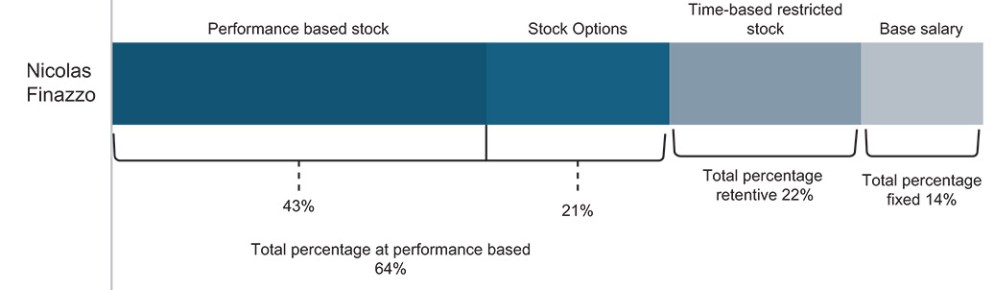
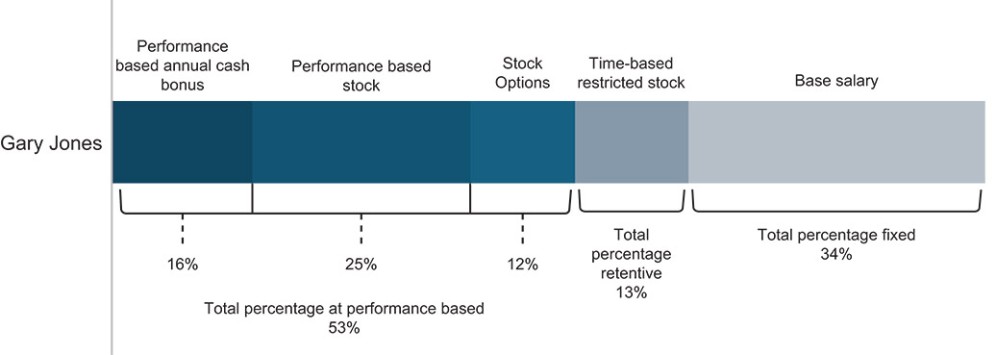
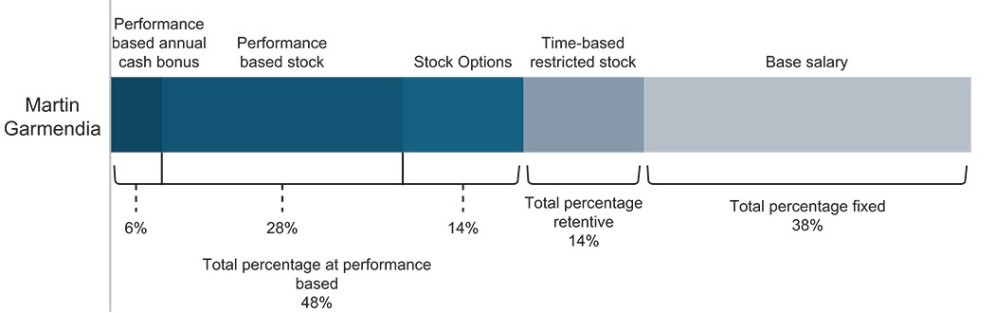
AerSale, Inc. | 82
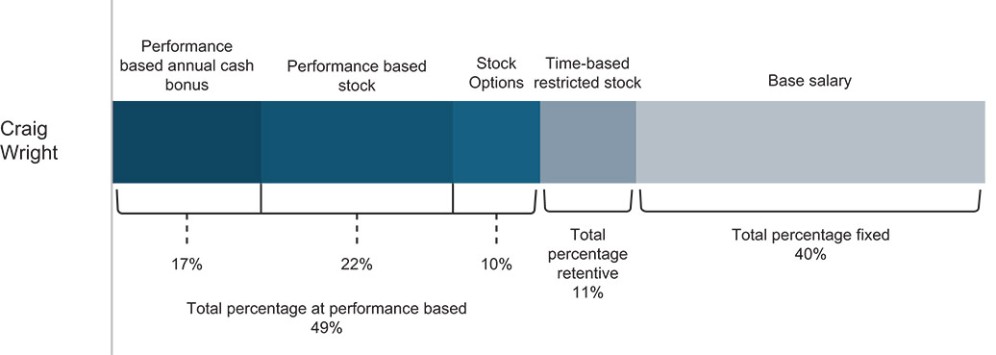
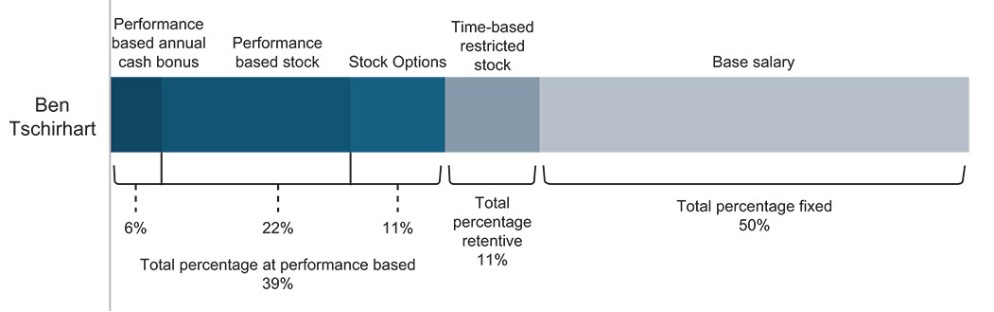
Fiscal 2025 Peer Group
The Compensation Committee believes that total compensation opportunities for the Company’s key executives, including the named executive officers, should be competitive with those offered by other companies competing for talent in the Company’s employment market.
The goal of the Compensation Committee is to assemble a set of peer group companies that provide relevant pay and performance comparisons with the Company. The Compensation Committee and its independent compensation consultant recognize that any peer group of the Company will be imprecise given the Company’s unique characteristics, the diversity of its businesses and the diversity of the markets in which the Company operates. The Compensation Committee and its independent compensation consultant further recognize that there will be larger-sized and smaller-sized companies in the Company’s peer group; companies that are competitors in some but not all of the Company’s businesses; and other financial, business or market attributes that the peer group companies may or may not share with the Company.
When determining the fiscal 2025 peer group, the Compensation Committee used the following criteria: company type; industry classification (using Standard and Poor’s GICS codes); companies of comparable size to the Company by annual revenue (with secondary consideration given to market value); and business focus (organizations that conducted business similar in nature to that conducted by the Company).
AerSale, Inc. | 83
Following its review and analysis, the Compensation Committee recommended and the Board approved a fiscal 2025 peer group consisting of the following eight companies:
| ● | VSE Corporation |
| ● | AeroVironment |
| ● | Astronics |
| ● | Ducommun |
| ● | Willis Lease Finance |
| ● | Cadre |
| ● | Loar Holdings |
| ● | Intuitive Machines |
Recommendations of the Chief Executive Officer
In addition to receiving analysis from the compensation consultant, the Compensation Committee may consider the Chief Executive Officer’s recommendations with respect to compensation of the Company’s other executive officers but retains the ultimate decision-making authority and responsibility for compensation decisions affecting the Company’s executive officers.
The Compensation Committee considered the recommendations of the Chief Executive Officer in making fiscal 2025 cash incentive bonus and equity award decisions for the executive officers other than the Chief Executive Officer. In making his recommendations, the Chief Executive Officer evaluated the performance of the executives during the prior year against pre-established performance goals. Some of the performance goals related to the financial performance of the Company or the executive officer’s business group. Other performance goals were non-quantitative and related to leadership development, customer relationships, department performance, or similar Company initiatives. The Chief Executive Officer’s recommendations reflected his assessment of an individual executive officer’s overall contributions to the performance of the Company.
Perquisites
Mr. Finazzo is the only executive officer that receives limited perquisites. See footnotes to the “All Other Compensation” column of the Summary Compensation Table for a description and valuation of these perquisites. The Compensation Committee believes these perquisites are reasonable, market-competitive and consistent with the Company’s overall executive compensation program.
Retirement Benefits
The Company’s named executive officers also participate in a tax-qualified 401(k) savings plan available to all employees.
In addition, as discussed below under “Accelerated Equity Vesting Upon Retirement”, the Company has implemented a retirement program for the acceleration of outstanding unvested equity awards for certain qualifying retirement events.
The Compensation Committee views the retirement benefits for the named executive officers as reasonable, market-competitive and consistent with the Company’s overall executive compensation program.
AerSale, Inc. | 84
Risk Management
The Compensation Committee determined that the Company’s compensation policies and practices did not encourage excessive or inappropriate risk-taking and that they were not reasonably likely to have any such material adverse effect on the Company.
The Compensation Committee believes that the design and operation of the Company’s executive compensation program are consistent with the Company’s risk management strategies for the following reasons:
| ● | The fiscal 2025 executive compensation program was designed to provide a proper balance between cash and equity compensation, and short-term and long-term compensation. The Compensation Committee generally favors a heavier weighting of longer-term equity compensation to align the executives’ interests with the interests of stockholders, to promote performance and to encourage long-term value creation. |
| ● | Fiscal 2025 short-term incentive plan awards — performance-based cash compensation — were based on Adjusted EBITDA as a performance metric. In any year, regardless of the Company’s performance against this metric, the Compensation Committee retains (and has exercised) the discretion to adjust any annual cash bonus for any reason. |
| ● | The balance built into the fiscal 2025 short-term incentive plan was also reflected in the fiscal 2025 long-term incentive plan awards, which consisted of PSUs, stock options and time-based RSUs. Each of these long-term equity-based incentive awards contains vesting periods designed to promote employee retention. They also are linked to the value of the Company’s common stock, thus aligning the executives’ interests with the interests of the Company’s stockholders. |
| ● | The Compensation Committee, its independent compensation consultant and senior management work together to ensure that the aggregate level of executive compensation fits within the Company’s budget. |
Role of the Independent Compensation Consultant
Mercer served as the independent compensation consultant to the Compensation Committee in fiscal 2025. Mercer provides research, data analysis, market information and compensation plan design expertise and experience to the Compensation Committee. Mercer assisted with the design and implementation of the fiscal 2025 short-term and long-term incentive plans for the Company’s senior executives and the development of the Company’s peer group for executive compensation purposes. Mercer also kept the Committee apprised of regulatory developments and market trends related to executive compensation practices.
The Compensation Committee considered the independence of Mercer in fiscal 2025. The Compensation Committee’s consideration of Mercer’s independence focused on the following factors:
| ● | Other than the services and fees described below, Mercer did not provide services to the Company, and received no other fees from the Company, during 2025 apart from its compensation for consulting with the Compensation Committee; |
| ● | The conflicts of interest policies and procedures of the Company and of Mercer, which are designed to ensure independence; |
| ● | Fees paid to Mercer by the Company during 2025 were less than 1% of Mercer’s total revenue; |
| ● | The fact that Mercer’s employees who provided compensation consulting services did not own any shares of the Company’s common stock; |
| ● | The lack of any relationships between Mercer and members of the Company’s Board; and |
| ● | The lack of any relationships between Mercer and any of the Company’s executive officers. |
Based on this assessment, the Compensation Committee concluded that no conflicts of interest existed with respect to Mercer and that Mercer was independent of the Company.
AerSale, Inc. | 85
In 2025, the Company retained Mercer for services in connection with consulting services related to the procurement and implementation of new HR software for employee self-service, consultation on investor relations, and consultation around structure of employee benefit plans. The fees for such services totaled approximately $195,855. The fees for services associated with consulting the Compensation Committee on executive and director compensation in 2025 totaled approximately $143,863. The decision to retain Mercer for the additional services was determined by management and discussed with the Compensation Committee. Previously, additional services provided by Mercer or its affiliates to the Company as determined by management were initially approved by the Compensation Committee when Mercer was initially engaged in 2022. In the opinion of the Compensation Committee, the types of services provided to the Company by Mercer consultants who were distinct from the Mercer consultants who provided the Compensation Committee with executive and director compensation advisory services did not compromise Mercer’s independence with respect to the executive and director compensation advisory services provided directly to the Compensation Committee.
Clawback Policy
In order to encourage sound financial reporting and enhance individual accountability, we adopted a clawback policy, compliant with Section 10D of the Exchange Act, and Rule 10D-1 thereunder, and Rule 5608 of the Nasdaq Stock Market LLC Rules (the “Clawback Policy”), which includes, in the event of a restatement of our financial statements due to material non-compliance with any financial reporting requirement under securities laws, a mandatory clawback of excess cash- or equity-based incentive compensation of a Section 16 officer that was granted, earned or vested as a result of achieving financial performance goals that were not met under the restated financial results. The 2020 Plan (as defined below) provides that all awards made thereunder are subject to our clawback policies.
Insider Trading and Hedging Policy
Our Board of Directors has
Director and Executive Stock Ownership Guidelines
The Company has adopted stock ownership guidelines applicable to its executive officers and non-employee directors to encourage such persons to acquire a meaningful ownership stake in the Company over time by retaining financial interest in our common stock. Each of our Chief Executive Officer and Chief Financial Officer is encouraged to hold shares of our common stock and unvested time-based restricted stock units with an aggregate value equal to five times his annual base salary. Our other officers who fall within the definition of “officer” under Rule 16a-1(f) under the Exchange Act (together with the CEO and CFO, the “Section 16 officers”) are encouraged to hold shares of common stock and unvested time-based restricted stock units with an aggregate value equal to one times their respective base salaries. Each non-employee director is encouraged to hold shares of common stock with an aggregate value equal to three times such director’s annual cash retainer. Section 16 officers and non-employee directors are expected to refrain from selling shares of common stock unless such guideline is satisfied, and, so long as they are complying with such holding requirement, such officer or director will not be considered out of compliance.
AerSale, Inc. | 86
The Section 16 officers are expected to meet their applicable guideline level within five years after being hired or promoted into the officer position. Non-employee directors have four years of Board service before they are expected to meet the minimum guideline. Based on the closing price of shares of our common stock on the Record Date, all of our Section 16 officers and directors are currently in compliance with the stock ownership guidelines.
Equity Grant Practices
The Company did not grant stock options (or similar awards) in 2025 to any named executive officer during any period beginning four business days before and ending one business day after the filing of any Company periodic report on Form 10-Q or Form 10-K, or the filing or furnishing of any Company Form 8-K that disclosed any material non-public information.
Compensation Committee Report
The Compensation Committee reviewed and discussed the “COMPENSATION DISCUSSION AND ANALYSIS” section of this proxy statement with the Company’s management. Based on that review and discussion, the Compensation Committee recommended to the Board that the Compensation Discussion and Analysis be included in this proxy statement and the Company’s annual report on Form 10-K for the year ended December 31, 2025.
Lt. General Judith Fedder - Chair
Carol DiBattiste
Thomas Mullins
AerSale, Inc. | 87
Summary Compensation Table
The following table sets forth information concerning the compensation of our named executive officers for the years ended December 31, 2025, 2024 and 2023, as applicable.
| | | | | | Non-Equity | | | ||||||||
Stock | Option | Incentive Plan | All Other | |||||||||||||
Salary | Bonus | Awards | Awards | Compensation | Compensation | Total | ||||||||||
Name and Principal Position | Year | ($) | ($)(1) | ($)(2) | ($) | ($)(3) | ($)(4) | ($) | ||||||||
Nicolas Finazzo | | 2025 |
| 1,000,000 | — | 4,500,000 | 1,500,000 | — | 62,230 | 7,062,230 | ||||||
Chairman and Chief Executive |
| 2024 |
| 1,000,000 |
| — |
| 3,242,460 |
| 1,081,141 |
| — |
| 65,159 |
| 5,388,760 |
Officer |
| 2023 |
| 1,000,000 |
| 2,480,000 |
| — |
| — |
| — |
| 66,515 |
| 3,546,515 |
Gary Jones |
| 2025 |
| 497,981 | — | 562,490 | 180,274 | 240,000 | 31,043 | 1,511,788 | ||||||
Chief Operating Officer and Head |
| 2024 |
| 414,218 |
| — |
| 459,340 |
| 153,161 |
| 199,283 |
| 43,382 |
| 1,269,384 |
of Material Sales |
| 2023 |
| 390,384 |
| — |
| — |
| — |
| 175,100 |
| 33,746 |
| 599,230 |
Martin Garmendia |
| 2025 |
| 449,327 | 67,500 | 506,245 | 162,246 | — | 23,301 | 1,208,619 | ||||||
Chief Financial Officer and |
| 2024 |
| 413,558 |
| — |
| 459,340 |
| 153,161 |
| 71,783 |
| 32,633 |
| 1,130,475 |
Treasurer | 2023 | 399,038 |
| 285,000 |
| — |
| — |
| — |
| 21,238 |
| 705,276 | ||
Craig Wright |
| 2025 |
| 373,846 | 160,000 | 299,992 | 96,144 | — | 29,966 | 959,948 | ||||||
Senior Vice President | ||||||||||||||||
Head of Asset Management | ||||||||||||||||
Ben Tschirhart |
| 2025 |
| 399,156 | 43,750 | 262,493 | 84,128 | — | 38,290 | 827,817 | ||||||
Senior Vice President |
| |||||||||||||||
Head of Engineered Solutions |
| (1) | In 2023, Messrs. Finazzo and Garmendia received a bonus of $2,480,000 and $285,000 respectively. The Board determined that Messrs. Finazzo and Garmendia were not adequately compensated prior to April 1, 2023 for producing the exceptional results the Company achieved in 2021 and 2022 due to limitations on payment of certain employee compensation through April 1, 2023 to which the Company was subject as a result of certain of its subsidiaries receiving grants through the Payroll Support Program under the Coronavirus Aid, Relief, and Economic Security Act (the “CARES Act”). Accordingly, in recognition of their achievements and the previous CARES Act restrictions on compensation, in April 2023, Messrs. Finazzo and Garmendia received a one-time cash bonus. |
| (2) | These amounts reflect the aggregate grant date fair value of RSU, PSU and stock option awards granted in fiscal 2025 based upon the probable outcome of performance conditions computed in accordance with ASC Topic 718. The value of the stock awards assuming the highest level of performance conditions for the PSU awards will be achieved is $6,000,000, $781,718, $703,547, $416,910 and $364,796 for each of Messrs. Finazzo, Jones, Garmendia, Wright, and Tschirhart. For additional information on the valuation assumptions regarding the RSU, PSU and stock option awards, see Note O to the Consolidated Financial Statements in the 2025 Annual Report. |
| (3) | See “2025 Non-Equity Cash Incentive” below for a discussion of the performance targets for the 2025 annual cash incentive program and actual results. |
| (4) | Amounts for 2025 reflect (i) insurance premiums paid by us on behalf of Messrs. Finazzo, Jones, Garmendia, Wright, and Tschirhart of $28,778, $20,543, $11,479, $19,466, and $27,790 respectively, (ii) car allowances paid to Mr. Finazzo of $22,952.04, which includes a tax gross-up of $1,941.04 related to personal use of the vehicle and (iii) a $10,500 fully vested 401(k) matching contribution for each of Messrs. Finazzo, Jones, Garmendia, Wright, and Tschirhart. |
Base Salary
Our named executive officers receive an annual base salary to compensate them for the performance of services rendered to us each year. The base salary payable to each named executive officer is intended to provide a fixed component of compensation reflecting their skill set, experience, role and responsibilities. Base salaries for our named executive officers have generally been set at levels deemed necessary to attract and retain individuals with superior talent.
The actual salaries paid to each named executive officer for 2025 are set forth above in the Summary Compensation Table in the column entitled “Salary.”
AerSale, Inc. | 88
2025 Non-Equity Cash Incentive
Pursuant to their respective offer letters, as subsequently adjusted, each of our named executive officers, with the exception of Mr. Finazzo, is eligible to earn an annual cash incentive based on Company and individual achievement of performance targets established by our Compensation Committee and Board in its discretion. Each eligible named executive officer is eligible to earn a target bonus amount , which reflects a percentage of their annual base salary ("Target Bonus Amount"). Messrs. Jones and Garmendia are entitled to receive a targeted incentive cash award of 60% of their base salary, and Messrs. Wright and Tschirhart are entitled to receive a targeted incentive cash award of 50% of their base salary, which can be increased or decreased at the discretion of the Board, but with a maximum cash incentive payout of 200% of the Target Bonus Amount based upon the amount by which actual Adjusted EBITDA exceeds Target Adjusted EBITDA and based upon the individual performance of the officer. For 2025, the cash incentive awards were contingent on the Company achieving certain adjusted EBITDA metrics ("Target Adjusted EBITDA"). Adjusted EBITDA, as calculated for purposes of the 2025 Non-Equity Cash Incentive Plan, is net income (loss) after giving effect to interest expense, depreciation and amortization, income tax expense (benefit), and other non-recurring or unusual items. Although the Target Bonus Amount to be paid is contingent upon and based upon the Company achieving the Target Adjusted EBITDA, the Compensation Committee and the Board have the discretion to award a cash incentive of 0%-80% of the employee Target Bonus Amount if the Company achieves a minimum adjusted EBITDA of at least 80% of the Target Adjusted EBITDA ("Minimum Target Adjusted EBITDA”). In 2025, the Target Adjusted EBITDA was $53.5 million. The Company achieved an actual adjusted EBITDA of $46.1 million for fiscal 2025 or 86% of the Target Adjusted EBITDA . Messrs. Jones and Wright received a cash bonus of 80% of their Target Bonus Amount, and Messrs. Garmendia and Tschirhart received a cash bonus of 25% of their Target Bonus Amount. The determination to award Messrs. Jones and Wright a cash bonus of 80% of their Target Bonus Amount was based on the recommendation of the Company’s Chief Executive Officer taking into consideration their individual performance in achieving strong performance results in their respective business units. The determination to award Messrs. Garmendia and Tschirhart a cash bonus of 25% of their Target Bonus Amount was also based on the recommendation of the Company’s Chief Executive Officer taking into consideration their individual performance despite the fact the Company failed to achieve 100% of the Target Adjusted EBITDA. The following table presents for each NEO the Target Bonus Amount in dollars and as a percentage of base salary together with the actual cash incentive bonus awarded paid in 2025 in dollars and as a percentage of the Target Bonus Amount.
Target Bonus Amount, as a | | 2025 non-equity cash incentive | |||||
dollar amount of | paid for 2025 as a dollar | ||||||
base salary and a | amount and as a percentage | ||||||
Name | | percentage of base salary(1) | | of the Target Bonus Amount | |||
Gary Jones | $ | 300,000/60 | % | $ | 240,000/80 | % | |
Martin Garmendia | $ | 270,000/60 | % | $ | 67,500/25 | % | |
Craig Wright | $ | 200,000/50 | % | $ | 160,000/80 | % | |
Ben Tschirhart | $ | 175,000/50 | % | $ | 43,750/25 | % | |
| (1) | Represents the dollar amount of the Target Bonus and the Target Bonus Amount as a percentage of base salary. |
In August 2025, the Compensation Committee recommended, and the Board approved, revising Mr. Finazzo’s 2025 compensation package in order to further align Mr. Finazzo’s interests with those of the Company’s stockholders by eliminating his eligibility to participate in the Company’s annual non-equity incentive program and increasing the portion of his compensation package tied to long-term equity incentive grants instead.
2025 Equity Compensation
In December 2020, we adopted the 2020 Equity Incentive Plan as amended in June 2023 (the “2020 Plan”) in order to facilitate the grant of cash and equity incentives to our directors, employees (including the named executive officers) and consultants and to enable us to obtain and retain services of these individuals, which is essential to our long-term success.
AerSale, Inc. | 89
The following table represents the number of RSUs, stock options and PSUs granted to the named executive officers for fiscal 2025:
Name | | RSUs(1) | | Options(2) | | PSUs(3) |
Nicolas Finazzo |
| 243,506 |
| 513,949 |
| 487,012 |
Gary Jones |
| 31,725 |
| 64,376 |
| 63,451 |
Martin Garmendia |
| 28,553 |
| 57,938 |
| 57,106 |
Craig Wright |
| 16,920 |
| 34,333 |
| 33,840 |
Ben Tschirhart |
| 14,805 |
| 30,042 |
| 29,610 |
| (1) | Represents the number of RSUs granted on August 1, 2025 (and August 6, 2025 for Mr. Finazzo) that will vest annually in three equal amounts commencing June 7, 2026 and convert into one share of common stock upon vesting. |
| (2) | Represents the number of stock options granted on August 1, 2025 (and August 6, 2025 for Mr. Finazzo) with an exercise price of $5.91 (and $6.16 for Mr. Finazzo) that will vest annually in three equal amounts commencing on June 7, 2026 and convert into one share of AerSale common stock upon vesting and exercise. The stock options expire June 7, 2035. |
| (3) | Represents the number of PSUs granted on August 1, 2025 (and August 6, 2025 for Mr. Finazzo) (at target level of performance) that will only vest into one share of AerSale common stock contingent upon the Company achieving certain cumulative adjusted EBITDA performance metrics over a three year period commencing January 1, 2025 and ending December 31, 2027. |
AerSale, Inc. | 90
Grant of Plan-Based Awards
All other | ||||||||||||||||||||||
All other | option | |||||||||||||||||||||
stock awards: | awards: | Exercise or | Grant date | |||||||||||||||||||
Number of | Number of | base | fair value of | |||||||||||||||||||
Estimated Future Payouts Under Non-Equity | Estimated Future Payouts Under | shares of | securities | price of | stock and | |||||||||||||||||
Incentive Plan Awards | Equity Incentive Plan Awards | stock or | underlying | option | option | |||||||||||||||||
Threshold(1) | Target(1) | Maximum(1) | Threshold | Target(2) | Maximum(3) | units(4) | options(5) | awards(6) | awards(7) | |||||||||||||
Name | | Grant date | | ($) | | ($) | | ($) | | (#) | | (#) | | (#) | | (#) | | (#) | | ($/Sh) | | ($) |
Nicolas Finazzo | 8/6/2025 | — | — | — | — | 487,012 | 974,024 | — | — | — | 3,000,000 | |||||||||||
8/6/2025 | — | — | — | — | — | — | 243,506 | — | — | 1,500,000 | ||||||||||||
8/6/2025 | — | — | — | — | — | — | — | 513,949 | 6.16 | 1,500,000 | ||||||||||||
Gary Jones |
|
| — | 300,000 | 600,000 |
| — | — | — | — | — |
| — |
| — | |||||||
8/1/2025 | — | — | — | — | 63,451 | 126,902 | — | — | — | 374,995 | ||||||||||||
8/1/2025 | — | — | — | — | — | — | 31,725 | — | — | 187,495 | ||||||||||||
8/1/2025 | — | — | — | — | — | — | — | 64,376 | 5.91 | 180,275 | ||||||||||||
Martin Garmendia |
|
| — | 270,000 | 540,000 |
| — | — | — | — | — |
| — |
| — | |||||||
8/1/2025 | — | — | — | — | 57,106 | 114,212 | — | — | — | 337,496 | ||||||||||||
8/1/2025 | — | — | — | — | — | — | 28,553 | — | — | 168,748 | ||||||||||||
8/1/2025 | — | — | — | — | — | — | — | 57,938 | 5.91 | 162,247 | ||||||||||||
Craig Wright |
|
| — | 200,000 | 400,000 |
| — | — | — | — | — |
| — |
| — | |||||||
8/1/2025 | — | — | — | — | 33,840 | 67,680 | — | — | — | 199,994 | ||||||||||||
8/1/2025 | — | — | — | — | — | — | 16,920 | — | — | 99,997 | ||||||||||||
8/1/2025 | — | — | — | — | — | — | — | 34,333 | 5.91 | 96,145 | ||||||||||||
Ben Tschirhart |
|
| — | 175,000 | 350,000 |
| — | — | — | — | — |
| — |
| — | |||||||
8/1/2025 | — | — | — | — | 29,610 | 59,220 | — | — | — | 174,995 | ||||||||||||
8/1/2025 | — | — | — | — | — | — | 14,805 | — | — | 87,498 | ||||||||||||
8/1/2025 | — | — | — | — | — | — | — | 30,042 | 5.91 | 84,129 | ||||||||||||
| (1) | As discussed in more detail under “2025 Non-Equity Cash Incentive” above, although there is no Threshold amount, the Compensation Committee and the Board can make discretionary awards of non-equity cash incentives if the Company achieves the Minimum Target Adjusted EBITDA (i.e., at least 80% of the Target Adjusted EBITDA), subject to modification in consideration of individual performance objectives. The Target and Maximum represent the amount which the employee may receive if the Company achieves 100% and 200% or more, respectively, of the one year Target Adjusted EBITDA performance goal for the year ending December 31, 2025, in each case, subject to modification in consideration of individual performance objectives. |
| (2) | Represents the amount which the employee may receive if the Company achieves 100% of the three year cumulative Target Adjusted EBITDA performance goal for the cumulative three year period ending December 31, 2027. |
| (3) | Represents the maximum amount which the employee may receive if the Company achieves 200% or more of the Target Adjusted EBITDA performance goal for cumulative three year period ending December 31, 2027. |
| (4) | Represents the number of RSUs granted August 1, 2025 (and August 6, 2025 for Mr. Finazzo) that vest equally on June 7, 2026, 2027, and 2028 and convert into one share of Company common stock. |
| (5) | Represents the number of stock options granted August 1, 2025 (and August 6, 2025 for Mr. Finazzo) that vest equally on June 7, 2026, 2027, and 2028 and convert into one share of Company common stock with an exercise price of $5.91 (and $6.16 for Mr. Finazzo) and expire June 7, 2035. |
| (6) | Represents the exercise price which was the closing price of the Company stock as of the August 1, 2025 (and August 6, 2025 for Mr. Finazzo) grant date. |
| (7) | For RSUs and PSUs (at target), represents the closing price of the Company stock of 5.91 on the August 1, 2025 (and $6.16 for Mr. Finazzo on the August 6, 2025) grant date. For stock options, represents the August 1, 2025 (and August 6, 2025 for Mr. Finazzo) grant date fair value based upon the Black Scholes valuation method which was $2.80 (and $2.92 Mr. Finazzo) per share. |
AerSale, Inc. | 91
Outstanding Equity Awards at Fiscal Year-End
| Option Awards | | Stock Awards | |||||||||||||
Equity | ||||||||||||||||
Equity | Incentive Plan | |||||||||||||||
Incentive Plan | Awards: | |||||||||||||||
Awards: | Market or | |||||||||||||||
Number of | Payout Value | |||||||||||||||
Number of | Number of | Unearned | of Unearned | |||||||||||||
Securities | Securities | Number of | Market Value | Shares, Units | Shares, Units | |||||||||||
Underlying | Underlying | Shares or | of Shares or | or Other | or Other | |||||||||||
Unexercised | Unexercised | Option | Units of Stock | Units of Stock | Rights That | Rights That | ||||||||||
Options | Options | Exercise | Option | that Have Not | That Have Not | Have Not | Have Not | |||||||||
(#) | (#) | Price | Expiration | Vested | Vested(7) | Vested | Vested(7) | |||||||||
Name | | Exercisable | | Unexercisable | | ($) | | Date | | (#) | | ($) | | (#) | | ($) |
Nicolas Finazzo | — | | 513,949(1) | | 6.16⁽³⁾ | | 8/6/2035 | | 243,506⁽⁵⁾ | | 1,731,328 | | 487,012⁽⁸⁾ | | 3,462,655 | |
96,616 | 193,234(2) | | 7.02⁽⁴⁾ | | 6/7/2034 | | 102,642⁽⁶⁾ | | 729,785 | | 307,926⁽⁹⁾ | | 2,189,354 | |||
Gary Jones | — |
| 64,376(1) | | 5.91⁽³⁾ | | 8/1/2035 | | 31,725⁽⁵⁾ | | 225,565 | | 63,451⁽⁸⁾ | | 451,137 | |
13,687 | 27,375(2) | | 7.02⁽⁴⁾ | | 6/7/2034 | | 14,541⁽⁶⁾ | | 103,387 | | 43,622⁽⁹⁾ | | 310,152 | |||
Martin Garmendia | — |
| 57,938(1) | | 5.91⁽³⁾ | | 8/1/2035 | | 28,553⁽⁵⁾ | | 203,012 | | 57,106⁽⁸⁾ | | 406,024 | |
13,687 | 27,375(2) | | 7.02⁽⁴⁾ | | 6/7/2034 | | 14,541⁽⁶⁾ | | 103,387 | | 43,622⁽⁹⁾ | | 310,152 | |||
Craig Wright | — |
| 34,333(1) | | 5.91⁽³⁾ | | 8/1/2035 | | 16,920⁽⁵⁾ | | 120,301 | | 33,840⁽⁸⁾ | | 240,602 | |
10,735 | 21,470(2) | | 7.02⁽⁴⁾ | | 6/7/2034 | | 11,405⁽⁶⁾ | | 81,090 | | 34,214⁽⁹⁾ | | 243,262 | |||
Ben Tschirhart | — |
| 30,042(1) | | 5.91⁽³⁾ | | 8/1/2035 | | 14,805⁽⁵⁾ | | 105,264 | | 29,610⁽⁸⁾ | | 210,527 | |
5,836 | 11,674(2) | | 7.02⁽⁴⁾ | | 6/7/2034 | | 9,695⁽⁶⁾ | | 68,931 | | 18,603⁽⁹⁾ | | 132,267 | |||
| (1) | Represents the number of stock options granted August 1, 2025 (and August 6, 2025 for Mr. Finazzo) that vest equally on each of the first three anniversary dates from the grant date and convert into one share of Company common stock with an exercise price of $5.91 (and $6.16 for Mr. Finazzo) and expire June 7, 2035. |
| (2) | Represents the number of stock options granted June 7, 2024 that vest equally on each of the first three anniversary dates from the grant date and convert into one share of Company common stock with an exercise price of $7.02 and expire June 7, 2034. |
| (3) | Represents the exercise price which was the closing price of the Company stock as of the August 1, 2025 (and August 6, 2025 for Mr. Finazzo) grant date. |
| (4) | Represents the exercise price which was the closing price of the Company stock as of the June 7, 2024 grant date. |
| (5) | Represents the number of RSUs granted August 1, 2025 (and August 6, 2025 for Mr. Finazzo) that vest equally on each of June 7, 2026, 2027, and 2028 and convert into one share of Company common stock. |
| (6) | Represents the number of RSUs granted on June 7, 2024 that vest equally on each of the first anniversary dates from the grant date and convert into one share of Company common stock. |
| (7) | Based on a closing price of the Company stock of $7.11 as of December 31, 2025. |
| (8) | The numbers shown represent the 2025-2027 PSUs, which are earned based on the Company’s achievement of Adjusted EBITDA for the cumulative three year period ending December 31, 2027. The amounts shown reflect the target number of PSUs that may be earned at the end of the three-year performance period. See the “Executive and Director Compensation—2025 Equity Compensation” section of this proxy statement for a more complete description of the PSUs. |
| (9) | The numbers shown represent the 2024-2026 PSUs, which are earned based on the Company’s achievement of Adjusted EBITDA for the cumulative three year period ending December 31, 2026. The amounts shown reflect the target number of PSUs that may be earned at the end of the three-year performance period. See the “Executive and Director Compensation—2025 Equity Compensation” section of this proxy statement for a more complete description of the PSUs. |
All of the awards reflected in the above table were made pursuant to the 2020 Plan.
AerSale, Inc. | 92
Option Exercises and Stock Vested
Option Awards | Stock Awards | ||||||||
Number of Shares | Value Realized | Number of Shares | Value Realized | ||||||
Acquired on Exercise | on Vesting | Acquired on Exercise | on Vesting | ||||||
Name | | (#) | | ($) | (#) | | ($)(1) | ||
Nicolas Finazzo | — | — | 51,321 | 299,201 | |||||
Gary Jones |
| — | — | 7,270 | 42,384 | ||||
Martin Garmendia |
| — | — | 7,270 | 42,384 | ||||
Craig Wright |
| — | — | 5,702 | 33,243 | ||||
Ben Tschirhart |
| — | — | 6,594 | 49,156 | ||||
| (1) | Amounts are calculated by multiplying the number of shares underlying RSUs by the closing price of the common stock of the Company on the date of vesting. |
Potential Payments Upon Termination or Change of Control
Executive Severance Plan
On June 7, 2024, we revised and restated the executive severance agreements pursuant to which certain of our key employees (including Messrs. Finazzo, Garmendia, Jones, Wright and Tschirhart) will be entitled to certain severance benefits in the event of a qualifying termination of employment (the “Severance Plan”).
The Severance Plan provides that, in the event that an executive’s employment is terminated without “cause” (as defined below), other than because of death or disability, or by the named executive officer for “good reason” (as defined below), then the executive officer will be entitled to the following compensation and benefits, subject to his or her execution of a release of claims: (1) continued payments of the executive’s base salary for a number of years equal to the executive’s “Severance Multiple”; (2) a prorated annual cash incentive bonus, based on actual performance; (3) continued medical and welfare benefits for the named executive officer and his or her spouse and dependents for a number of years equal to the executive’s Severance Multiple; and (4) if the executive is at the Senior Vice President level or above and has been employed by us for at least three years, full vesting of outstanding equity awards (with any performance-based equity awards vesting based on actual performance through the end of the applicable performance period(s)). With respect to our named executive officers, Mr. Finazzo’s Severance Multiple is three, and the Severance Multiple for each of Messrs. Garmendia, Jones, Wright and Tschirhart is two.
The Severance Plan further provides that, in the event that an executive officer’s employment is terminated without “cause” (other than because of death or disability) or by the named executive officer for “good reason,” in each case within one year following a “change in control” (as defined below), in lieu of the compensation and benefits described above, the executive officer will instead be entitled to the following compensation and benefits, subject to his or her execution of a release of claims: (1) severance pay in an amount equal to the executive’s Severance Multiple times the sum of the executive officer’s annual base salary and annual cash incentive target bonus (or, if the executive officer does not have an annual target bonus, the average of the annual cash incentive bonuses paid to the executive officer in the three calendar years preceding the year of termination); (2) a pro rated annual cash incentive bonus, based on actual performance; (3) if the executive is at the Senior Vice President level or above and has been employed by us for at least three years, full vesting of outstanding equity awards (with any performance-based equity awards vesting based on actual performance through the end of the applicable performance period(s)); and (4) continued medical and welfare benefits for the executive officer and his or her spouse and dependents for a number of years equal to the executive’s Severance Multiple.
Under the Severance Plan, if an executive officer’s employment is terminated because of death or disability, then the executive (or his or her estate) will be entitled to receive (1) a prorated annual bonus, based on actual performance, and (2) if the executive is at the Senior Vice President level or above and has been employed by us for at least three years, full vesting of outstanding equity awards (with any performance-based equity awards vesting based on actual performance).
AerSale, Inc. | 93
For purposes of the Severance Plan, an executive officer may be terminated for “cause” if the named executive officer (1) is charged with (x) a felony, or (y) a misdemeanor relating to our business or involving moral turpitude; (2) willfully fails to substantially perform his or her duties; (3) commits any act of material dishonesty involving his or her employment with us (including, without limitation, fraud, misappropriation, or embezzlement); (4) materially breaches any written agreement with us or our affiliates; (5) materially violates our Code of Conduct or other applicable policies; or (6) fails to reasonably cooperate with a material internal investigation by the Company regarding any corporate conduct, misconduct, wrongdoing or illegal conduct. For purposes of the Severance Plan, an executive officer may terminate such executive officer’s employment for “good reason” if (A) we materially breach a written agreement with the executive officer; (B) there is a reduction in the executive officer’s base salary (excluding across-the-board reductions that apply to similarly situated executives); (C) there is a change in the executive officer’s principal place of employment of more than 40 miles, which increases the executive officer’s one-way commute; or (D) there is a material adverse change in the executive officer’s position or duties. In addition, within the 12-month period following a change in control, an executive officer may also terminate such executive officer’s employment for “good reason” if there is any reduction in the executive officer’s target annual bonus or target long-term incentive opportunity from the target level in effect immediately prior to the change in control.
The Severance Plan also contains restrictive covenants applicable to the covered executive officers, including a perpetual confidentiality covenant; a non-compete that applies during employment and for a number of years thereafter equal to the Severance Multiple; a non-solicit of our employees, clients, customers, suppliers, consultants, or other business relations that applies during employment and for two years thereafter; and a perpetual non-disparagement covenant.
Under the Severance Plan, any of the following events would generally constitute a “change in control”:
| ● | an acquisition by any individual, entity, or group of beneficial ownership of more than 50% of AerSale’s then outstanding shares of common stock or combined voting power of then outstanding voting securities entitled to vote generally in the election of directors; |
| ● | during any period of 12 months, a change in the composition of a majority of our Board that is not supported by two-thirds of the incumbent directors (excluding for this purpose any directors that are initially elected or nominated as a result of an actual or threatened election contest or proxy contest); |
| ● | a merger or consolidation of our Company with any other company, other than a transaction that would result in our voting securities outstanding immediately prior to the transaction continuing to represent more than 50% of the combined voting power of the voting securities of our or the surviving entity outstanding immediately after the transaction; |
| ● | the sale, transfer, or other disposition of all or substantially all our assets and our subsidiaries’ assets (taken as a whole); or |
| ● | the date of a complete liquidation or dissolution of our Company. |
In the event that any payments made in connection with a change in control or termination would be subjected to the excise tax imposed by Section 409A of the Code, the payments to the named executive officers would be reduced to the maximum amount that can be paid under the Code without the imposition of an excise tax under Section 409A of the Code, but only if such reduction provides a higher benefit on an after-tax basis to the named executive officers.
Accelerated Equity Vesting Upon Retirement
In 2024, the Company implemented an accelerated vesting retirement plan which provides that, upon a “Qualified Retirement Event,” any unvested stock units shall remain outstanding and shall continue to vest on each respective vesting date irrespective of the recipient’s termination due to a Qualified Retirement Event. A Qualified Retirement Event means a voluntary termination from the Company after satisfying each of the following requirements:
| a. | the employee has attained age 65 with at least five years of continuous service; |
AerSale, Inc. | 94
| b. | the employee has provided the Company with at least twelve months advance written notice of their intent to retire; and |
| c. | the employee has signed a twelve month non-compete covenant. |
Table of potential payments upon a termination of employment or a change-in-control of the Company
The table below quantifies the benefits described above that would be paid to each current named executive officer under the following termination of employment or change-in-control events, assuming a change-in-control or a termination of employment occurred on December 31, 2025.
Other than Cause and Change in Control | Death or Disability | Qualified Retirement(7) | |||||||||||||||||||||||||||||||||||||||||||||||||||||||||||||||||||||||||||||||||||||||||||||||||||||||||||||||||||||||||||||||||
Pro-rated | Pro-rated | ||||||||||||||||||||||||||||||||||||||||||||||||||||||||||||||||||||||||||||||||||||||||||||||||||||||||||||||||||||||||||||||||||
Named | Target Cash | Actual Cash | Actual Cash | ||||||||||||||||||||||||||||||||||||||||||||||||||||||||||||||||||||||||||||||||||||||||||||||||||||||||||||||||||||||||||||||||
Executive | Incentive | Incentive | Stock | Health and | Incentive | Stock | Stock | ||||||||||||||||||||||||||||||||||||||||||||||||||||||||||||||||||||||||||||||||||||||||||||||||||||||||||||||||||||||||||||
Officer | | Salary(1) | | Bonus(2) | | Bonus | | RSUs(3) | | Options(4) | | PSUs(5) | | Welfare(6) | | Bonus | | RSUs(3) | | Options(4) | | PSUs(5) | | RSUs | | Options | | PSUs | |||||||||||||||||||||||||||||||||||||||||||||||||||||||||||||||||||||||||||||||||||||||||||||||||||||||
Nicolas | $ | 3,000,000 | $ | — | — | $ | 2,461,112 | 505,636 | 5,652,009 | $ | 86,340 | — | $ | 2,461,112 | 505,636 | 5,652,009 | $ | 2,461,112 | 505,636 | 5,652,009 | |||||||||||||||||||||||||||||||||||||||||||||||||||||||||||||||||||||||||||||||||||||||||||||||||||||||||||||||
Gary | $ | 1,000,000 | $ | 600,000 | $ | — | $ | 328,951 |
| 79,715 |
| 761,289 | $ | 41,086 | $ | — | $ | 328,951 |
| 79,715 | 761,289 |
| 328,951 |
| 79,715 | 761,289 | |||||||||||||||||||||||||||||||||||||||||||||||||||||||||||||||||||||||||||||||||||||||||||||||||||||||||
Martin | $ | 900,000 | $ | 540,000 | $ | — | $ | 306,398 |
| 71,989 |
| 716,176 | $ | 22,959 | $ | — | $ | 306,398 |
| 71,989 | 716,176 |
| 306,398 |
| 71,989 | 716,176 | |||||||||||||||||||||||||||||||||||||||||||||||||||||||||||||||||||||||||||||||||||||||||||||||||||||||||
Craig | $ | 800,000 | $ | 400,000 | $ | — | $ | 201,391 |
| 43,132 |
| 483,864 | $ | 38,932 | $ | — | $ | 201,391 |
| 43,132 | 483,864 |
| 201,391 |
| 43,132 | 483,864 | |||||||||||||||||||||||||||||||||||||||||||||||||||||||||||||||||||||||||||||||||||||||||||||||||||||||||
Ben | $ | 700,000 | $ | 350,000 | $ | — | $ | 174,195 |
| 37,101 |
| 342,794 | $ | 55,581 | $ | — | $ | 174,195 |
| 37,101 | 342,794 |
| 174,195 |
| 37,101 | 342,794 | |||||||||||||||||||||||||||||||||||||||||||||||||||||||||||||||||||||||||||||||||||||||||||||||||||||||||
| (1) | For Mr. Finazzo, represents continued salary for three years. For Messrs. Jones, Garmendia, Wright, and Tschirhart, represents a continued salary for two years. |
| (2) | For Messrs. Jones, Garmendia, Wright and Tschirhart, represents a bonus target for two years. For termination outside of a change in control, the named executive officers would not be entitled to these amounts. |
| (3) | Represents the value of RSUs that would vest upon termination or a change in control as of December 31, 2025 based on the closing price of AerSale stock on December 31, 2025 of $7.11. |
| (4) | Represents the value of stock options as of December 31, 2025 and a stock closing price of $7.11. |
| (5) | The PSUs are contingent upon the Company achieving certain cumulative performance metrics for applicable three-year performance periods. We have shown performance at target for the 2024-2026 PSUs and the 2025-2027 PSUs. |
| (6) | For Mr. Finazzo, represents the current cost of health benefits for three years. For Messrs. Jones, Garmendia, Wright, and Tschirhart, represents the current cost of health benefits for two years. |
| (7) | Mr. Finazzo is the only NEO that meets the age and tenure requirements under the definition of a Qualified Retirement. Qualified Retirement is defined as a participant’s voluntary termination after attaining the age of 65 with at least five years of continuous service with the Company and the participant has provided the Company with at least twelve months advance written notice of their intent to retire subject to a non-compete and non-solicitation covenant. The amounts in this column represents the value of RSUs that would vest upon retirement as of December 31, 2025 based on the closing price of AerSale stock on December 31, 2025 of $7.11. The PSUs are contingent upon the Company achieving certain cumulative performance metrics for the applicable three-year performance periods. We have shown performance at target for the 2024-2026 PSUs and the 2025-2027 PSUs. |
CEO Pay Ratio
Pursuant to SEC rules, we are required to disclose the ratio of our median employee’s annual total compensation to the annual total compensation of our Chief Executive Officer for 2025. We calculated the annual total compensation of the median employee for fiscal 2025 using the same methodology that we used to calculate the annual total compensation of our Chief Executive Officer in the Summary Compensation Table.
In determining the median employee for 2025, we used the same Company employee as used in 2024 given that there has been no change in the Company’s employee population or employee compensation arrangements that the Company reasonably believes would significantly impact its pay ratio disclosure. In determining the median employee for 2024, we used the following methodology:
| 1. | We determined that as of December 31, 2024 we had a total employee population of 720 employees. |
AerSale, Inc. | 95
| 2. | Of this group, we identified a selected employee group of 708 employees, representing all of our U.S. employees. |
| 3. | As permitted by SEC rules, we excluded our employees in all other non-U.S. jurisdictions as these employees together represented less than 5% of our total employee population. The number of employees excluded in non-U.S. jurisdictions at the December 31, 2024 determination date were: United Kingdom (3), Ireland (1), and Singapore (1). |
| 4. | For our selected employee group, we determined each domestic employee’s total cash compensation based on their 2024 earned compensation which includes certain bonus payments earned, but not paid until 2025, for the 2024 calendar year, as reflected in our payroll records and systems. |
| 5. | We identified our median employee from our selected employee group (excluding the Chief Executive Officer). |
The following table shows the ratio of the annual total compensation of our Chief Executive Officer compared to that of our median employee for fiscal 2025:
Annual total compensation for our CEO for 2025 | | $ | 7,062,230 |
Annual total compensation for our median employee for 2025 | $ | 76,943 | |
Ratio of annual total compensation of our CEO to the annual total compensation of our median employee for 2025 |
| 92 to 1 |
Pay Versus Performance
In accordance with rules adopted by the SEC, we provide the following disclosure regarding executive “Compensation Actually Paid” or “CAP” (as calculated in accordance with SEC rules) and certain Company performance for the fiscal years listed below. You should refer to the Compensation Discussion and Analysis section in this proxy statement for a complete description of how executive compensation relates to Company performance and how the Compensation Committee makes its decisions.
(a) | (b) | (c) | (d) | (e) | (f) | (g) | (h) | (i) | ||||||||||||||||
Value of Initial Fixed $100 | ||||||||||||||||||||||||
Investment Based on: | ||||||||||||||||||||||||
Average | ||||||||||||||||||||||||
Summary | Summary | Average | ||||||||||||||||||||||
Compensation | Compensation | Compensation | Compensation | Total | Peer Group Total | |||||||||||||||||||
Table Total for | Actually Paid to | Table Total for | Actually Paid to | Shareholder | Shareholder | |||||||||||||||||||
PEO | PEO | Non-PEO NEOs | Non-PEO NEOs | Return | Return | Net Income | ||||||||||||||||||
Year | | ($) | | ($)(1)(2) | | ($) | | ($)(1)(2) | | ($) | | ($)(2) | | ($Thousands) | | ($Thousands)(3) | ||||||||
2025 | $ | | $ | | $ | | $ | | $ | | $ | | $ | | $ | | ||||||||
2024 | $ | | $ | | $ | | $ | | $ | | $ | | $ | | $ | | ||||||||
2023 | $ | | $ | ( | $ | | $ | ( | $ | | $ | | $ | ( | $ | | ||||||||
2022 | $ | | $ | ( | $ | | $ | ( | $ | | $ | | $ | | $ | | ||||||||
| (1) | Amounts represent Compensation Actually Paid to our principal executive officer (“PEO”) and the average Compensation Actually Paid to our remaining named executive officers for the relevant fiscal year, as determined under SEC rules (and described below), which includes the individuals indicated in the table below for each fiscal year: |
Year | | PEO | | Non-PEO NEOs |
2025 |
|
| Gary Jones; Martin Garmendia; Craig Wright; Ben Tschirhart | |
2024 |
| Nicolas Finazzo |
| Gary Jones; Martin Garmendia; James Fry; Iso Nezaj |
2023 |
| Nicolas Finazzo |
| Robert Nichols; Martin Garmendia |
2022 |
| Nicolas Finazzo |
| Robert Nichols; Gary Jones |
AerSale, Inc. | 96
| (2) | Compensation actually paid to our named executive officers represents the “Total” compensation reported in the Summary Compensation Table for the applicable fiscal year, as adjusted as follows: |
2022 | 2023 | 2024 | 2025 | |||||||||||||||||||||
Average non-PEO | Average non-PEO | Average non-PEO | Average non-PEO | |||||||||||||||||||||
Adjustments | | PEO | | NEOs | | PEO | | NEOs | | PEO | | NEOs | | PEO | | NEOs | ||||||||
Deduction for Amounts Reported under the “Stock Awards” and “Option Awards” Columns in the Summary Compensation Table for Applicable Fiscal Year | $ | — | | $ | — | | $ | — | | $ | — | | $ | ( | | $ | ( | | $ | ( | $ | ( | ||
Increase based on ASC 718 Fair Value of Awards Granted during Applicable Fiscal Year that Remain Unvested as of Applicable Fiscal Year End, determined as of Applicable Fiscal Year End | $ | — | $ | — | $ | — | $ | — | $ | | $ | | $ | | $ | | ||||||||
Increase based on ASC 718 Fair Value of Awards Granted during Applicable Fiscal Year that Vested during Applicable Fiscal Year, determined as of Vesting Date | $ | — | $ | — | $ | — | $ | — | $ | — | $ | — | $ | — | $ | — | ||||||||
Increase/deduction for Awards Granted during Prior Fiscal Year that were Outstanding and Unvested as of Applicable Fiscal Year End, determined based on change in ASC 718 Fair Value from Prior Fiscal Year End to Applicable Fiscal Year End | $ | ( | $ | ( | $ | — | $ | — | $ | — | $ | ( | $ | | $ | | ||||||||
Increase/deduction for Awards Granted during Prior Fiscal Year that Vested During Applicable Fiscal Year, determined based on change in ASC 718 Fair Value from Prior Fiscal Year End to Vesting Date | $ | ( | $ | ( | $ | ( | $ | ( | $ | — | $ | ( | $ | ( | $ | ( | ||||||||
Deduction of ASC 718 Fair Value of Awards Granted during Prior Fiscal Year that were | $ | — | $ | — | $ | — | $ | — | $ | — | $ | — | $ | — | $ | — | ||||||||
Increase based on Dividends or Other Earnings Paid during Applicable Fiscal Year prior to Vesting Date | $ | — | $ | — | $ | — | $ | — | $ | — | $ | — | $ | — | $ | — | ||||||||
TOTAL ADJUSTMENTS | $ | ( | $ | ( | $ | ( | $ | ( | $ | ( | $ | ( | $ | ( | $ | | ||||||||
AerSale, Inc. | 97
Narrative Disclosure to Pay Versus Performance Table
Relationship Between Financial Performance Measures
The line graph below compares (i) the Compensation Actually Paid to our PEO and the average of the Compensation Actually Paid to our remaining NEOs, with (ii) our cumulative TSR, (iii) our Peer Group TSR, (iv) our Net Income, and (v) our Adjusted EBITDA, in each case, for the fiscal years ended December 31, 2022, 2023, 2024, and 2025.
TSR amounts reported in the graph assume an initial fixed investment of $100.
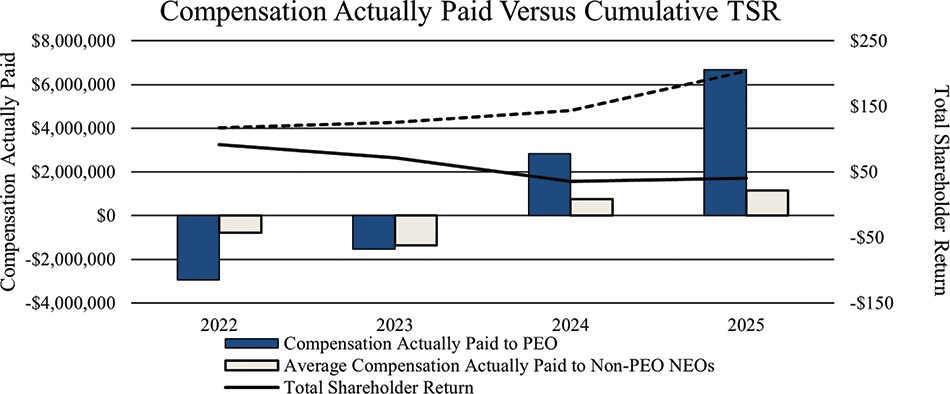
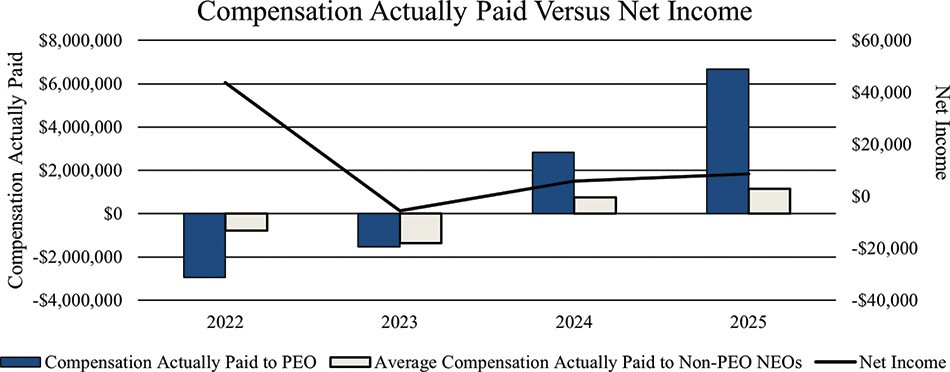
AerSale, Inc. | 98
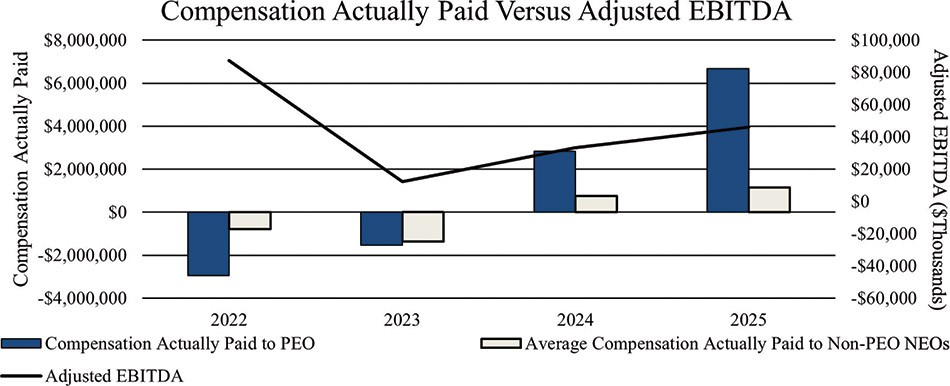
Pay Versus Performance Tabular List
We believe the following performance measures represent the most important financial performance measures used by us to link compensation actually paid to our NEOs for the fiscal year ended December 31, 2025:
| ● |
| ● |
Director Compensation
Effective February 23, 2021, we adopted a non-employee director compensation policy that was applicable to each of our non-employee directors. This non-employee director compensation policy was first amended and restated on February 8, 2022 (as amended and restated, the “Prior Director Compensation Policy”), and further amended and restated on June 9, 2023 (the “Amended Director Compensation Policy”). Pursuant to the Amended Director Compensation Policy, each eligible non-employee director will receive an annual cash retainer of $75,000, paid quarterly in arrears. The director serving as the lead independent director of the Board will receive an additional cash retainer of $100,000. The chairpersons of each of the committees and committee members each receive additional cash retainers as follows:
Committee | | Chair | | Member | ||
Audit | $ | 17,500 | $ | 10,000 | ||
Compensation | $ | 15,000 | $ | 7,000 | ||
Nominating & Governance | $ | 10,000 | $ | 5,000 | ||
In addition, under the Amended Director Compensation Policy, eligible non-employee directors are granted an annual RSU award that has a grant date value of $125,000 (with prorated awards made to directors who join on a date other than the annual award date), which will generally vest in full on the first anniversary of the grant date, subject to the director’s continued service through the applicable vesting date. These amounts reflect the aggregate grant date fair value of RSUs granted in fiscal year 2025 in accordance with ASC Topic 718. For additional information on the valuation assumptions regarding the RSU awards, see Note O to the Consolidated Financial Statements in the 2025 Annual Report.
AerSale, Inc. | 99
The following table sets forth information concerning the compensation of our directors for the year ended December 31, 2025.
Name | | Fees Earned or Paid in Cash | | Stock Awards(7) | | Total | |||
Andrew Levy(1) | $ | 147,674 | $ | 125,000 | $ | 272,674 | |||
Lt. General Judith Fedder(2) | $ | 98,000 | $ | 125,000 | $ | 223,000 | |||
Robert Nichols(3) | $ | 75,000 | $ | 125,000 | $ | 200,000 | |||
Thomas Mullins(4) | $ | 84,139 | $ | 162,329 | $ | 246,468 | |||
Carol DiBattiste(5) | $ | 69,000 | $ | 147,260 | $ | 216,260 | |||
Thomas Mitchell(6) | $ | 60,000 | $ | 147,260 | $ | 207,260 | |||
| (1) | Pursuant to the Director Compensation Policy, includes (a) annual retainer of $75,000; (b) additional annual retainer of $100,000 as lead independent director pro-rated for his appointment date; (c) $10,000 retainer as a member of the Audit Committee, with an amount pro rated through his resignation date as Chair; and (d) $5,000 as a member of the Governance Committee pro-rated for his appointment date. |
| (2) | Pursuant to the Director Compensation Policy, includes (a) annual retainer of $75,000; and (b) $15,000 retainer as chair of the Compensation Committee; and (c) $10,00 retained as a member of the Audit Committee. |
| (3) | Pursuant to the Director Compensation Policy, reflects annual retainer of $75,000. |
| (4) | Pursuant to the Director Compensation Policy, includes (a) annual retainer of $75,000 pro-rated for his appointment date.; (b) $17,500 retainer as the Chair of the Audit Committee pro-rated for his appointment dates; and (c) $7,000 retainer as a member of the Compensation Committee pro-rated for his appointment date. Stock awards also represent, in addition to the annual award, a pro-rated amount for his appointment date. |
| (5) | Pursuant to the Director Compensation Policy, includes (a) annual retainer of $75,000 pro-rated for her appointment date; and(b) $10,000 as the Chair of the Nominating and Governance Committee pro-rated for her appointment date. Stock awards also represent, in addition to the annual award, a pro-rated amount for her appointment date. |
| (6) | Pursuant to the Director Compensation Policy, includes (a) annual retainer of $75,000 pro-rated for his appointment date; and (b) $5,000 as a member of the Nominating and Governance Committee pro-rated for his appointment date. Stock awards also represent, in addition to the annual award, a pro-rated amount for his appointment date. |
| (7) | As of December 31, 2025, there were 16,960, 16,960, 16,960, 22,394, 19,850, and 19,850 shares of unvested RSU awards granted to each of Mr. Levy, Lt. General Fedder, Messrs. Nichols and Mullins, Ms. DiBattiste, and Mr. Mitchell, respectively. |
Mr. Finazzo, who served as an executive officer and director in 2025, did not receive any additional compensation for his service on our Board.
AerSale, Inc. | 100
SECURITY OWNERSHIP OF CERTAIN BENEFICIAL OWNERS AND MANAGEMENT |
The following table sets forth certain information with respect to holdings of our common stock by (i) stockholders who beneficially owned more than 5% of the outstanding shares of our common stock, and (ii) each of our directors (which includes all nominees), each of our named executive officers and all directors and executive officers as a group as of April [21], 2026, unless otherwise indicated. The number of shares beneficially owned by each stockholder is determined under rules issued by the SEC. Under these rules, beneficial ownership includes any shares as to which a person has sole or shared voting power or investment power.
Applicable percentage ownership is based on shares of common stock outstanding as of April [21], 2026. In computing the number of shares beneficially owned by a person and the percentage ownership of that person, shares of common stock subject to options or other rights held by such person that are currently exercisable or will become exercisable within 60 days of April [21], 2026 and shares of RSUs that vest within 60 days of April [21], 2026, are considered outstanding, although these shares are not considered outstanding for purposes of computing the percentage ownership of any other person.
We believe, based on information provided to us, that each of the stockholders listed below has sole voting and investment power with respect to the shares beneficially owned by the stockholder unless noted otherwise, subject to community property laws where applicable.
Beneficial Ownership | |||||
Name and Address of Beneficial Owner(1) | | Number of Shares | | Percentage | |
Directors and Named Executive Officers |
| |
| | |
Nicolas Finazzo |
| 5,028,783 | (2) | 10.7 | % |
Robert B. Nichols |
| 3,491,954 | (3) | 7.4 | % |
Craig Wright |
| 235,645 | (9) | * | |
Martin Garmendia |
| 208,889 | (7) | * | |
Gary Jones |
| 189,447 | (8) | * | |
Ben Tschirhart |
| 38,505 | (10) | * | |
Enrique Pizzi |
| 95,298 | (11) | * | |
Andrew Levy |
| 60,905 | (12) | * | |
Lt. General Judith A. Fedder |
| 62,175 | (12) | * | |
Thomas Mullins |
| 26,801 | (12) | * | |
Carol DiBattiste |
| 24,257 | (12) | * | |
Thomas Mitchell |
| 24,257 | (12) | * | |
All Directors and Executive Officers as a Group (16 individuals) |
| 9,486,916 |
| 20.1 | % |
Greater than 5% Stockholders |
| |
| | |
George P. Bauer Revocable Trust, dated 7/20/1990 and Greg P. Bauer | 3,914,794 | (4) | 8.3 | % | |
AltraVue Capital, LLC |
| 3,539,618 | (5) | 7.5 | % |
M3 Funds, LLC |
| 3,319,415 | (6) | 7.0 | % |
* | Less than one percent. |
| (1) | Unless otherwise noted, the business address of each of the following individuals is 9850 NW 41 Street, Suite 400, Doral, Florida 33178. |
| (2) | Includes (i) 4,392,204 shares of our common stock held by Enarey, L.P., (ii) 44,619 shares of our common stock held by Mr. Finazzo’s daughter, (iii) 6,600 shares of our common stock held by his spouse, and (iv) 88,321 owned directly by Mr. Finazzo. Mr. Finazzo is the sole member and manager of Enarey, LLC, the sole general partner of Enarey, L.P. Accordingly, all of the shares held by Enarey, L.P. may be deemed to be beneficially held by Mr. Finazzo. Mr. Finazzo disclaims beneficial ownership in shares held by his daughter. Also includes 364,550 shares of our common stock underlying stock options that are exercisable or will be exercisable within 60 days of April [21], 2026 and 132,489 RSUs with restrictions that may lapse and be paid in shares of common stock within 60 days of April [21], 2026. |
| (3) | Includes (i) 3,462,087 shares of our common stock held by ThoughtValley L.P. and (ii) 8,500 shares of common stock held by his spouse. Mr. Nichols is the sole member and manager of ThoughtValley, LLC, the sole general partner of ThoughtValley L.P. Accordingly, all of the shares held by ThoughtValley L.P. may be deemed to be beneficially held by Mr. Nichols. Also includes 21,367 RSUs with restrictions that may lapse and be paid in shares of common stock within 60 days of April [21], 2026. |
| (4) | Represents shares of our common stock held by the George P. Bauer Revocable Trust, dated 7/20/1990 (the “Bauer Trust”). George P. Bauer is the trustee and beneficiary of the Bauer Trust and has sole power to vote or direct the vote, and to dispose or direct the disposition, of |
AerSale, Inc. | 101
| 3,914,794 shares of our common stock owned by the Bauer Trust. The address for the Bauer Trust and George P. Bauer is 499 Silvermine Rd, New Canaan, CT 06840. Information included in this footnote is derived from a Schedule 13D/A filed on March 12, 2024. |
| (5) | AltraVue Capital, LLC reports sole voting power with respect to 2,309,024 shares of our common stock, shared voting power with respect to 1,230,594 shares of our common stock and sole dispositive power with respect to 3,539,618 shares of our common stock. The address for AltraVue Capital, LLC is 11747 NE 1st Street, Suite 205, Bellevue, WA 98005-3018. Information included in this footnote is derived from a Schedule 13G/A filed on January 23, 2024. |
| (6) | Represents shares of our common stock held by M3 Funds, LLC, M3 Partners, LP, M3F, Inc., Jason A. Stock and William C. Waller (collectively, “M3 Funds”). Voting and dispositive power with respect to 3,319,415 shares of our common stock held by M3 Funds is shared. Each of the foregoing entities’ address is 2070 E 2100 S, Suite 250, Salt Lake City, UT 84109. Information included in this footnote is derived from a Schedule 13G/A filed on February 4, 2026. |
| (7) | Includes 46,687 shares of our common stock underlying stock options that are exercisable or will be exercisable within 60 days of April 21, 2026 and 16,788 RSUs with restrictions that may lapse and be paid in shares of common stock within 60 days of April 21, 2026. |
| (8) | Includes 48,833 shares of our common stock underlying stock options that are exercisable or will be exercisable within 60 days of April [21], 2026 and 17,845 RSUs with restrictions that may lapse and be paid in shares of common stock within 60 days of April 21, 2026. |
| (9) | Includes 32,914 shares of our common stock underlying stock options that are exercisable or will be exercisable within 60 days of April [21], 2026 and 11,342 RSUs with restrictions that may lapse and be paid in shares of common stock within 60 days of April 21, 2026. |
| (10) | Includes 20,520 shares of our common stock underlying stock options that are exercisable or will be exercisable within 60 days of April 21, 2026 and 8,035 RSUs with restrictions that may lapse and be paid in shares of common stock within 60 days of April 21, 2026. |
| (11) | Includes 26,117 shares of our common stock underlying stock options that are exercisable or will be exercisable within 60 days of April 21, 2026 and 9,212 RSUs with restrictions that may lapse and be paid in shares of common stock within 60 days of April 21, 2026. |
| (12) | Includes 21,367 RSUs with restrictions that may lapse and be paid in shares of common stock within 60 days of April 21, 2026. |
AerSale, Inc. | 102
EQUITY COMPENSATION PLAN INFORMATION |
The following table provides information on our equity compensation plans as of December 31, 2025:
| | | | Number of Securities | | |||||
Number of Securities to | Weighted-Average | | Remaining |
| ||||||
be Issued Upon Exercise | Exercise Price of | Available for Future |
| |||||||
of Outstanding Options, | Outstanding Options, | Issuance Under Equity |
| |||||||
Plan Category: | Warrants, and Rights | Warrants, and Rights | Compensation Plans |
| ||||||
Equity compensation plans approved by security holders (1) | 3,820,216 | (2) | $ | 6.58 | | 3,420,666 | (3) | |||
Equity compensation plans not approved by security holders | | — | |
| — | | — | | ||
Total | | 3,820,216 | | $ | 6.58 | | 3,420,666 | | ||
| (1) | Consists of the AerSale Corporation 2020 Equity Incentive Plan, as amended (the “2020 Plan”), and the AerSale Corporation 2020 Employee Stock Purchase Plan (the “ESPP”). |
| (2) | All outstanding awards represent shares issuable pursuant to the 2020 Plan at target level of performance. |
| (3) | Under the 2020 Plan, a total of 3,185,260 shares were available for issuance in the form of restricted stock, restricted stock units, stock options, or other stock-based or cash-based awards as of December 31, 2025, excluding shares to be issued under outstanding equity awards. Under the ESPP, a total of 235,406 shares were available for issuance as of December 31, 2025. |
AerSale, Inc. | 103
DELINQUENT SECTION 16(a) REPORTS |
Section 16(a) of the Exchange Act requires our directors, officers (as defined under Rule 16a-1(f) under the Exchange Act) and stockholders who beneficially own more than 10% of any class of our equity securities registered pursuant to Section 12 of the Exchange Act (collectively, the “Reporting Persons”) to file with the SEC initial statements of beneficial ownership of securities and statements of changes in beneficial ownership of securities with respect to our equity securities. Based solely on our review of such statements filed with the SEC and written representations of the Reporting Persons received by us, we believe that there has been compliance with all Section 16(a) filing requirements applicable to such Reporting Persons with respect to the fiscal year ended December 31, 2025, except for Mr. Pizzi who filed a Form 4 one day late on January 13, 2024 with respect to the sale of shares of our common stock on January 8, 2025 pursuant to a Rule 10b5-1 trading plan adopted by Mr. Pizzi to cover tax withholding obligations in connection with the vesting of restricted stock units; Mr. Mullins who filed a late Form 3 on March 10, 2025 with respect to his appointment as a director of the Company on February 18, 2025 and a late Form 4 on March 13, 2025 to report a grant of restricted stock units on February 18, 2025 in connection with such appointment; Ms. DiBattiste who filed a late Form 4 on June 9, 2025 with respect to a grant of restricted stock units on April 1, 2025 in connection with her appointment as a director on April 1, 2025; Mr. Mitchell who filed a late Form 4 on June 9, 2025 with respect to a grant of restricted stock units on April 1, 2025 in connection with his appointment as a director on April 1, 2025; Mr. Hechenberger who filed a late Form 3 on August 14, 2025 with respect to his appointment as Senior Vice President, General Counsel and Corporate Secretary of the Company on August 1, 2025 and a late Form 4 on August 14, 2025 to report a grant of restricted stock units on August 1, 2025 in connection with such appointment; and Mr. Tschirhart who filed a late Form 4 on November 25, 2025 with respect the sale of shares of our common stock on September 3, 2025 pursuant to a Rule 10b5-1 trading plan adopted by Mr. Tschirhart to cover tax withholding obligations in connection with the vesting of restricted stock units.
AerSale, Inc. | 104
CERTAIN RELATIONSHIPS AND RELATED PERSON TRANSACTIONS |
Policies and Procedures for Related Person Transactions
Our Board of Directors has adopted a written Related Person Transaction Policy, setting forth the policies and procedures for the review and approval or ratification of related person transactions. Under the policy, our finance department is primarily responsible for developing and implementing processes and procedures to obtain information regarding related persons with respect to potential related person transactions and then determining, based on the facts and circumstances, whether such potential related person transactions do, in fact, constitute related person transactions requiring compliance with the policy. If our finance department determines that a transaction or relationship is a related person transaction requiring compliance with the policy, our Chief Financial Officer is required to present to the Audit Committee all relevant facts and circumstances relating to the related person transaction. Our Audit Committee must review the relevant facts and circumstances of each related person transaction, including if the transaction is on terms comparable to those that could be obtained in arm’s length dealings with an unrelated third party and the extent of the related person’s interest in the transaction, take into account the conflicts of interest and corporate opportunity provisions of our Code of Business Conduct and Ethics, and either approve or disapprove the related person transaction. If advance Audit Committee approval of a related person transaction requiring the Audit Committee’s approval is not feasible, then the transaction may be preliminarily entered into by management upon prior approval of the transaction by the chair of the Audit Committee subject to ratification of the transaction by the Audit Committee at the Audit Committee’s next regularly scheduled meeting; provided, that if ratification is not forthcoming, management will make all reasonable efforts to cancel or annul the transaction. If a transaction was not initially recognized as a related person, then upon such recognition the transaction will be presented to the Audit Committee for ratification at the Audit Committee’s next regularly scheduled meeting; provided, that if ratification is not forthcoming, management will make all reasonable efforts to cancel or annul the transaction. Our management will update the Audit Committee as to any material changes to any approved or ratified related person transaction and will provide a status report at least annually of all then current related person transactions. No director may participate in approval of a related person transaction for which he or she is a related person.
Except as set forth below, there were no transactions, arrangements and relationships with our directors, executive officers and stockholders owning 5% or more of our outstanding common stock, or any member of the immediate family of any of the foregoing persons, since January 1, 2025, other than as described under “Executive Compensation.”
Paul J. Finazzo, the son of our Chief Executive Officer, Nicolas Finazzo, was employed as a full-time commissioned sales and business development manager with a salary of $140,000, and earned commissions of $136,422, for a total of $276,422 earned in fiscal 2025. The salary was determined to be market based on his skill levels, education, and years of experience, using third party market information, and commissions were determined under the Companywide policy on sales commissions. The Audit Committee had previously approved such compensation after review.
Paul J. Finazzo has seven years of aviation industry experience, having served as an Engine Product Manager for Miami-based iAero Thrust from 2019-2020, and as a Program Manager, Sales Manager, and now Senior Director – Sales for Engineered Solutions and on-airport MRO for the Company from 2021 to the present. Paul earned a BA Degree in 2018 from the University of Miami and an MBA in 2023 from Barry University.
AerSale, Inc. | 105
STOCKHOLDER PROPOSALS |
Stockholders who intend to have a proposal considered for inclusion in our proxy materials for presentation at our 2027 Annual Meeting of Stockholders pursuant to Rule 14a-8 under the Exchange Act must submit the proposal to our Corporate Secretary at our offices at 9850 NW 41st St., Suite 400, Doral, Florida 33178 in writing not later than December [28], 2026.
Stockholders intending to present a proposal at the 2027 Annual Meeting of Stockholders, but not to include the proposal in our proxy statement, or to nominate a person for election as a director, must comply with the requirements set forth in our Amended and Restated Bylaws, as amended. Our Amended and Restated Bylaws, as amended, require, among other things, that our Corporate Secretary receive written notice from the stockholder of record of their intent to present such proposal or nomination not later than the close of business on the 90th day, nor earlier than the close of business on the 120th day prior to the first anniversary of the preceding year’s annual meeting.
Therefore, we must receive notice of such a proposal or nomination for the 2027 Annual Meeting of Stockholders no earlier than February [11], 2027 and no later than March [13], 2027. The notice must contain the information required by the Amended and Restated Bylaws, as amended, a copy of which is available upon request to our Corporate Secretary. In the event that the date of the 2027 Annual Meeting of Stockholders is more than 30 days before or more than 60 days after June [11], 2027, then our Corporate Secretary must receive such written notice not earlier than the close of business on the 120th day prior to the 2027 Annual Meeting and not later than the close of business on the later of the 90th day prior to the 2027 Annual Meeting or the close of business on 10th day following the day on which public disclosure of the date of such meeting is first made by us.
In addition to satisfying the foregoing advance notice requirements under our Amended and Restated Bylaws, as amended, stockholders who intend to solicit proxies in support of director nominees other than the Company’s nominees must provide the Company notice that sets forth the information required by Rule 14a-19 under the Exchange Act postmarked to the Company at its corporate headquarters or transmitted electronically at 9850 NW 41st St, Suite 400, Doral, FL 33178 no later than April [12], 2027 to comply with the SEC’s universal proxy rules.
We reserve the right to reject, rule out of order, or take other appropriate action with respect to any proposal that does not comply with these or other applicable requirements.
AerSale, Inc. | 106
OTHER MATTERS |
Our Board of Directors is not aware of any matter to be presented for action at the Annual Meeting other than the matters referred to above and does not intend to bring any other matters before the Annual Meeting. However, if other matters should properly come before the Annual Meeting, it is intended that holders of the proxies named on the Company’s proxy card will vote thereon in their discretion.
AerSale, Inc. | 107
SOLICITATION OF PROXIES |
The accompanying proxy is solicited by and on behalf of our Board of Directors, whose Notice of Annual Meeting is attached to this proxy statement, and the entire cost of our solicitation will be borne by us. In addition to the use of mail, proxies may be solicited by personal interview, telephone, e-mail and facsimile by our directors, officers and other employees who will not be specially compensated for these services. We will also request that brokers, nominees, custodians and other fiduciaries forward soliciting materials to the beneficial owners of shares held by the brokers, nominees, custodians and other fiduciaries. We will reimburse these persons for their reasonable expenses in connection with these activities.
AerSale, Inc. | 108
AERSALE’S ANNUAL REPORT ON FORM 10-K |
A copy of AerSale’s Annual Report on Form 10-K for the fiscal year ended December 31, 2025, including financial statements and schedules thereto but not including exhibits, as filed with the SEC, will be sent to any stockholder of record on April 21, 2026, without charge upon written request addressed to:
AerSale Corporation
Attention: Corporate Secretary
9850 NW 41st St, Suite 400
Doral, Florida 33178
A reasonable fee will be charged for copies of exhibits. You also may access this proxy statement and the 2025 Annual Report at www.proxyvote.com. You also may access the 2025 Annual Report at www.ir.aersale.com/sec-filings.
WHETHER OR NOT YOU PLAN TO ATTEND THE ANNUAL MEETING ONLINE, WE URGE YOU TO VOTE YOUR SHARES VIA THE TOLL-FREE TELEPHONE NUMBER OR OVER THE INTERNET AS DESCRIBED IN THIS PROXY STATEMENT. IF YOU RECEIVED A COPY OF THE PROXY CARD BY MAIL, YOU MAY SIGN, DATE AND MAIL THE PROXY CARD IN THE ENCLOSED RETURN ENVELOPE. PROMPTLY VOTING YOUR SHARES WILL ENSURE THE PRESENCE OF A QUORUM AT THE ANNUAL MEETING AND WILL SAVE US THE EXPENSE OF FURTHER SOLICITATION.
By Order of the Board of Directors
/s/ Paul A. Hechenberger
Paul A. Hechenberger
Senior Vice President, General Counsel and Corporate Secretary
April 27, 2026
AerSale, Inc. | 109
ANNEX A
ACTION BY UNANIMOUS WRITTEN CONSENT OF
THE BOARD OF DIRECTORS OF
AERSALE CORPORATION
April [__], 2026
The undersigned, being all of the members of the Board of Directors (the “Board”) of AerSale Corporation, a Delaware corporation (the “Company”), acting pursuant to Section 141(f) of the General Corporation Law of the State of Delaware, hereby adopt, by this written consent, the following resolutions with the same force and effect as if they had been unanimously adopted at a duly convened meeting of the Board and direct that this written consent be filed with the minutes and proceedings of the Board.
Redomestication of the Company to the State of Texas by Conversion
WHEREAS, as part of its ongoing oversight, direction and management of the business of the Company, the Board and management have thoroughly discussed the matter of the Company’s jurisdiction of incorporation;
WHEREAS, after investigating and considering the benefits and detriments of redomesticating the Company from the State of Delaware and considering other jurisdictions of incorporation, including Texas, the Board determined to focus on Delaware and Texas and evaluate the conversion of the Company from a corporation organized under the laws of the State of Delaware (the Company when organized under such laws, the “Delaware Corporation”) to a corporation organized under the laws of the State of Texas (the Company when organized under such laws, the “Texas Corporation”), pursuant to Section 266 of the DGCL, Title 1, Chapter 10, Subchapter C of the Texas Business Organizations Code (the “TBOC”), and the proposed Plan of Conversion (the “Plan of Conversion”), substantially in the form attached hereto as Exhibit A (such conversion, the “Texas Redomestication”);
WHEREAS, the Board evaluated a number of factors in reaching a decision regarding the Company’s jurisdiction of incorporation, including possible negative impacts from a potential redomestication, meaningful differences in corporate law between Delaware and Texas and implications to the Company’s stockholders for economic, governance and litigation rights, as well as the other factors and considerations reflected in the draft management proposal (the “Texas Redomestication Proposal”), substantially in the form attached hereto as Exhibit B, to be included in the Company’s proxy statement for its 2026 Annual Meeting of Stockholders (the “Annual Meeting”);
WHEREAS, through the adoption of the Plan of Conversion, upon the effectiveness of the Texas Redomestication, the Company will cease to be governed by the laws of the State of Delaware and its existing governing documents and will become a corporation governed by the laws of the State of Texas, as well as by the proposed Texas certificate of formation (the “Texas Charter”) and the proposed Texas bylaws (the “Texas Bylaws” and, together with the Texas Charter, the “Texas Governing Documents”), substantially in the forms attached hereto as Exhibit C and Exhibit D, respectively;
WHEREAS, upon receipt of stockholder approval of the Texas Redomestication Proposal (including approval of the Plan of Conversion and the Texas Governing Documents) at the Annual Meeting, and these resolutions approving the Texas Redomestication, the Texas Redomestication will become effective at the date and time (the “Effective Time”) specified in (i) a Certificate of Conversion meeting the requirements of Title 1, Chapter 10, Subchapter C of the TBOC (the “Texas Certificate of Conversion”) to be properly executed and filed in accordance with such section, and (ii) a Certificate of Conversion meeting the requirements of Section 266 of the DGCL (the “Delaware Certificate of Conversion”) to be properly executed and filed in accordance with such section;
WHEREAS, at the Effective Time, each outstanding share of common stock (including restricted stock, which shall remain restricted on the same terms as currently apply), par value $0.0001 per share, of the Delaware Corporation will be automatically converted into one validly issued, fully paid and nonassessable share
AerSale, Inc. | A-1
of common stock, par value $0.0001 per share, of the Texas Corporation, and any option, warrant, restricted stock unit or other right to receive or acquire shares of common stock of the Delaware Corporation issued and outstanding immediately prior to the Effective Time will continue in existence in the form of and will automatically become an option, warrant, restricted stock unit or other right to receive or acquire an equal number of shares of common stock of the Texas Corporation under the same terms and conditions; and
WHEREAS, the Board has determined that approving and effecting the Texas Redomestication and approving and adopting the Plan of Conversion and the Texas Governing Documents are advisable and in the best interests of the Company and its stockholders.
NOW, THEREFORE, BE IT RESOLVED, that the Board hereby (a) determines that the Texas Redomestication, the Plan of Conversion and the Texas Governing Documents are in the best interests of the Company and its stockholders and (b) approves and adopts the Texas Redomestication, the Plan of Conversion and the Texas Governing Documents;
RESOLVED FURTHER, that the forms, terms, provisions and conditions of the Plan of Conversion be, and the same hereby are, in all respects approved and adopted;
RESOLVED FURTHER, that, in accordance with the Plan of Conversion, at the Effective Time, the board of directors of the Texas Corporation shall consist of the same directors as the Board immediately prior to the Effective Time, having the same director terms, to serve until their successors have been duly elected or appointed and qualified or until their earlier death, resignation or removal;
RESOLVED FURTHER, that, at the Effective Time, the chairman and independent lead director of the Board as of immediately prior to the Effective Time shall continue to serve as the chairman and the independent lead director of the board of directors of the Texas Corporation until their successors has been duly elected or appointed and qualified or until their earlier death, resignation or removal;
RESOLVED FURTHER, that, at the Effective Time, each committee of the Board as of immediately prior to the Effective Time shall be constituted as a committee of the board of directors of the Texas Corporation on the same terms and with the same powers and authority of the Board as of immediately prior to the Effective Time, and the members of each committee of the Board as of immediately prior to the Effective Time shall be the members of each such committee of the board of directors of the Texas Corporation, to serve until their successors have been duly elected or appointed and qualified or until their earlier death, resignation or removal;
RESOLVED FURTHER, that the Board hereby directs that the Texas Redomestication (including the Plan of Conversion and the Texas Governing Documents) and these resolutions approving the Texas Redomestication be submitted for approval and adoption, respectively, by the stockholders of the Company at the Annual Meeting;
RESOLVED FURTHER, that the Board hereby unanimously recommends that the Company’s stockholders vote “FOR” the Texas Redomestication Proposal, including, without limitation, the Texas Redomestication (including the Plan of Conversion and the Texas Governing Documents) and these resolutions and that the Company’s stockholders approve the Texas Redomestication (including the Plan of Conversion and the Texas Governing Documents) and adopt these resolutions at the Annual Meeting;
RESOLVED FURTHER, that upon receipt of stockholder approval of the Texas Redomestication (including the Plan of Conversion and the Texas Governing Documents) and the adoption of these resolutions, the officers of the Company (each, an “Authorized Officer” and collectively, the “Authorized Officers”) be, and each of them hereby is, authorized, empowered and directed, in the name and on behalf of the Company and without further action by the Board, to prepare, execute, file and deliver all agreements, documents, notices, certificates, consents, approvals or other instruments and take all such actions that such Authorized Officer deems necessary, desirable or appropriate in order to perform the Company’s obligations under the Plan of Conversion and to consummate the Texas Redomestication, including, without limitation, (a) the execution and filing of any and all documents relating to and in connection with the Texas Redomestication required under the DGCL and TBOC, (b) the execution and filing of the Delaware Certificate of Conversion and the Texas Certificate of Conversion (including the Plan of Conversion and the Texas Charter); (c) the filing of the annual franchise tax
AerSale, Inc. | A-2
reports required by the Secretary of State of the State of Delaware and the payment of the applicable franchise taxes; (d) the payment of any fees that may be necessary in connection with the Texas Redomestication; (e) the submission of all required applications or notifications to the Nasdaq Capital Market or any other applicable stock exchange; and (f) the filing of Current Reports on Form 8-K and any other regulatory filings that may be necessary, desirable or appropriate in connection with the Texas Redomestication;
RESOLVED FURTHER, that, in accordance with the foregoing resolutions, each of the Authorized Officers be, and each of them hereby is, authorized, empowered and directed to (a) include the Texas Redomestication Proposal, including, without limitation, the Texas Redomestication (including the Plan of Conversion and the Texas Governing Documents) and these resolutions in the Company’s proxy materials for the Annual Meeting, and (b) solicit proxies on behalf of the Board from the Company’s stockholders authorizing the persons named in such proxies to vote their shares of the Company’s common stock in favor of the Texas Redomestication Proposal, including, without limitation, the Texas Redomestication (including the Plan of Conversion and the Texas Governing Documents) and the Texas Redomestication Board Resolutions, at the Annual Meeting;
RESOLVED FURTHER, that, notwithstanding approval by the stockholders of the Company of the Texas Redomestication (including the Plan of Conversion and the Texas Governing Documents) and the adoption of these resolutions, the Board may, at any time prior to the Effective Time, abandon the Texas Redomestication and the Plan of Conversion without further action by the stockholders of the Company;
RESOLVED FURTHER, that, pursuant to the Plan of Conversion, at the Effective Time, any outstanding stock certificates that immediately prior to the Effective Time represented issued and outstanding shares of common stock of the Company shall be deemed for all purposes to evidence ownership of and to represent the respective shares of the Texas Corporation into which the shares represented by such certificates are converted pursuant to the Plan of Conversion; and
RESOLVED FURTHER, that notwithstanding the foregoing resolutions, any shares of the Texas Corporation may be issued as uncertificated shares, whether upon original issuance, re-issuance or subsequent transfer;
General Resolutions
RESOLVED, that the Authorized Officers hereby are, and each hereby is, empowered and directed to take all such further action and to execute and deliver all such further agreements, certificates, instruments and documents required to consummate the transactions contemplated hereby, and to pay or cause to be paid all expenses, to take all such other actions as an Authorized Officer shall deem necessary, desirable, advisable or appropriate to consummate, effectuate, carry out or further the transactions contemplated by, and the intent and purposes of, the foregoing resolutions;
RESOLVED FURTHER, that each of the Authorized Officers be, and each of them hereby is, authorized and empowered, in the name and on behalf of the Company and without further action from the Board, to delegate such Authorized Officer’s authority granted by these resolutions to one or more attorneys-in-fact or agents acting for such Authorized Officer;
RESOLVED FURTHER, that any and all actions taken on or prior to the date hereof by the directors, officers, and agents of the Company, if within the authority of such director, officer, and agent be and hereby are ratified, adopted, authorized and approved in all respects; and
RESOLVED FURTHER, that this Action by Unanimous Written Consent may be executed by facsimile and in one or more counterparts and, upon such execution, shall have the same force and effect as an original.
[Signature Page Follows]
AerSale, Inc. | A-3
IN WITNESS WHEREOF, the undersigned members of the Board have executed this Action by Unanimous Written Consent, effective as of the date first above written.
BOARD:
/s/ Nicolas Finazzo
Nicolas Finazzo
/s/ Robert B. Nichols
Robert B. Nichols
/s/ Lt. General Judith A. Fedder
Lt. General Judith A. Fedder
/s/ Andrew Levy
Andrew Levy
/s/ Thomas Mullins
Thomas Mullins
/s/ Carol DiBattiste
Carol DiBattiste
/s/ Thomas Mitchell
Thomas Mitchell
AerSale, Inc. | A-4
ANNEX B
PLAN OF CONVERSION
OF
AERSALE CORPORATION, A DELAWARE CORPORATION,
INTO
AERSALE CORPORATION, A TEXAS CORPORATION
This Plan of Conversion (this “Plan”), dated as of [________], 2026, is hereby adopted by AerSale Corporation, a Delaware corporation (the “Converting Entity”), and sets forth the terms, conditions and procedures governing its conversion into, and continued existence as, AerSale Corporation, a Texas corporation (the “Converted Entity”), pursuant to the Delaware General Corporation Law (the “DGCL”) and the Texas Business Organizations Code (the “TBOC”).
Recitals
A.The Converting Entity was formed as a Delaware corporation on December 2, 2019.
B.The Converting Entity desires to convert into a Texas corporation (the “Conversion”) pursuant to the terms and conditions set forth in this Plan and in accordance with Section 266 of the DGCL and Title 1, Chapter 10, Subchapter C of the TBOC.
C.The Board of Directors (the “Board”) of the Converting Entity has unanimously (i) determined that the Conversion is advisable and in the best interests of the Converting Entity and its stockholders and recommended the approval of the Conversion by the stockholders of the Converting Entity, and (ii) approved and adopted this Plan, the Conversion and the other documents and transactions contemplated by this Plan, including the Texas Charter (as defined below), the Texas Bylaws (as defined below), the Texas Certificate of Conversion (as defined below), and the Delaware Certificate of Conversion (as defined below).
D.The stockholders of the Converting Entity have approved and adopted this Plan, the Conversion and the other documents and transactions contemplated by this Plan, including the Texas Charter, the Texas Bylaws, the Texas Certificate of Conversion and the Delaware Certificate of Conversion, in accordance with the requirements of the DGCL and the certificate of incorporation of the Converting Entity.
E. The mode of carrying out the Conversion into effect shall be as described in this Plan.
NOW THEREFORE, in reliance on the above set forth recitals, the Converting Entity does hereby adopt the Plan, as set forth below:
Terms and Conditions of the Plan of Conversion
AerSale, Inc. | B-1
AerSale, Inc. | B-2
[Signature Page Follows]
AerSale, Inc. | B-3
IN WITNESS WHEREOF, this Plan of Conversion is executed as of the date first set forth above.
AERSALE CORPORATION,
a Delaware corporation
By: _____________________________
Name:
Title:
AerSale, Inc. | B-4
ANNEX C
CERTIFICATE OF FORMATION
OF
AERSALE CORPORATION
AerSale Corporation, a corporation organized and existing under the laws of the State of Texas (the “Company”), hereby certifies as follows:
A.AerSale Corporation, a Delaware corporation (the “Delaware Corporation”), with its principal place of business at 9850 NW 41st Street, Suite 400, Doral Florida, was originally incorporated in Delaware on December 2, 2019.
B.The Delaware Corporation was converted into a corporation incorporated under the laws of the State of Texas under the name of “AerSale Corporation” on [__], 2026 pursuant to a plan of conversion, under which the Delaware Corporation converted to the Company.
ARTICLE I
The filing entity being formed is a for-profit corporation. The name of the Company is AerSale Corporation.
ARTICLE II
The name of the initial registered agent is [Corporation Service Company d/b/a CSC-Lawyers Incorporating Service Company]. The business address of the initial registered agent and the registered office address is [211 E. 7th Street, Suite 620, Austin, Texas, 78701]. The initial mailing address of the Company is [9850 NW 41st Street, Suite 400, Doral, Florida, 33178].
ARTICLE III
The purpose of the Company is to engage in any lawful act or activity for which a for-profit corporation may be organized under the Texas Business Organizations Code (the “TBOC”), as the same exists or as may hereafter be amended from time to time.
ARTICLE IV
4.1Authorized Capital Stock. The total number of shares of capital stock the Company has authority to issue is 200,000,000 shares of common stock, par value, $0.0001 per share (“Common Stock”), and 5,000,000 shares of preferred stock, par value $0.0001 per share (“Preferred Stock”).
4.2Adjustment in Authorized Capital Stock. Except as otherwise may be expressly provided by the terms of any series of Preferred Stock, the number of authorized shares of Common Stock or Preferred Stock may be increased or decreased (but not below the number of shares of Common Stock or Preferred Stock then outstanding, as applicable) by an affirmative vote of the holders of a majority of the total voting power represented by the outstanding capital stock of the Company entitled to vote thereon, and without a separate class vote by the Common Stock or Preferred Stock, except as may be required by the TBOC.
AerSale, Inc. | C-1
4.3Common Stock.
(a)Voting Power. The holders of shares of Common Stock shall be entitled to one vote for each such share on each matter properly submitted to the shareholders on which the holders of shares of Common Stock are entitled to vote. Except as otherwise required by law or this certificate of formation (this “Certificate of Formation” which term, as used herein, shall mean the certificate of formation of the Corporation, as amended from time to time, including the terms of any certificate of designations of any series of Preferred Stock), and subject to the rights of the holders of Preferred Stock, at any annual or special meeting of the shareholders the holders of shares of Common Stock shall have the right to vote for the election of directors and on all other matters properly submitted to a vote of the shareholders; provided, however, that, except as otherwise required by law, holders of Common Stock shall not be entitled to vote on any amendment to this Certificate of Formation that relates solely to the terms, number of shares, powers, designations, preferences, or relative participating, optional or other special rights (including, without limitation, voting rights), or to qualifications, limitations or restrictions thereon, of one or more outstanding series of Preferred Stock if the holders of such affected series are entitled, either separately or together with the holders of one more other such series, to vote thereon pursuant to this Certificate of Formation (including, without limitation, by any certificate of designations relating to any series of Preferred Stock) or pursuant to the TBOC. To the maximum extent permitted by the TBOC, but subject to the rights, if any, of the holders of Preferred Stock as specified in this Certificate of Formation or in any certificate of designation, and further subject to the Bylaws and the provisions of ARTICLE X of this Certificate of Formation, the vote of shareholders holding a majority of the shares of stock entitled to vote on the matter then outstanding shall be sufficient to approve, authorize, adopt, or to otherwise cause the Company to take, or affirm the Company’s taking of, any action, including any “fundamental business transaction” as defined in the TBOC.
(b)Dividends and Distributions. Subject to the rights of the holders of Preferred Stock, the holders of shares of Common Stock shall be entitled to receive such dividends and other distributions (payable in cash, property or capital stock of the Company) when, as and if declared thereon by the Board (a from time to time out of any assets or funds of the Company legally available therefor and shall share equally on a per share basis in such dividends and distributions.
(c)Liquidation, Dissolution or Winding Up. In the event of any voluntary or involuntary liquidation, dissolution or winding-up of the Company, after payment or provision for payment of the debts and other liabilities of the Company, and subject to the rights of the holders of Preferred Stock in respect thereof, the holders of shares of Common Stock shall be entitled to receive all the remaining assets of the Company available for distribution to its shareholders, ratably in proportion to the number of shares of Common Stock held by them.
4.4Preferred Stock.
The Preferred Stock may be issued from time to time in one or more series pursuant to a resolution or resolutions providing for such issue duly adopted by the board of directors of the Company (the “Board”) (authority to do so being hereby expressly vested in the Board); provided that any such resolution shall be set forth in a statement filed with the Texas Secretary of State as required by Section 21.156 of the TBOC. The Board is further authorized, subject to limitations prescribed by law, to fix by resolution or resolutions and to set forth in a certificate of designations filed pursuant to the TBOC the powers, designations, preferences and relative, participation, optional or other rights, if any, and the qualifications, limitations or restrictions thereof, if any, of any series of Preferred Stock, including, without
AerSale, Inc. | C-2
limitation, dividend rights, dividend rate, conversion rights, voting rights, rights and terms of redemption (including sinking fund provisions), redemption price or prices, and liquidation preferences of any such series, and the number of shares constituting any such series and the designation thereof, or any of the foregoing. The Board is further authorized to increase (but not above the total number of authorized shares of the class) or decrease (but not below the number of shares of any such series then outstanding) the number of shares of any series, the number of which was fixed by it, subsequent to the issuance of shares of such series then outstanding, subject to the powers, preferences and rights, and the qualifications, limitations and restrictions thereof stated in the Certificate of Formation or the resolution of the Board originally fixing the number of shares of such series. Except as may be otherwise specified by the terms of any series of Preferred Stock, if the number of shares of any series of Preferred Stock is so decreased, then the Company shall take all such steps as are necessary to cause the shares constituting such decrease to resume the status which they had prior to the adoption of the resolution originally fixing the number of shares of such series.
ARTICLE V
5.1General Powers. The business and affairs of the Company shall be managed by or under the direction of the Board. In furtherance and not in limitation of the powers conferred by statute, the Board is expressly authorized to make, alter, amend or repeal the Bylaws of the Company.
5.2Number of Directors; Initial Directors; Term; Election.
(a)Subject to the rights of holders of any series of Preferred Stock with respect to the election of directors, the number of directors that constitutes the whole Board shall be fixed exclusively by resolution of the Board. The Board currently consists of seven directors, and the names and addresses of such directors are:
Name | Address | |||
[Nicolas Finazzo] | [9850 NW 41st Street, Suite 400, Doral, Florida, 33178] | |||
[Robert B. Nichols] | [9850 NW 41st Street, Suite 400, Doral, Florida, 33178] | |||
[Lt. General Judith A. Fedder] | [9850 NW 41st Street, Suite 400, Doral, Florida, 33178] | |||
[Andrew Levy] | [9850 NW 41st Street, Suite 400, Doral, Florida, 33178] | |||
[Thomas Mullins] | [9850 NW 41st Street, Suite 400, Doral, Florida, 33178] | |||
[C. Carol DiBattiste] | [9850 NW 41st Street, Suite 400, Doral, Florida, 33178] | |||
[Thomas Mitchell] | [9850 NW 41st Street, Suite 400, Doral, Florida, 33178] | |||
(b)At a meeting of shareholders at which directors are to be elected and a quorum is present, a nominee for director shall be elected to the Board if the number of votes cast “for” such nominee’s election exceed the number of votes cast “against” such nominee’s election, excluding abstentions; provided that directors are elected by a plurality of the votes cast if the number of nominees exceeds the number of directors to be elected at such meeting.
AerSale, Inc. | C-3
(c)Subject to the rights of holders of any series of Preferred Stock with respect to the election of directors, each director shall serve until his or her successor is duly elected and qualified or until his or her earlier death, resignation, or removal.
(d)Elections of directors need not be by written ballot unless otherwise provided in the Bylaws of the Company.
5.3Removal. Subject to the rights of holders of any series of Preferred Stock with respect to the election of directors, a director may be removed from office by the shareholders of the Company in such manner as shall be provided in the Bylaws.
5.4Vacancies and Newly Created Directorships. Subject to the rights of holders of any series of Preferred Stock with respect to the election of directors, and except as otherwise provided in the TBOC, vacancies occurring on the Board for any reason and newly created directorships resulting from an increase in the authorized number of directors may be filled solely and exclusively by a majority vote of the remaining members of the Board, even if less than a quorum, or by a sole remaining director (and not by shareholders). A person so elected or appointed to fill a vacancy or newly created directorship shall hold office until the next annual meeting of shareholders and until his or her successor shall be duly elected and qualified.
5.5Action by Written Consent of the Board of Directors. Unless otherwise restricted by this Certificate of Formation or the TBOC, any action required or permitted to be taken at any meeting of the Board, or of any committee or subcommittee thereof, may be taken without a meeting all the members of the Board or committee or subcommittee, as the case may be, consent thereto in writing or by electronic transmission.
ARTICLE VI
6.1Action by Written Consent of Shareholders. Except as otherwise provided by the TBOC, any action required or permitted by the TBOC to be taken at any annual or special meeting of shareholders of the Company may be taken without a meeting, without prior notice and without a vote, if a consent or consents in writing, setting forth the action so taken, is signed by holders having at least the minimum number of votes that would be necessary to take the action that is the subject of the consent at a meeting in which each holder entitled to vote thereon is present and votes.
6.2Special Meetings. Except as otherwise may be expressly provided by the terms of any series of Preferred Stock, special meetings of shareholders of the Company may be called only by the Board, the chairperson of the Board, the chief executive officer or the president of the Company or, subject to the Bylaws, by the holders of not less than [25%] [50%]1 (or the highest percentage of ownership that may be set under the TBOC) of the Company’s then outstanding shares of capital stock entitled to vote at such special meeting. To the extent permitted under the TBOC, the Board may cancel, postpone or reschedule any previously scheduled special meeting at any time, before or after the notice for such meeting has been sent to the shareholders.
1 25% is the current threshold under AerSale’s current Delaware Charter. Consider whether AerSale would like to maintain this threshold (as an effort to maintain the majority of the terms of the Bylaws to the extent permissible under Texas law) or change to 50% threshold, which may be more effective.
AerSale, Inc. | C-4
6.3Advance Notice of Shareholder Business. Advance notice of shareholder nominations for the election of directors and of business to be brought by shareholders before any meeting of the shareholders of the Company shall be given in the manner provided in the Bylaws of the Company.
6.4No Cumulative Voting. No shareholder will be permitted to cumulate votes at any election of directors.
ARTICLE VII
7.1Limitation of Personal Liability. To the fullest extent permitted by the TBOC, as the same exists or as may hereafter be amended from time to time, no director or officer of the Company shall be personally liable to the Company or its shareholders for monetary damages for an act or omission in the director’s or officer’s capacity as a director or officer, as applicable. If the TBOC is amended to authorize corporate action further eliminating or limiting the personal liability of directors or officers, then the liability of a director or officer of the Company shall be eliminated or limited to the fullest extent permitted by the TBOC, as so amended.
Neither any amendment nor repeal of this Section 7.1, nor the adoption of any provision of this Certificate of Formation inconsistent with this Section 7.1, shall eliminate or reduce the effect of this Section 7.1 in respect of any matter occurring, or any cause of action, suit or claim accruing or arising or that, but for this Section 7.1, would accrue or arise, prior to such amendment, repeal or adoption of an inconsistent provision.
ARTICLE VIII
8.1Indemnification and Advancement of Expenses.
(a)Subject to any provisions in the Bylaws related to indemnification of directors or officers of the Company, the Company shall indemnify, to the fullest extent permitted by applicable law, any director or officer of the Company who was or is a party or is threatened to be made a party to any threatened, pending or completed action, suit or proceeding, whether civil, criminal, administrative or investigative (a “Proceeding”) by reason of the fact that he or she is or was a director, officer, employee or agent of the Company or is or was serving at the request of the Company as a director, officer, employee or agent of another corporation, partnership, joint venture, trust or other enterprise, including service with respect to employee benefit plans, against expenses (including attorneys’ fees), judgments, fines and amounts paid in settlement actually and reasonably incurred by such person in connection with any such Proceeding. The Company shall be required to indemnify a person in connection with a Proceeding initiated by such person only if the Proceeding was authorized by the Board.
(b)The Company shall have the power to indemnify, to the extent permitted by the TBOC, as it presently exists or may hereafter be amended from time to time, any employee or agent of the Company who was or is a party or is threatened to be made a party to any Proceeding by reason of the fact that he or she is or was a director, officer, employee or agent of the Company or is or was serving at the request of the Company as a director, officer, employee or agent of another corporation, partnership, joint venture, trust or other enterprise, including service with respect to employee benefit plans, against expenses (including attorneys’ fees), judgments, fines and amounts paid in settlement actually and reasonably incurred by such person in connection with any such Proceeding.
(c)A right to indemnification or to advancement of expenses arising under a provision of this Certificate of Formation or a bylaw of the Company shall not be eliminated or impaired by an
AerSale, Inc. | C-5
amendment to this Certificate of Formation or the Bylaws after the occurrence of the act or omission that is the subject of the civil, criminal, administrative or investigative action, suit or proceeding for which indemnification or advancement of expenses is sought, unless the provision in effect at the time of such act or omission explicitly authorizes such elimination or impairment after such action or omission has occurred.
ARTICLE IX
The Company elects not to be governed by Section 21.606 of the TBOC.
ARTICLE X
Except as provided in 0 and 0 above, the Company reserves the right to amend, alter, change or repeal any provision contained in this Certificate of Formation (including any rights, preferences or other designations of Preferred Stock), in the manner now or hereafter prescribed by statute, and all rights conferred upon the shareholders herein are granted subject to this reservation.
The Board is expressly authorized and empowered to alter, amend or repeal the Bylaws or adopt new Bylaws. Notwithstanding any provision of the Certificate of Formation, the Bylaws or any provision of law that might otherwise permit a lesser vote, the affirmative vote of a majority of the voting power of the outstanding capital stock of the Company entitled to vote thereon, voting together as a single class, shall be required for the shareholders of the Company to amend, alter, change or repeal any provision of the Bylaws.
ARTICLE XI
This document becomes effective when the document is accepted and filed by the Secretary of State of the State of Texas.
The undersigned affirms that the person designated as registered agent has consented to the appointment. The undersigned also affirms that, to the best knowledge of the undersigned, the name provided as the name of the filing entity does not falsely imply an affiliation with a governmental entity. The undersigned signs this document subject to the penalties imposed by law for the submission of a materially false or fraudulent instrument and certifies under penalty of perjury that the undersigned is authorized to execute the filing instrument.
IN WITNESS WHEREOF, the Company has caused this Certificate of Formation to be signed by its duly authorized officer as of this ______ day of ________, 2026.
By:
Name:
Title:
AerSale, Inc. | C-6
ANNEX D
BYLAWS
OF
AERSALE CORPORATION
ARTICLE I
OFFICES
1.1Registered Office. The registered office of AerSale Corporation (the “Company”) shall be the registered office named in the Certificate of Formation, subject to change upon such filings with the Secretary of State as may be required by law.
1.2.Other Offices. The Company may also have offices at such other places, both within and without the State of Texas, as the Board of Directors of the Company (the “Board”) may from time to time determine.
ARTICLE II
MEETINGS OF SHAREHOLDERS
2.1Place of Meetings. Meetings of the shareholders for the election of directors or for any other purpose shall be held at such time and place, either within or without the State of Texas, as shall be designated from time to time by the Board. The Board may, in its sole discretion, determine that a meeting of shareholders shall not be held at any place, but may instead be held solely by means of remote communication as authorized by the Texas Business Organizations Code (the “TBOC”).
2.2.Annual Meetings. Annual meetings of shareholders shall be held on such date and time as shall be designated from time to time by the Board and stated in the notice of the meeting, at which meeting the shareholders shall elect directors and transact such other business as may properly be brought before the meeting.
2.3.Special Meetings.
(i)Special meetings of the shareholders, for any purpose or purposes, unless otherwise prescribed by statute or by the Certificate of Formation of the Company (the “Certificate of Formation”), may be called by the Board, the Chairman of the Board, the Chief Executive Officer, the President, or shareholders holding at least [25%] [50%]1 of the Company’s then outstanding shares of capital stock entitled to vote at such special meeting, such voting power to be calculated and determined in the manner specified, and with any limitations as may be set forth, in these Bylaws. Subject to the rights of the holders of any shares of preferred stock, special meetings of shareholders may not be called by any other person or persons. To the extent permitted under the TBOC, the Board may cancel, postpone or reschedule any previously scheduled special meeting at any time, before or after the notice for such meeting has been sent to the shareholders.
(ii)The notice of a special meeting shall include the purpose for which the meeting is called. Only such business shall be conducted at a special meeting of shareholders as shall have been brought before the special meeting pursuant to the notice of a special meeting. Nothing contained in this Section 2.3(ii) shall be construed as limiting, fixing or affecting the time when a meeting of shareholders called by action of the Board may be held.
1 25% is the current threshold under AerSale’s current Delaware Charter. Consider whether AerSale would like to maintain this threshold (as an effort to maintain the majority of the terms of the Bylaws to the extent permissible under Texas law) or change to 50% threshold, which may be more effective.
AerSale, Inc. | D-1
2.4Advance Notice Procedures.
(i) | Annual Meetings of Shareholders. |
a. | Nominations of persons for election to the Board or the proposal of other business to be transacted by the shareholders at an annual meeting of shareholders may be made only (1) pursuant to the Company’s notice of meeting (or any supplement thereto); (2) by or at the direction of the Board; or (3) as may be provided in the certificate of designations for any class or series of preferred stock; or (4) by any shareholder of the Company who (A) is a shareholder of record at the time of giving of the notice contemplated by Section 2.4(i)(b); (B) is a shareholder of record on the record date for the determination of shareholders entitled to notice of the annual meeting; (C) is a shareholder of record on the record date for the determination of shareholders entitled to vote at the annual meeting (if such date is different from the record date for determining shareholders entitled to notice of the meeting); (D) is a shareholder of record at the time of the annual meeting; and (E) complies with the procedures set forth in this Section 2.4(i). |
b. | For nominations or other business to be properly brought before an annual meeting of shareholders by a shareholder pursuant to clause (4) of Section 2.4(i)(a), the shareholder must have given timely notice in writing to the Secretary of the Company and any such nomination or proposed business must constitute a proper matter for shareholder action. To be timely, a shareholder’s notice must be received by the Secretary at the principal executive offices of the Company no earlier than 8:00 a.m., local time, on the one hundred twentieth (120th) day and no later than 5:00 p.m., local time, on the ninetieth (90th) day prior to the day of the first anniversary of the preceding year’s annual meeting of shareholders. However, if no annual meeting of shareholders was held in the preceding year, or if the date of the applicable annual meeting has been changed by more than thirty (30) days from the first anniversary of the preceding year’s annual meeting, then to be timely such notice must be received by the Secretary at the principal executive offices of the Company no earlier than 8:00 a.m., local time, on the one hundred twentieth (120th) day prior to the day of the annual meeting and no later than 5:00 p.m., local time, on the tenth (10th) day following the day on which Official Notice of the date of the annual meeting was first given by the Company. In no event will the adjournment, rescheduling or postponement of any annual meeting, or any announcement thereof, commence a new time period (or extend any time period) for the giving of a shareholder’s notice as described above. If the number of directors to be elected to the Board is increased and there is no Official Notice naming all of the nominees for director or specifying the size of the increased Board at least ten (10) days before the last day that a shareholder may deliver a notice of nomination pursuant to the foregoing provisions, then a shareholder’s notice required by this Section 2.4(i)(b) will also be considered timely, but only with respect to nominees for any new positions created by such increase, if it is received by the Secretary at the principal executive offices of the Company no later than 5:00 p.m., local time, on the tenth (10th) day following the day on which such Official Notice is first given. “Official Notice” means disclosure in a press release, by notice in writing or electronic transmission disseminated by or at the direction of the Company to all shareholders entitled to notice of shareholder meetings, or in a document publicly filed by the Company with the U.S. Securities and Exchange Commission. |
AerSale, Inc. | D-2
c. | A shareholder’s notice to the Secretary must set forth: |
i. | as to each person whom the shareholder proposes to nominate for election as a director: |
1. | such person’s name, age, business address, residence address and principal occupation or employment; the class and number of shares of the Company that are held of record or are beneficially owned by such person and a description of any Derivative Instruments (defined below) held or beneficially owned thereby or of any other agreement, arrangement or understanding (including any short position or any borrowing or lending of shares), the effect or intent of which is to mitigate loss to, or to manage the risk or benefit of share price changes for, or to increase or decrease the voting power of such person; and all information relating to such person that would be required to be disclosed in solicitations of proxies for the contested election of directors of publicly traded corporations (even if a contested election is not involved), or otherwise would be required, in each case pursuant to Regulation 14A under the Securities Exchange Act of 1934, as amended (the “1934 Act”), or applicable law; |
2. | such person’s written consent to being named in such shareholder’s proxy statement as a nominee of such shareholder, to being named in the Company’s form of proxy pursuant to Rule 14a-19 under the 1934 Act, and to serving as a director of the Company if elected; |
3. | a reasonably detailed description of any direct or indirect compensatory, payment, indemnification or other financial agreement, arrangement or understanding that such person has, or has had within the past three (3) years, with any person or entity other than the Company (including the amount of any payment or payments received or receivable thereunder), in each case in connection with candidacy or service as a director of the Company (a “Third-Party Compensation Arrangement”); and |
4. | a description of any other material relationships between such person and such person’s respective affiliates and associates, or others acting in concert with them, on the one hand, and such shareholder giving the notice and the beneficial owner, if any, on whose behalf the nomination is made, and their respective affiliates and associates, or others acting in concert with them, on the other hand; |
ii.as to any other business that the shareholder proposes to bring before the annual meeting:
1. | a brief description of the business desired to be brought before the annual meeting; |
2. | the text of the proposal or business (including the text of any resolutions proposed for consideration and, if applicable, the text of any proposed amendment to these Bylaws or the Certificate of Formation); |
3. | the reasons for conducting such business at the annual meeting; |
AerSale, Inc. | D-3
4. | any material interest in such business of such shareholder giving the notice and the beneficial owner, if any, on whose behalf the proposal is made, and their respective affiliates and associates, or others acting in concert with them; and |
5. | a description of all agreements, arrangements and understandings between such shareholder and the beneficial owner, if any, on whose behalf the proposal is made, and their respective affiliates or associates or others acting in concert with them, and any other person or persons (including their names) in connection with the proposal of such business by such shareholder; and |
iii.as to the shareholder giving the notice and the beneficial owner, if any, on whose behalf the nomination or proposal is made:
1. | the name and address of such shareholder (as they appear on the Company’s books), of such beneficial owner and of their respective affiliates or associates or others acting in concert with them; |
2. | for each class or series, the number of shares of stock of the Company that are, directly or indirectly, held of record or are beneficially owned by such shareholder, such beneficial owner or their respective affiliates or associates or others acting in concert with them; |
3. | a description of any agreement, arrangement or understanding between such shareholder, such beneficial owner or their respective affiliates or associates or others acting in concert with them, and any other person or persons (including, in each case, their names) in connection with the proposal of such nomination or other business; |
4. | a description of any agreement, arrangement or understanding (including, regardless of the form of settlement, any derivative, long or short positions, profit interests, forwards, futures, swaps, options, warrants, convertible securities, stock appreciation or similar rights, hedging transactions and borrowed or loaned shares) that has been entered into by or on behalf of such shareholder, such beneficial owner or their respective affiliates or associates or others acting in concert with them, with respect to the Company’s securities (any of the foregoing, a “Derivative Instrument”), or any other agreement, arrangement or understanding that has been made the effect or intent of which is to create or mitigate loss to, manage risk or benefit of share price changes for or increase or decrease the voting power of such shareholder, such beneficial owner or their respective affiliates or associates or others acting in concert with them, with respect to the Company’s securities; |
5. | any rights to dividends on the Company’s securities owned beneficially by such shareholder, such beneficial owner or their respective affiliates or associates or others acting in concert with them, that are separated or separable from the underlying security; |
6. | any proportionate interest in the Company’s securities or Derivative Instruments held, directly or indirectly, by a general or limited partnership in which such shareholder, such beneficial owner or their |
AerSale, Inc. | D-4
respective affiliates or associates or others acting in concert with them, is a general partner or, directly or indirectly, beneficially owns an interest in a general partner of such general or limited partnership;
7. | any performance-related fees (other than an asset-based fee) that such shareholder, such beneficial owner or their respective affiliates or associates or others acting in concert with them is entitled to based on any increase or decrease in the value of the Company’s securities or Derivative Instruments, including, without limitation, any such interests held by members of the immediate family of such persons sharing the same household; |
8. | any significant equity interests or any Derivative Instruments in any principal competitor of the Company that are held by such shareholder, such beneficial owner or their respective affiliates or associates or others acting in concert with them; |
9. | any direct or indirect interest of such shareholder, such beneficial owner or their respective affiliates or associates or others acting in concert with them, in any contract with the Company, any affiliate of the Company or any principal competitor of the Company (in each case, including any employment agreement, collective bargaining agreement or consulting agreement); |
10. | a representation and undertaking that the shareholder is a holder of record of stock of the Company as of the date of submission of the shareholder’s notice and intends to appear in person or by proxy at the meeting to bring such nomination or other business before the meeting; |
11. | a representation and undertaking that such shareholder or any such beneficial owner intends, or is part of a group that intends, to (x) deliver a proxy statement or other proxy solicitation material or form of proxy to holders of at least the percentage of the voting power of the Company’s then-outstanding stock required to approve or adopt the proposal or to elect each such nominee, which representation and undertaking must include a statement as to whether such shareholder or any such beneficial owner intends to solicit the requisite percentage of the voting power of the Company’s stock under Rule 14a-19 under the 1934 Act; or (y) otherwise solicit proxies from shareholders in support of such proposal or nomination; |
12. | any other information relating to such shareholder, such beneficial owner, or their respective affiliates or associates or others acting in concert with them, or director nominee or proposed business that, in each case, would be required to be disclosed in a proxy statement or other filing that would be required to be made in connection with the solicitation of proxies in support of such nominee (in a contested election of directors) or proposal pursuant to Section 14 of the 1934 Act if the Company were publicly traded; and |
AerSale, Inc. | D-5
13. | such other information relating to any proposed item of business as the Company may reasonably require to determine whether such proposed item of business is a proper matter for shareholder action. |
d. | In addition to the requirements of this Section 2.4, to be timely, a shareholder’s notice (and any additional information submitted to the Company in connection therewith) must further be updated and supplemented, if necessary, (1) so that the information provided or required to be provided in such notice is true and correct as of the record date(s) for determining the shareholders entitled to notice of, and to vote at, the meeting and as of the date that is ten (10) business days prior to the meeting or any adjournment, rescheduling or postponement thereof and (2) to provide any additional information that the Company may reasonably request. Such update and supplement or additional information, if applicable, must be received by the Secretary at the principal executive offices of the Company, in the case of a request for additional information, promptly following a request therefor, which response must be delivered not later than such reasonable time as is specified in any such request from the Company or, in the case of an update or supplement of any information, not later than five (5) business days after the record date(s) for the meeting (in the case of any update and supplement required to be made as of the record date(s)), and not later than eight (8) business days prior to the date for the meeting or any adjournment, rescheduling or postponement thereof (in the case of the update and supplement required to be made as of eight (10) business days prior to the meeting or any adjournment, rescheduling or postponement thereof). The failure to timely provide such update, supplement or additional information shall result in the nomination or proposal no longer being eligible for consideration at the meeting. |
(ii) | Special Meetings of Shareholders. Except to the extent required by the TBOC, and subject to Section 2.3, special meetings of shareholders may be called only in accordance with the Certificate of Formation and these Bylaws. Only such business will be conducted at a special meeting of shareholders as has been brought before the special meeting pursuant to the Company’s notice of meeting. If the election of directors is included as business to be brought before a special meeting in the Company’s notice of meeting, then nominations of persons for election to the Board at such special meeting may be made by any shareholder who (i) is a shareholder of record at the time of giving of the notice contemplated by this Section 2.4(ii); (ii) is a shareholder of record on the record date for the determination of shareholders entitled to notice of the special meeting; (iii) is a shareholder of record on the record date for the determination of shareholders entitled to vote at the special meeting; (iv) is a shareholder of record at the time of the special meeting; and (v) complies with the procedures set forth in this Section 2.4(ii). For nominations to be properly brought by a shareholder before a special meeting pursuant to this Section 2.4(ii), the shareholder’s notice must be received by the Secretary at the principal executive offices of the Company no earlier than 8:00 a.m., local time, on the one hundred twentieth (120th) day prior to the day of the special meeting and no later than 5:00 p.m., local time, on the later of the ninetieth (90th) day prior to such special meeting and the tenth (10th) day following the day on which Official Notice of the date of the special meeting was first given. In no event will any adjournment, rescheduling or postponement of a special meeting or the announcement thereof commence a new time period (or extend any time period) for the giving of a shareholder’s notice. A shareholder’s notice to the Secretary must comply with the applicable notice requirements of Section 2.4(a)(iii). |
AerSale, Inc. | D-6
(iii) | Other Requirements. |
a. | To be eligible to be a nominee by any shareholder for election as a director of the Company at a meeting of shareholders, the proposed nominee must provide to the Secretary, in accordance with the applicable time periods prescribed for delivery of notice under Section 2.4(i)(b) or Section 2.4(i): |
i. | a signed and completed written questionnaire (in the form provided by the Secretary at the written request of the nominating shareholder, which form will be provided by the Secretary within ten (10) days of receiving such request) containing information regarding such nominee’s background and qualifications and such other information as may reasonably be required by the Company to determine the eligibility of such nominee to serve as a director of the Company or to serve as an independent director of the Company; |
ii.a written representation and undertaking that, unless previously disclosed to the Company, such nominee is not, and will not become, a party to any voting agreement, arrangement, commitment, assurance or understanding with any person or entity as to how such nominee, if elected as a director, will vote on any issue;
iii.a written representation and undertaking that, unless previously disclosed to the Company, such nominee is not, and will not become, a party to any Third-Party Compensation Arrangement;
iv.a written representation and undertaking that, if elected as a director, such nominee would be in compliance, and will continue to comply, with the Company’s corporate governance guidelines as disclosed on the Company’s website, as amended from time to time; and
v.a written representation and undertaking that such nominee, if elected, intends to serve a full term on the Board.
b. | At the request of the Board, any person nominated by the Board for election as a director must furnish to the Secretary the information that is required to be set forth in a shareholder’s notice of nomination that pertains to such nominee. |
c. | No person will be eligible to be nominated by a shareholder for election as a director of the Company unless nominated in accordance with the procedures set forth in this Section 2.4. No business proposed by a shareholder will be conducted at a shareholder meeting except in accordance with this Section 2.4. |
d. | The chairperson of the applicable meeting of shareholders will, if the facts warrant, determine and declare to the meeting that a nomination was not made in accordance with the procedures prescribed by these Bylaws or that business was not properly brought before the meeting. If the chairperson of the meeting should so determine, then the chairperson of the meeting will so declare to the meeting and the defective nomination will be disregarded or such business will not be transacted, as the case may be. |
e. | Notwithstanding anything to the contrary in this Section 2.4, unless otherwise required by law, if the shareholder (or a qualified representative of the shareholder) does not appear in person at the meeting to present a nomination or other proposed business, such nomination will be disregarded or such proposed business will not be transacted, |
AerSale, Inc. | D-7
as the case may be, notwithstanding that proxies in respect of such nomination or business may have been received by the Company and counted for purposes of determining a quorum. For purposes of this Section 2.4, (1) to be considered a qualified representative of the shareholder, a person must be a duly authorized officer, manager or partner of such shareholder or must be authorized by a writing executed by such shareholder or an electronic transmission delivered by such shareholder to act for such shareholder as proxy at the meeting, and such person must produce such writing or electronic transmission, or a reliable reproduction of the writing or electronic transmission, at the meeting and (2) “principal executive offices” shall mean the address for the Company’s principal executive offices as set forth on the cover page of its most recent Annual Report on Form 10-K filed with the U.S. Securities and Exchange Commission, as such address may be updated by any subsequent report filed with the U.S. Securities and Exchange Commission or other public announcement by the Company.
f. | Without limiting this Section 2.4, a shareholder must also comply with all applicable requirements of the 1934 Act with respect to the matters set forth in this Section 2.4, it being understood that (1) any references in these Bylaws to the 1934 Act are not intended to, and will not, limit any requirements applicable to nominations or proposals as to any other business to be considered pursuant to this Section 2.4; and (2) compliance with clause (4) of Section 2.4(i)(a) and with Section 2.4(ii) are the exclusive means for a shareholder to make nominations or submit other business (other than as provided in Section 2.4(iii)(g)). |
Notwithstanding anything to the contrary in this Section 2.4, the notice requirements set forth in these Bylaws with respect to the proposal of any business (other than nominations) pursuant to this Section 2.4 will be deemed to be satisfied by a shareholder if (1) such shareholder has submitted a proposal to the Company in compliance with Rule 14a-8 under the 1934 Act; and (2) such shareholder’s proposal has been included in a proxy statement that has been prepared by the Company to solicit proxies for the meeting of shareholders. Subject to Rule 14a-8 and other applicable rules and regulations under the 1934 Act, nothing in these Bylaws will be construed to permit any shareholder, or give any shareholder the right, to include or have disseminated or described in the Company’s proxy statement any nomination of a director or any other business proposal.
2.5Notice of Shareholders’ Meetings. Whenever shareholders are required or permitted to take any action at a meeting, a notice of the meeting in the form of a writing or electronic transmission shall be given which shall state the place, if any, date and hour of the meeting, the means of remote communications, if any, by which shareholders and proxy holders may be deemed to be present in person and vote at such meeting, the record date for determining the shareholders entitled to vote at the meeting, if such date is different from the record date for determining shareholders entitled to notice of the meeting, and, in the case of a special meeting, the purpose or purposes for which the meeting is called. Except as otherwise provided in the TBOC, the Certificate of Formation or these Bylaws, the notice of any meeting of shareholders shall be given not less than ten (10) nor more than sixty (60) days before the date of the meeting to each shareholder entitled to vote at such meeting as of the record date for determining the shareholders entitled to notice of the meeting.
Notwithstanding the preceding paragraph, notice of a shareholder meeting regarding a “fundamental business transaction” (as defined in Section 1.002 of the TBOC) must be given to each shareholder of the Company not later than twenty-one (21) days prior to such meeting, regardless of whether the shareholder is entitled to vote on the matter, in accordance with the TBOC.
AerSale, Inc. | D-8
2.6Adjournments. Any meeting of the shareholders may be adjourned from time to time to reconvene at the same or some other place (if any), and notice need not be given of any such adjourned meeting if the time, place (if any), and the means of remote communication (if any) by which shareholders and proxy holders may be deemed to be present in person and vote at such adjourned meeting are announced at the meeting at which the adjournment is taken. At the adjourned meeting, the Company may transact any business which might have been transacted at the original meeting. If the adjournment is for more than 30 days, a notice of the adjourned meeting in accordance with the requirements of Section 2.4 of this Article II shall be given to each shareholder of record entitled to vote at the meeting. If, after the adjournment, a new record date for determination of shareholders entitled to vote is fixed for the adjourned meeting, the Board shall fix as the record date for determining shareholders entitled to notice of the adjourned meeting the same or an earlier date as that fixed for determination of shareholders entitled to vote at the adjourned meeting, and shall give notice of the adjourned meeting to each shareholder of record as of the record date so fixed for notice of the adjourned meeting.
2.7Quorum. Unless otherwise required by applicable law, the Certificate of Formation, or these Bylaws, at each meeting of shareholders the presence in person or by proxy of the holders of shares of capital stock having a majority of the votes which could be cast by the holders of all issued and outstanding shares of capital stock of the Company entitled to vote at the meeting shall constitute a quorum for the transaction of business. A quorum, once established, shall not be broken by the withdrawal of enough votes to leave less than a quorum, including, to the fullest extent permitted by law, at any adjournment thereof (unless a new record date is fixed for the adjourned meeting).
If a quorum is not present or represented at any meeting of the shareholders, then either (i) the chairperson of the meeting, or (ii) the holders of a majority of the voting power of the shares entitled to vote, present in person or represented by proxy, shall have power to adjourn the meeting from time to time, in the manner provided in Section 2.5 of this Article II without notice other than announcement at the meeting, until a quorum is present or represented.
2.8Organization. Meetings of shareholders shall be presided over by the Chairman of the Board or, in his or her absence, by the Chief Executive Officer or, in his or her absence, by the President or, in his or her absence, by a Vice President or, in the absence of the foregoing persons, by a chairman designated by the Board or, in the absence of such designation, by a chairman chosen at the meeting. The Secretary shall act as secretary of the meeting, but in his or her absence the chairman of the meeting may appoint any person to act as secretary of the meeting.
2.9Voting. Unless otherwise provided in the Certificate of Formation, and subject to Section 12(a) of this Article II, each shareholder represented at a meeting of the shareholders shall be entitled to cast one vote for each share of the capital stock entitled to vote thereat held by such shareholder. Such votes may be cast in person or by proxy as provided in Section 9 of this Article II. Voting at meetings of shareholders need not be by written ballot and, unless otherwise required by law, need not be conducted by inspectors of election, unless (in either case) so determined by the holders of shares of stock having a majority of the votes which could be cast by the holders of issued and outstanding shares of capital stock entitled to vote that are present in person or by proxy at the meeting. If authorized by the Board, any requirement of a written ballot shall be satisfied by a ballot submitted by electronic transmission, if any such electronic transmission sets forth or is submitted with information from which it can be determined that the electronic transmission was authorized by the shareholder or proxy holder. Except as otherwise required by law, the Certificate of Formation, or these Bylaws, (i) in all matters other than the election of directors, the affirmative vote of a majority of the voting power of the shares present in person or represented by proxy at the meeting that are entitled to vote on the subject matter shall be the act of the shareholders, and (ii) directors shall be elected to the Board if the number of votes cast “for” such nominee’s election exceed the number of votes cast “against” such nominee’s election, excluding
AerSale, Inc. | D-9
abstentions; provided that directors are elected by a plurality of the votes cast if the number of nominees exceeds the number of directors to be elected at such meeting.
2.10Proxies.
(i)Each shareholder entitled to vote at a meeting of shareholders or to express consent or dissent to corporate action in writing without a meeting may authorize another person or persons to act for such shareholder by proxy authorized by a document or by an electronic transmission permitted by law filed in accordance with the procedure established for the meeting, but no such proxy shall be voted or acted upon after eleven (11) months from its date, unless the proxy provides for a longer period. The revocability of a proxy that states on its face that it is irrevocable shall be governed by the provisions of Sections 21.368, 21.369 and 21.370 of the TBOC.
(ii)Any shareholder directly or indirectly soliciting proxies from other shareholders must use a proxy card color other than white, which shall be reserved for the exclusive use by the Board.
2.11Action Without Meeting. Except as otherwise provided by the TBOC, any action required by the TBOC to be taken at any annual or special meeting of shareholders of the Company, or any action which may be taken at any annual or special meeting of such shareholders, may be taken without a meeting, without prior notice and without a vote, if a consent or consents in writing, setting forth the action so taken, is signed by the holders of outstanding stock having at least the minimum number of votes that would be necessary to take the action that is the subject of the consent at a meeting in which each holder entitled to vote thereon is present and votes. An electronic transmission consenting to an action to be taken and transmitted by a shareholder or proxy holder, or by a person or persons authorized to act for a shareholder or proxy holder, shall be deemed written, signed, and dated for the purposes of the preceding sentence, so long as such electronic transmission sets forth or is delivered with information from which the Company can determine that the electronic transmission was transmitted by the shareholder or proxy holder, or by a person or persons authorized to act for the shareholder or proxy holder, and the date on which such shareholder or proxy holder or authorized person or persons transmitted the electronic transmission. If the Board is soliciting the written consent of shareholders of the Company, an electronic transmission of a written consent by or on behalf of a shareholder pursuant to that solicitation may be delivered to the President or the Secretary of the Company or a person designated by the President or the Secretary of the Company. The President or the Secretary of the Company, or the designee of either of them, shall cause any such written consent by electronic transmission to be reproduced in paper form and inserted in the corporate records of the Company.
2.12List of Shareholders Entitled to Vote. Not later than the eleventh (11th) day before the date of each meeting of the shareholders of the Company, an officer or agent having charge of the Company’s stock transfer records shall prepare an alphabetical list of the shareholders entitled to vote at such meeting or any adjournment or postponement thereof showing the address and the type and number of shares held by each shareholder. Such list shall be kept on file at the registered office or the principal executive office of the Company and shall be subject to inspection by any shareholder at any time during regular business hours for a period of at least ten (10) days prior to such meeting. Alternatively, the list of shareholders may be kept on a reasonably accessible electronic network, if the information required to gain access to the list is provided with the notice of the meeting. In the event that the Company determines to make the list available on an electronic network, the Company may take reasonable steps to ensure that such information is available only to shareholders of the Company. Except as otherwise provided by law, the Company may maintain and authorize examination of the list of shareholders in any manner expressly permitted by the TBOC at the time.
AerSale, Inc. | D-10
2.13Record Date.
(a)In order that the Company may determine the shareholders entitled to notice of any meeting of the shareholders or any adjournment thereof, the Board may fix a record date, which record date shall not precede the date upon which the resolution fixing the record date is adopted by the Board, and which record date shall (unless otherwise required by law) not be more than 60 nor less than 10 days before the date of such meeting. If the Board so fixes a date, such date shall also be the record date for determining the shareholders entitled to vote at such meeting unless the Board determines, at the time it fixes such record date, that a later date on or before the date of the meeting shall be the date for making such determination. If no record date is fixed by the Board, the record date for determining shareholders entitled to notice of or to vote at a meeting of the shareholders shall be at the close of business on the day next preceding the day on which notice is given, or, if notice is waived, at the close of business on the day next preceding the day on which the meeting is held. A determination of shareholders of record entitled to notice of or to vote at a meeting of the shareholders shall apply to any adjournment of the meeting; provided, that the Board may fix a new record date for determination of shareholders entitled to vote at the adjourned meeting, and in such case shall also fix as the record date for shareholders entitled to notice of such adjourned meeting the same or an earlier date as that fixed for determination of shareholders entitled to vote in accordance herewith at the adjourned meeting.
(b)In order that the Company may determine the shareholders entitled to consent to corporate action in writing without a meeting, the Board may fix a record date, which record date shall not precede the date upon which the resolution fixing the record date is adopted by the Board, and which record date shall not be more than 10 days after the date upon which the resolution fixing the record date is adopted by the Board. If no record date has been fixed by the Board, the record date for determining shareholders entitled to consent to corporate action in writing without a meeting shall be determined in accordance with Sections 6.101 and 6.201 of the TBOC; provided, however, that if no record date is otherwise determinable under the TBOC, the record date shall be the close of business on the day immediately preceding the day on which the first signed written consent setting forth the action taken or proposed to be taken is delivered to the Company. If no record date has been fixed by the Board and prior action by the Board is required by applicable law, the record date for determining shareholders entitled to consent to corporate action in writing without a meeting shall be at the close of business on the day on which the Board adopts the resolution taking such prior action.
(c)In order that the Company may determine the shareholders entitled to receive payment of any dividend or other distribution or allotment of any rights or the shareholders entitled to exercise any rights in respect of any change, conversion or exchange of stock, or for the purpose of any other lawful action, the Board may fix a record date, which record date shall not precede the date upon which the resolution fixing the record date is adopted, and which record date shall be not more than 60 days prior to such action. If no record date is fixed, the record date for determining shareholders for any such purpose shall be at the close of business on the day on which the Board adopts the resolution relating thereto.
2.14Conduct of Meetings. The Board may adopt by resolution such rules and regulations for the conduct of any meeting of the shareholders as it shall deem appropriate. Except to the extent inconsistent with such rules and regulations as adopted by the Board, the chairman of any meeting of the shareholders shall have the right and authority to prescribe such rules, regulations and procedures and to do all such acts as, in the judgment of such chairman, are appropriate for the proper conduct of the meeting. Such rules, regulations or procedures, whether adopted by the Board or prescribed by the chairman of the meeting, may include (without limitation) the following: (i) the establishment of an agenda or order of business for the meeting; (ii) the determination of when the polls shall open and close for any given matter to be voted on at the meeting; (iii) rules and procedures for maintaining order at the meeting and the safety of those present; (iv) limitations on attendance at or participation in the meeting to shareholders of record
AerSale, Inc. | D-11
of the Company, their duly authorized and constituted proxies or such other persons as the chairman of the meeting shall determine; (v) restrictions on entry to the meeting after the time fixed for the commencement thereof; and (vi) limitations on the time allotted to questions or comments by participants. Except to the extent determined by the Board or the chairman of the meeting, meetings of shareholders shall not be required to be conducted in accordance with the rules of parliamentary procedure.
ARTICLE III
DIRECTORS
3.1Duties and Powers. The business and affairs of the Company shall be managed by or under the direction of the Board, which may exercise all such powers of the Company and do all such lawful acts and things as are not by the TBOC, the Certificate of Formation, or these Bylaws required to be exercised or done by the shareholders.
3.2Election, Number and Term. The Board shall initially consist of the person or persons named as director or directors in the Certificate of Formation, and such director or directors shall hold office until the first annual meeting of shareholders or until his, her or their successor is duly elected and qualified. At the first annual meeting of shareholders and at each annual meeting thereafter, the shareholders shall elect one or more directors each of whom shall hold office for a term of one year or until his or her successor is duly elected and qualified, subject to such director’s earlier death, resignation, disqualification, or removal. The number of directors serving on the Board shall be fixed from time to time by resolution of the Board, but shall in no event consist of less than one director. Directors shall be elected at each annual meeting of the shareholders, and each director shall be elected to serve until his or her successor shall be elected and shall qualify. Directors need not be shareholders.
3.3Vacancies. Unless otherwise provided in the Certificate of Formation or these Bylaws, subject to the rights of holders of any series of preferred stock with respect to the election of directors, and except as otherwise provided in the TBOC, vacancies occurring on the Board of Directors for any reason and newly created directorships resulting from an increase in the authorized number of directors may be filled solely and exclusively by a majority vote of the remaining members of the Board of Directors, even if less than a quorum, or by a sole remaining director (and not by shareholders). A person so elected or appointed to fill a vacancy or newly created directorship shall hold office until the next annual meeting of shareholders and until his or her successor shall be duly elected and qualified.
3.4Meetings. The Board may hold meetings, both regular and special, either within or without the State of Texas. Regular meetings of the Board may be held without notice at such time and at such place as may from time to time be determined by the Board. Special meetings of the Board may be called by the Chairman of the Board, if there be one, the President, or any two or more directors or by one director in the event that there is only a single director in office. Notice of any special meeting, stating the place, date, and hour of the meeting, shall be given to each director (i) in person or by telephone, or by prepaid courier, by telecopy, or by electronic transmission to the director’s business, home, or electronic-mail address in the Company’s records at least 24 hours before the meeting, or (ii) by first-class, postage-prepaid mail to the director’s business or home address in the Company’s records at least four days before the meeting.
3.5Organization. At each meeting of the Board, the Chairman of the Board or, in his or her absence, a director chosen by a majority of the directors present shall act as chairman of the meeting. The Secretary of the Company shall act as secretary at each meeting of the Board. If, however, the Secretary shall be absent from any meeting of the Board, an Assistant Secretary shall perform the duties of secretary at such meeting; and in the absence from any such meeting of the Secretary and all the Assistant Secretaries, the chairman of the meeting may appoint any other person to act as secretary of the meeting.
AerSale, Inc. | D-12
3.6Quorum. Except as otherwise required by law or the Certificate of Formation, at all meetings of the Board, (i) the directors entitled to cast a majority of the votes of the entire Board shall constitute a quorum for the transaction of business, and (ii) a majority of the votes entitled to be cast by the directors present at any meeting at which there is a quorum shall be the act of the Board. If a quorum shall not be present at any meeting of the Board, the directors present thereat may adjourn the meeting from time to time, without notice other than announcement at the meeting of the time and place of the adjourned meeting, until a quorum shall be present.
3.7Actions of the Board by Written Consent. Unless otherwise restricted by the Certificate of Formation or these Bylaws, any action required or permitted to be taken at any meeting of the Board or of any committee thereof may be taken without a meeting, if all the members of the Board or the committee, as the case may be, consent thereto in writing or by electronic transmission, and the writing or writings or the electronic transmission or transmissions are filed with the minutes of proceedings of the Board or committee. Such filing shall be in paper form if the minutes are maintained in paper form and shall be in electronic form if the minutes are maintained in electronic form.
3.8Meetings by Means of Conference Telephone. Unless otherwise provided in the Certificate of Formation or these Bylaws, members of the Board, or any committee thereof, may participate in a meeting of the Board or such committee by means of a conference telephone or other communications equipment by means of which all persons participating in the meeting can hear each other, and participation in a meeting pursuant to this Section 3.8 shall constitute presence in person at such meeting.
3.9Fees and Compensation of Directors. Unless otherwise restricted by the Certificate of Formation or these Bylaws, the Board shall have the authority to fix the compensation of directors.
3.10Resignations and Removals of Directors. Any director of the Company may resign at any time, by giving notice in writing or by electronic transmission to the Chairman of the Board, the President or the Secretary of the Company. Such resignation shall take effect at the time therein specified or, if no time is specified, immediately; and, unless otherwise specified in such notice, the acceptance of such resignation shall not be necessary to make it effective. Except as otherwise required by applicable law and subject to the rights, if any, of the holders of shares of preferred stock of the Company then outstanding with respect to the election of directors, any director may be removed from office at any time, with or without cause, by the affirmative vote of the holders of at least a majority in voting power of the issued and outstanding capital stock of the Company entitled to vote in the election of directors.
ARTICLE IV
COMMITTEES
4.1Committees of Directors. The Board may designate one or more committees, each committee to consist of one or more of the directors of the Company. The Board may designate one or more directors as alternate members of any committee, who may replace any absent or disqualified member at any meeting of the committee. In the absence or disqualification of a member of a committee, the member or members thereof present at any meeting and not disqualified from voting, whether or not such member or members constitute a quorum, may unanimously appoint another member of the Board to act at the meeting in the place of any such absent or disqualified member. In the event a member or members of a committee abstain or are disqualified from a vote, the majority vote of the member or members thereof not abstaining or disqualified from voting, whether or not such member or members constitute a quorum, shall be the act of such committee. Any such committee, to the extent provided in the resolution of the Board or in these Bylaws, shall have and may exercise all the powers and authority of the Board in the management of the business and affairs of the Company, and may authorize the seal of the Company to
AerSale, Inc. | D-13
be affixed to all papers that may require it; but no such committee shall have the power or authority to (i) amend the certificate of formation, except to (x) establish series of shares, (y) increase or decrease the number of shares in a series or (z) eliminate a series of shares as authorized by Section 21.155 of the TBOC, (ii) propose a reduction of stated capital under Sections 21.253 and 21.254 of the TBOC, (iii) approve a plan of merger, share exchange, or conversion of the Company, (iv) recommend to shareholders the sale, lease or exchange of all or substantially all of the property and assets of the Company not made in the usual and regular course of its business, (v) recommend to the shareholders a voluntary winding up and termination or a revocation of a voluntary winding up and termination, (vi) amend, alter or repeal the bylaws or adopt new bylaws, (vii) fill vacancies on the Board, (viii) fill vacancies on or designate alternate members of a committee of the Board, (ix) fill a vacancy to be filled because of an increase in the number of directors, (x) elect or remove officers of the Company or members or alternate members of a committee of the Board, (xi) set the compensation of the members or alternate members of a committee of the Board or (xii) alter or repeal a resolution of the Board that states that it may not be amended or repealed by a committee of the Board.
4.2Committee Minutes. Each committee and subcommittee shall keep regular minutes of its meetings and report the same to the Board, or the committee, when required.
4.3Meetings and Actions of Committees. A majority of the directors then serving on a committee or subcommittee shall constitute a quorum for the transaction of business by the committee or subcommittee, unless the Certificate of Formation, these Bylaws, a resolution of the Board or a resolution of a committee that created the subcommittee requires a greater or lesser number; provided that in no case shall a quorum be less than 1/3 of the directors then serving on the committee or subcommittee. The vote of the majority of the members of a committee or subcommittee present at a meeting at which a quorum is present shall be the act of the committee or subcommittee, unless the Certificate of Formation, these Bylaws, a resolution of the Board or a resolution of a committee that created the subcommittee requires a greater number. Meetings and actions of committees and subcommittees shall otherwise be governed by, and held and taken in accordance with, the provisions of:
(i) | Section 3.4 (Meetings); |
(ii) | Section 3.5 (Organization); |
(iii) | Section 3.6 (Quorum); |
(iv) | Section 3.7 (Actions of the Board by Written Consent); |
(v) | Section 3.8 (Meetings by Means of Conference Telephone); and |
(vi) | Section 7.2 (Waiver of Notice), |
with such changes in the context of these Bylaws as are necessary to substitute the committee or subcommittee and its members for the Board and its members. However:
(i)the time and place of regular meetings of committees and subcommittees may be determined either by resolution of the Board or by resolution of the committee or subcommittee;
(ii)special meetings of committees and subcommittees may also be called by resolution of the Board or the committee or subcommittee; and
(iii)notice of special meetings of committees and subcommittees shall also be given to all alternate members, as applicable, who shall have the right to attend all meetings of the committee or subcommittee. The Board, or, in the absence of any such action by the Board, the committee or subcommittee, may adopt rules for the government of any committee or subcommittee not inconsistent with the provision of these Bylaws.
AerSale, Inc. | D-14
Any provision in the Certificate of Formation providing that one or more directors shall have more or less than one vote per director on any matter shall apply to voting in any committee or subcommittee, unless otherwise provided in the Certificate of Formation or these Bylaws.
4.4Subcommittees. Unless otherwise provided in the Certificate of Formation, these Bylaws or the resolutions of the Board designating the committee, a committee may create one or more subcommittees, each subcommittee to consist of one or more members of the committee, and delegate to a subcommittee any or all of the powers and authority of the committee.
ARTICLE V
OFFICERS
5.1General. The officers of the Company shall be chosen by the Board and shall be a President, a Secretary, and a Treasurer. The Board, in its discretion, also may choose a Chairman of the Board, who must be a director, and one or more Vice Presidents, Assistant Secretaries, Assistant Treasurers, and other officers. Any number of offices may be held by the same person, unless otherwise prohibited by law, the Certificate of Formation, or these Bylaws. The officers of the Company need not be shareholders of the Company, nor, except in the case of the Chairman of the Board, need such officers be directors of the Company.
5.2Election. The Board, at its first meeting held after each annual meeting of shareholders (or action by written consent of shareholders in lieu of the annual meeting of shareholders), shall elect the officers of the Company, who shall hold their offices for such terms and shall exercise such powers and perform such duties as shall be determined from time to time by the Board; and each officer of the Company shall hold office until such officer’s successor is elected and qualified, or until such officer’s earlier death, resignation, disqualification, or removal. Any vacancy occurring in any office of the Company that is elected by the Board shall be filled by the Board. The compensation of all officers of the Company who are elected by the Board shall be fixed or approved by the Board. The Board may also empower or authorize the Chief Executive Officer or (if different) the President to appoint such other subordinate officers and agents of the Company as the business of the Company may require. The Chief Executive Officer or (if different) the President will report to the Board the names and titles of any such subordinate officers appointed by him or her. Unless the Board otherwise determines, the Chief Executive Officer or (if different) the President appointing any such subordinate officer may fix that subordinate officer’s compensation and may remove that appointed officer at any time, with or without cause.
5.3Voting Securities Owned by the Company. Powers of attorney, proxies, waivers of notice of meeting, consents and other instruments relating to securities owned by the Company may be executed in the name of and on behalf of the Company by the President or any Vice President or any other officer authorized to do so by the Board, and any such officer may, in the name of and on behalf of the Company, take all such action as any such officer may deem advisable to vote in person or by proxy at any meeting of security holders of any corporation or other entity in which the Company may own securities and at any such meeting shall possess and may exercise any and all rights and power incident to the ownership of such securities and which, as the owner thereof, the Company might have exercised and possessed if present. The Board may, by resolution, from time to time confer like powers upon any other person or persons.
5.4Chairman of the Board. The Chairman of the Board, if there be one, shall preside at all meetings of the shareholders and of the Board, shall have the authority to sign stock certificates of the Company, and shall perform such other duties and may exercise such other powers as may from time to time be assigned by these Bylaws or by the Board. The Chairman of the Board may, but need not be, an
AerSale, Inc. | D-15
employee or an officer of the Company. The Board may, if it chooses, designate the Chairman of the Board as the Chief Executive Officer of the Company.
5.5President. Unless the Board otherwise determines (including, without limitation, by election or designation of another Chief Executive Officer), the President shall be the Chief Executive Officer of the Company. As such Chief Executive Officer, the President shall, subject to the control of the Board and, if there be one, the Chairman of the Board, have general supervision of the business of the Company and shall see that all orders and resolutions of the Board are carried into effect. If the President is not the Chief Executive Officer, he or she shall be the Chief Operating Officer of the Company, with the general responsibility for the management and control of the operations of the Company. The President shall execute all bonds, mortgages, contracts and other instruments of the Company, under the seal of the Company (if required), except where required or permitted by law to be otherwise signed and executed and except that the other officers of the Company may sign and execute documents when so authorized by these Bylaws, the Board, or the President. In the absence or disability of the Chairman of the Board, or if there be none, the President shall preside at all meetings of the shareholders and, if the President is also a director, the Board. If, however, the Board shall designate another officer to be the Chief Executive Officer of the Company, then the President shall report to the Chief Executive Officer and perform such duties and have such powers as the Chief Executive Officer may from time to time prescribe. The President shall also perform such other duties and may exercise such other powers as may from time to time be assigned to such officer by these Bylaws or by the Board.
5.6Vice Presidents. At the request of the President or in the President’s absence or in the event of the President’s inability or refusal to act (and if there be no Chairman of the Board), the Vice President, or the Vice Presidents if there are more than one (in the order designated by the Board), shall perform the duties of the President, and when so acting, shall have all the powers of and be subject to all the restrictions upon the President. Each Vice President shall perform such other duties and have such other powers as the Board, the Chief Executive Officer, or the President from time to time may prescribe. If there be no Chairman of the Board and no Vice President, the Board shall designate the officer of the Company who, in the absence of the President or in the event of the inability or refusal of the President to act, shall perform the duties of the President, and when so acting, shall have all the powers of and be subject to all the restrictions upon the President.
5.7Secretary. The Secretary shall attend all meetings of the Board and all meetings of the shareholders and record all the proceedings thereat in a book or books to be kept for that purpose; the Secretary shall also perform like duties for committees of the Board when required. The Secretary shall give, or cause to be given, notice of all meetings of the shareholders and special meetings of the Board, and shall perform such other duties as may be prescribed by the Board, the Chairman of the Board (if there be one) or the President, under whose supervision the Secretary shall be. If the Secretary shall be unable or shall refuse to cause to be given notice of all meetings of the shareholders and special meetings of the Board, and if there be no Assistant Secretary, then either the Board or the President may choose another officer to cause such notice to be given. The Secretary shall have custody of the seal of the Company, and the Secretary or any Assistant Secretary, if there be one, shall have authority to affix the same to any instrument requiring it and when so affixed, it may be attested by the signature of the Secretary or by the signature of any such Assistant Secretary. The Board may give general authority to any other officer to affix the seal of the Company and to attest to the affixing by such officer’s signature. The Secretary shall see that all books, reports, statements, certificates and other documents and records required by law to be kept or filed are properly kept or filed, as the case may be.
5.8Treasurer. The Treasurer shall have the custody of or responsibility for the corporate funds and securities of the Company and shall keep full and accurate accounts of receipts and disbursements in books belonging to the Company and shall deposit all moneys and other valuable effects in the name and
AerSale, Inc. | D-16
to the credit of the Company in such depositories as may be designated by the Board. The Treasurer shall disburse the funds of the Company as may be ordered by the Board, taking proper vouchers for such disbursements, and shall render to the President and the Board, at its regular meetings, or when the Board so requires, an account of all transactions as Treasurer and of the financial condition of the Company. If required by the Board, the Treasurer shall give the Company a bond in such sum and with such surety or sureties as shall be satisfactory to the Board for the faithful performance of the duties of the office of the Treasurer and for the restoration to the Company, in case of the Treasurer’s death, resignation, retirement, or removal from office, of all books, papers, vouchers, money and other property of whatever kind in the Treasurer’s possession or under the Treasurer’s control belonging to the Company.
5.9Assistant Secretaries. Assistant Secretaries, if there be any, shall perform such duties and have such powers as from time to time may be assigned to them by the Board, the President, any Vice President, if there be one, or the Secretary and in the absence of the Secretary or in the event of the Secretary’s inability or refusal to act, shall perform the duties of the Secretary, and when so acting, shall have all the powers of and be subject to all the restrictions upon the Secretary.
5.10Assistant Treasurers. Assistant Treasurers, if there be any, shall perform such duties and have such powers as from time to time may be assigned to them by the Board, the President, any Vice President, if there be one, or the Treasurer and in the absence of the Treasurer or in the event of the Treasurer’s inability or refusal to act, shall perform the duties of the Treasurer, and when so acting, shall have all the powers of and be subject to all the restrictions upon the Treasurer. If required by the Board, an Assistant Treasurer shall give the Company a bond in such sum and with such surety or sureties as shall be satisfactory to the Board for the faithful performance of the duties of the office of Assistant Treasurer and for the restoration to the Company, in case of the Assistant Treasurer’s death, resignation, retirement, or removal from office, of all books, papers, vouchers, money and other property of whatever kind in the Assistant Treasurer’s possession or under the Assistant Treasurer’s control belonging to the Company.
5.11Other Officers. Such other officers as the Board may choose shall perform such duties and have such powers as from time to time may be assigned to them by the Board. The Board may delegate to the Chief Executive Officer or the President the power to choose such other officers and to prescribe their respective duties and powers, but such persons shall not be deemed officers of the Company unless elected by the Board.
5.12Removal and Resignation. Any officer of the Company may be removed as such, with or without cause, by the Board at any time or, except in the case of an officer elected by the Board, by any other officer upon whom such power of removal may be conferred by the Board. Any officer of the Company may resign as such at any time upon written notice to the Company. Such resignation shall be made in writing and shall take effect at the time specified therein or, if no time is specified therein, at the time of its receipt by the Company. The acceptance of a resignation shall not be necessary to make it effective, unless expressly so provided in the resignation. Any such removal or resignation shall be without prejudice to the rights, if any, of the officer or the Company under any contract to which such officer is a party.
ARTICLE VI
STOCK
6.1Stock Certificates; No Partly Paid Shares. The shares of the Company shall be uncertificated, provided that the Board may provide by resolution or resolutions that some or all of any or all classes or series of its stock shall be represented by certificates. Any such resolution shall not apply to shares represented by a certificate until such certificate is surrendered to the Company. Unless otherwise
AerSale, Inc. | D-17
provided by resolution of the Board, every holder of stock represented by certificates shall be entitled to have a certificate signed by, or in the name of, the Company by any two officers of the Company representing the number of shares registered in certificate form. Any or all of the signatures on the certificate may be a facsimile. In case any officer, transfer agent or registrar who has signed or whose facsimile signature has been placed upon a certificate has ceased to be such officer, transfer agent or registrar before such certificate is issued, it may be issued by the Company with the same effect as if such person were such officer, transfer agent or registrar at the date of issue. The Company shall not have power to issue a certificate in bearer form. The Company may not issue the whole or any part of its shares as partly paid.
6.2Special Designation on Certificates. If the Company is authorized to issue more than one class of stock or more than one series of any class, then the powers, designations, preferences and relative, participating, optional or other special rights of each class of stock or series thereof and the qualifications, limitations or restrictions of such preferences and/or rights shall be set forth in full or summarized on the face or back of the certificate that the Company shall issue to represent such class or series of stock; provided that, except as otherwise provided in Section 3.202 of the TBOC, in lieu of the foregoing requirements, there may be set forth on the face or back of the certificate that the Company shall issue to represent such class or series of stock, a statement that the Company will furnish without charge to each shareholder who so requests the powers, designations, preferences and relative, participating, optional or other special rights of each class of stock or series thereof and the qualifications, limitations or restrictions of such preferences and/or rights. Within a reasonable time after the issuance or transfer of uncertificated stock, the registered owner thereof shall be given a notice, in writing or by electronic transmission, containing the information required to be set forth or stated on certificates pursuant to this Section 6.2 or Section 3.205 of the TBOC or with respect to this Section 6.2 a statement that the Company will furnish without charge to each shareholder who so requests the powers, designations, preferences and relative, participating, optional or other special rights of each class of stock or series thereof and the qualifications, limitations or restrictions of such preferences and/or rights..
6.3Lost Certificates. Except as provided in this Section 6.3, no new certificates for shares shall be issued to replace a previously issued certificate unless the latter is surrendered to the Company and cancelled at the same time. The Company may issue a new certificate of stock or uncertificated shares in the place of any certificate theretofore issued by it, alleged to have been lost, stolen or destroyed, and the Company may require the owner of the lost, stolen or destroyed certificate, or such owner’s legal representative, to give the Company a bond sufficient to indemnify it against any claim that may be made against it on account of the alleged loss, theft or destruction of any such certificate or the issuance of such new certificate or uncertificated shares.
6.4Dividend Record Date. In order that the Company may determine the shareholders entitled to receive payment of any dividend or other distribution or allotment of any rights or the shareholders entitled to exercise any rights in respect of any change, conversion or exchange of stock, or for the purpose of any other lawful action, the Board may fix a record date, which record date shall not precede the date upon which the resolution fixing the record date is adopted, and which record date shall be not more than 60 days prior to such action. If no record date is fixed, the record date for determining shareholders for any such purpose shall be at the close of business on the day on which the Board adopts the resolution relating thereto.
6.5Transfer and Registry Agents. The Company may from time to time maintain one or more transfer offices or agencies and registry offices or agencies at such place or places as may be determined from time to time by the Board.
AerSale, Inc. | D-18
ARTICLE VII
NOTICES
7.1Notices. Whenever written notice is required by law, the Certificate of Formation, or these Bylaws to be given to any director, member of a committee, or shareholder, such notice may be given by mail, addressed to such director, member of a committee, or shareholder, at such person’s address as it appears on the records of the Company, with postage thereon prepaid, and such notice shall be deemed to be given at the time when the same shall be deposited in the United States mail or with a nationally recognized overnight courier service.
7.2Waivers of Notice. Whenever any notice is required by applicable law, the Certificate of Formation, or these Bylaws to be given to any director, member of a committee, or shareholder, a written waiver, signed by the person entitled to notice, or a waiver by electronic transmission by the person entitled to notice, whether before or after the time of the event for which the notice is to be given, shall be deemed equivalent to notice. Attendance of a person at a meeting, present in person or represented by proxy, shall constitute a waiver of notice of such meeting, except where the person attends the meeting for the express purpose of objecting, at the beginning of the meeting, to the transaction of any business because the meeting is not lawfully called or convened. Neither the business to be transacted at, nor the purpose of, any annual or special meeting of shareholders or any regular or special meeting of the directors or members of a committee of directors need be specified in any written waiver of notice unless so required by law, the Certificate of Formation or these Bylaws.
ARTICLE VIII
GENERAL PROVISIONS
8.1Distributions. Subject to the limitations prescribed by law and the provisions of the Certificate of Formation relating thereto, if any, the Board may authorize and the Company may make distributions out of assets legally available for such distributions to such extent as the Board may deem advisable. Distributions may be paid in cash or other property or in shares of the Company’s capital stock. Before payment of any distribution, there may be set aside out of any surplus or net profits of the Company such sum or sums as the Board from time to time, in its absolute discretion, deem proper as a reserve or reserves to meet contingencies, or for any other proper purpose, and the Board may modify or abolish any such reserve in its absolute discretion.
8.2Disbursements. All checks or demands for money and notes of the Company shall be signed by such officer or officers or such other person or persons as the Board may from time to time designate.
8.3Fiscal Year. The fiscal year of the Company shall be fixed by resolution of the Board.
8.4Corporate Seal. The Company may adopt a corporate seal, which shall be in such form as may be approved from time to time by the Board. The seal may be used by causing it or a facsimile thereof to be impressed or affixed or reproduced or otherwise.
8.5Certificate of Formation. All references in these Bylaws to the “Certificate of Formation” shall be deemed to refer to the Certificate of Formation of the Company, as amended or restated and in effect from time to time.
8.6Severability. Any determination that any provision of these Bylaws is for any reason inapplicable, illegal, or ineffective shall not affect or invalidate any other provision of these Bylaws.
8.7Forum Selection. Unless the Company consents in writing to the selection of an alternative forum, the Texas Business Court in the [_____] Division of the Texas Business Court (or, if the Texas
AerSale, Inc. | D-19
Business Court does not have jurisdiction, the federal district court for the [_____] District of Texas, [_____] Division or the state district court of [_____] County, Texas or another state court in Texas, provided, however, and for purposes of clarity, any suit, action or other proceeding shall only be brought before a state court in [_____] County, Texas, to the extent and only to the extent that the Texas Business Court and the Federal Court do not have jurisdiction over the same) shall, to the fullest extent permitted by law, be the sole and exclusive forum for (a) any derivative action or proceeding brought on behalf of the Company, (b) any action asserting a claim for or based on a breach of a fiduciary duty owed by any current or former director, shareholder, officer or other employee of the Company to the Company or the Company’s shareholders, (c) any action asserting a claim against the Company or any current or former director, officer or other employee of the Company arising pursuant to any provision of the TBOC or the Certificate of Formation or these Bylaws (as each may be amended from time to time), (d) any action asserting an “internal entity claim” (as defined in Section 2.115 of the TBOC) or (e) any other action or proceeding in which the Texas Business Court has jurisdiction, except for, as to each of (a) through (e) above, any claim as to which such court determines that there is an indispensable party not subject to the jurisdiction of such court (and the indispensable party does not consent to the personal jurisdiction of such court within ten (10) days following such determination), which is vested in the exclusive jurisdiction of a court or forum other than such court or for which such court does not have subject matter jurisdiction. For the avoidance of doubt, nothing contained in this first paragraph of Section 8.7 of this Article VIII shall apply to any action brought to enforce a duty or liability created by the Securities Act of 1933, as amended (the “1933 Act”), or the 1934 Act or any successor thereto.
8.8Inconsistent Provisions. In the event that any provision of these Bylaws is or becomes inconsistent with any provision of the Certificate of Formation, the TBOC, or any other applicable law, the provision of these Bylaws shall not be given any effect to the extent of such inconsistency, but shall otherwise be given full force and effect.
ARTICLE IX
INDEMNIFICATION
9.1Indemnification of Directors and Officers in Third Party Proceedings. Subject to the other provisions of this Article IX, the Company shall indemnify, to the fullest extent permitted by the TBOC, as now or hereinafter in effect, any person who was or is a party or is threatened to be made a party to any threatened, pending or completed action, suit or proceeding, whether civil, criminal, administrative or investigative (a “Proceeding”) (other than an action by or in the right of the Company) by reason of the fact that such person is or was a director or officer of the Company, or is or was a director or officer of the Company serving at the request of the Company as a director, officer, employee or agent of another corporation, partnership, joint venture, trust or other enterprise, against expenses (including attorneys’ fees), judgments, fines and amounts paid in settlement actually and reasonably incurred by such person in connection with such Proceeding if such person acted in good faith and in a manner such person reasonably believed to be in or not opposed to the best interests of the Company, and, with respect to any criminal action or proceeding, had no reasonable cause to believe such person’s conduct was unlawful. The termination of any Proceeding by judgment, order, settlement, conviction, or upon a plea of nolo contendere or its equivalent, shall not, of itself, create a presumption that the person did not act in good faith and in a manner which such person reasonably believed to be in or not opposed to the best interests of the Company, and, with respect to any criminal action or proceeding, had reasonable cause to believe that such person’s conduct was unlawful.
9.2Indemnification of Directors and Officers in Actions by or in the Right of the Company. Subject to the other provisions of this Article IX, the Company shall indemnify, to the fullest extent permitted by the TBOC, as now or hereinafter in effect, any person who was or is a party or is threatened
AerSale, Inc. | D-20
to be made a party to any threatened, pending or completed action or suit by or in the right of the Company to procure a judgment in its favor by reason of the fact that such person is or was a director or officer of the Company, or is or was a director or officer of the Company serving at the request of the Company as a director, officer, employee or agent of another corporation, partnership, joint venture, trust or other enterprise against expenses (including attorneys’ fees) actually and reasonably incurred by such person in connection with the defense or settlement of such action or suit if such person acted in good faith and in a manner such person reasonably believed to be in or not opposed to the best interests of the Company; except that no indemnification shall be made in respect of any claim, issue or matter as to which such person shall have been adjudged to be liable to the Company unless and only to the extent that the court in which such action or suit was brought shall determine upon application that, despite the adjudication of liability but in view of all the circumstances of the case, such person is fairly and reasonably entitled to indemnity for such expenses which such court shall deem proper.
9.3Successful Defense. To the extent that a present or former director or officer of the Company has been successful on the merits or otherwise in defense of any action, suit or proceeding described in Section 9.1 or Section 9.2 of these Bylaws, or in defense of any claim, issue or matter therein, such person shall be indemnified against expenses (including attorneys’ fees) actually and reasonably incurred by such person in connection therewith.
9.4Indemnification of Others. Subject to the other provisions of this Article IX, the Company shall have power to indemnify its employees and agents to the extent not prohibited by the TBOC or other applicable law. The Board shall have the power to delegate to any person or persons the determination of whether employees or agents shall be indemnified.
9.5Advanced Payment of Expenses. Expenses (including attorneys’ fees) actually and reasonably incurred by an officer or director of the Company in defending any Proceeding shall be paid by the Company in advance of the final disposition of such Proceeding upon receipt of a written request therefor (together with documentation reasonably evidencing such expenses and any documentation as may be required by the TBOC) and an undertaking by or on behalf of the person to repay such amounts if it shall ultimately be determined that the person is not entitled to be indemnified under this Article IX or the TBOC. Such expenses (including attorneys’ fees) actually and reasonably incurred by former directors and officers or other employees and agents of the Company or by persons serving at the request of the Company as directors, officers, employees or agents of another corporation, partnership, joint venture, trust or other enterprise may be so paid upon such terms and conditions, if any, as the Company deems appropriate. The right to advancement of expenses shall not apply to any Proceeding (or any part of any Proceeding) for which indemnity is excluded pursuant to these Bylaws, but shall apply to any Proceeding (or any part of any Proceeding) referenced in Section 9.6(ii) or Section 9.6(iii) of these Bylaws prior to a determination that the person is not entitled to be indemnified by the Company.
9.6Limitation on Indemnification. Subject to the requirements in Section 9.3 of these Bylaws and the TBOC, the Company shall not be obligated to indemnify any person pursuant to this Article IX in connection with any Proceeding (or any part of any Proceeding):
(i)for which payment has actually been made to or on behalf of such person under any statute, insurance policy, indemnity provision, vote or otherwise, except with respect to any excess beyond the amount paid;
(ii)for an accounting or disgorgement of profits pursuant to Section 16(b) of the 1934 Act, or similar provisions of federal, state or local statutory law or common law, if such person is held liable therefor (including pursuant to any settlement arrangements);
AerSale, Inc. | D-21
(iii)for any reimbursement of the Company by such person of any bonus or other incentive-based or equity-based compensation or of any profits realized by such person from the sale of securities of the Company, as required in each case under the 1934 Act (including any such reimbursements that arise from an accounting restatement of the Company pursuant to Section 304 of the Sarbanes-Oxley Act of 2002 (the “Sarbanes-Oxley Act”), or the payment to the Company of profits arising from the purchase and sale by such person of securities in violation of Section 306 of the Sarbanes-Oxley Act), if such person is held liable therefor (including pursuant to any settlement arrangements);
(iv)initiated by such person, including any Proceeding (or any part of any Proceeding) initiated by such person against the Company or its directors, officers, employees, agents or other indemnitees, unless (a) the Board authorized the Proceeding (or the relevant part of the Proceeding) prior to its initiation, (b) the Company provides the indemnification, in its sole discretion, pursuant to the powers vested in the Company under applicable law, (c) otherwise required to be made under Section 9.7 of these Bylaws or (d) otherwise required by applicable law; or
(v)if prohibited by applicable law.
9.7Determination; Claim. If a claim for indemnification or advancement of expenses under this Article IX is not paid by the Company or on its behalf within ninety (90) days after receipt by the Company of a written request therefor, the claimant shall be entitled to an adjudication by a court of competent jurisdiction of his or her entitlement to such indemnification or advancement of expenses. To the extent not prohibited by law, the Company shall indemnify such person against all expenses actually and reasonably incurred by such person in connection with any action for indemnification or advancement of expenses from the Company under this Article IX, to the extent such person is successful in such action. In any such suit, the Company shall, to the fullest extent not prohibited by law, have the burden of proving that the claimant is not entitled to the requested indemnification or advancement of expenses.
9.8Non-Exclusivity of Rights. The indemnification and advancement of expenses provided by, or granted pursuant to, this Article IX shall not be deemed exclusive of any other rights to which those seeking indemnification or advancement of expenses may be entitled under the Certificate of Formation or any statute, bylaw, agreement, vote of shareholders or disinterested directors or otherwise, both as to action in such person’s official capacity and as to action in another capacity while holding such office. The Company is specifically authorized to enter into individual contracts with any or all of its directors, officers, employees or agents respecting indemnification and advancement of expenses, to the fullest extent not prohibited by the TBOC or other applicable law.
9.9Insurance. The Company may purchase and maintain insurance on behalf of any person who is or was a director, officer, employee or agent of the Company, or is or was serving at the request of the Company as a director, officer, employee or agent of another corporation, partnership, joint venture, trust or other enterprise against any liability asserted against such person and incurred by such person in any such capacity, or arising out of such person’s status as such, whether or not the Company would have the power to indemnify such person against such liability under the provisions of the TBOC.
9.10Survival. The rights to indemnification and advancement of expenses conferred by this Article IX shall continue as to a person who has ceased to be a director, officer, employee or agent and shall inure to the benefit of the heirs, executors and administrators of such a person.
9.11Effect of Repeal or Modification. A right to indemnification or to advancement of expenses arising under a provision of the Certificate of Formation or a bylaw shall not be eliminated or
AerSale, Inc. | D-22
impaired by an amendment to the Certificate of Formation or these Bylaws after the occurrence of the act or omission that is the subject of the civil, criminal, administrative or investigative action, suit or proceeding for which indemnification or advancement of expenses is sought, unless the provision in effect at the time of such act or omission explicitly authorizes such elimination or impairment after such action or omission has occurred.
9.12Certain Definitions. For purposes of this Article IX, references to the “Company” shall include, in addition to the resulting corporation, any constituent corporation (including any constituent of a constituent) absorbed in a consolidation or merger which, if its separate existence had continued, would have had power and authority to indemnify its directors, officers, employees or agents, so that any person who is or was a director, officer, employee or agent of such constituent corporation, or is or was serving at the request of such constituent corporation as a director, officer, employee or agent of another corporation, partnership, joint venture, trust or other enterprise, shall stand in the same position under the provisions of this Article IX with respect to the resulting or surviving corporation as such person would have with respect to such constituent corporation if its separate existence had continued. For purposes of this Article IX, references to “other enterprises” shall include employee benefit plans; references to “fines” shall include any excise taxes assessed on a person with respect to an employee benefit plan; references to “serving at the request of the Company” shall include any service as a director, officer, employee or agent of the Company which imposes duties on, or involves services by, such director, officer, employee or agent with respect to an employee benefit plan, its participants or beneficiaries; and a person who acted in good faith and in a manner such person reasonably believed to be in the interest of the participants and beneficiaries of an employee benefit plan shall be deemed to have acted in a manner “not opposed to the best interests of the Company” as referred to in this Article IX.
ARTICLE X
AMENDMENTS
10.1By the Board of Directors. These Bylaws may be altered, amended, or repealed, or new Bylaws may be adopted, by the Board.
10.2By the Shareholders. These Bylaws may be altered, amended, or repealed, or new Bylaws may be adopted, at any special meeting of the shareholders if duly called for that purpose (provided that in the notice of such special meeting, notice of such purpose shall be given), or at any annual meeting, as provided in the Certificate of Formation.
AerSale, Inc. | D-23
| Signature [PLEASE SIGN WITHIN BOX] Date Signature (Joint Owners) Date TO VOTE, MARK BLOCKS BELOW IN BLUE OR BLACK INK AS FOLLOWS: KEEP THIS PORTION FOR YOUR RECORDS DETACH AND RETURN THIS PORTION ONLY THIS PROXY CARD IS VALID ONLY WHEN SIGNED AND DATED. V95268-P49034 1a. Nicolas Finazzo 1b. Robert B. Nichols 1c. Lt. General Judith Fedder 1d. Andrew Levy 1e. Thomas Mullins 1f. Carol DiBattiste 1g. Thomas Mitchell For Against Abstain For Against Abstain ! ! ! ! ! ! ! ! ! ! ! ! ! ! ! ! ! ! ! ! ! ! ! ! Nominees: 1. Election of Directors Please sign exactly as your name(s) appear(s) hereon. When signing as attorney, executor, administrator, or other fiduciary, please give full title as such. Joint owners should each sign personally. All holders must sign. If a corporation or partnership, please sign in full corporate or partnership name by authorized officer. AERSALE CORPORATION The Board of Directors recommends you vote FOR each of the seven directors identified below and FOR proposal 2, proposal 3, and proposal 4: NOTE: Such other business as may properly come before the meeting or any continuation, adjournment or postponement thereof. 4. Ratification of the appointment of Grant Thornton LLP as the Company's independent registered public accounting firm for the fiscal year ending December 31, 2026. 2. Approval, on an advisory basis, of the Company's named executive officer compensation. 3. Approval of the redomestication of the Company from Delaware to Texas by conversion. AERSALE CORPORATION 9850 NW 41ST STREET, SUITE 400 DORAL, FLORIDA 33178 VOTE BY INTERNET Before The Meeting - Go to www.proxyvote.com or scan the QR Barcode above Use the Internet to transmit your voting instructions and for electronic delivery of information up until 11:59 p.m. Eastern Time on June 10, 2026. Have your proxy card in hand when you access the web site and follow the instructions to obtain your records and to create an electronic voting instruction form. During The Meeting - Go to www.virtualshareholdermeeting.com/ASLE2026 You may attend the meeting via the Internet and vote during the meeting when the polls are open. We recommend, however, that you vote before the meeting even if you plan to participate in the meeting, since you can change your vote during the meeting by voting when the polls are open. Have the information that is printed in the box marked by the arrow available and follow the instructions. VOTE BY PHONE - 1-800-690-6903 Use any touch-tone telephone to transmit your voting instructions up until 11:59 p.m. Eastern Time on June 10, 2026. Have your proxy card in hand when you call and then follow the instructions. VOTE BY MAIL Mark, sign and date your proxy card and return it in the postage-paid envelope we have provided or return it to Vote Processing, c/o Broadridge, 51 Mercedes Way, Edgewood, NY 11717. ! ! ! ! ! ! SCAN TO VIEW MATERIALS & VOTEw PRELIMINARY COPY - SUBJECT TO COMPLETION |
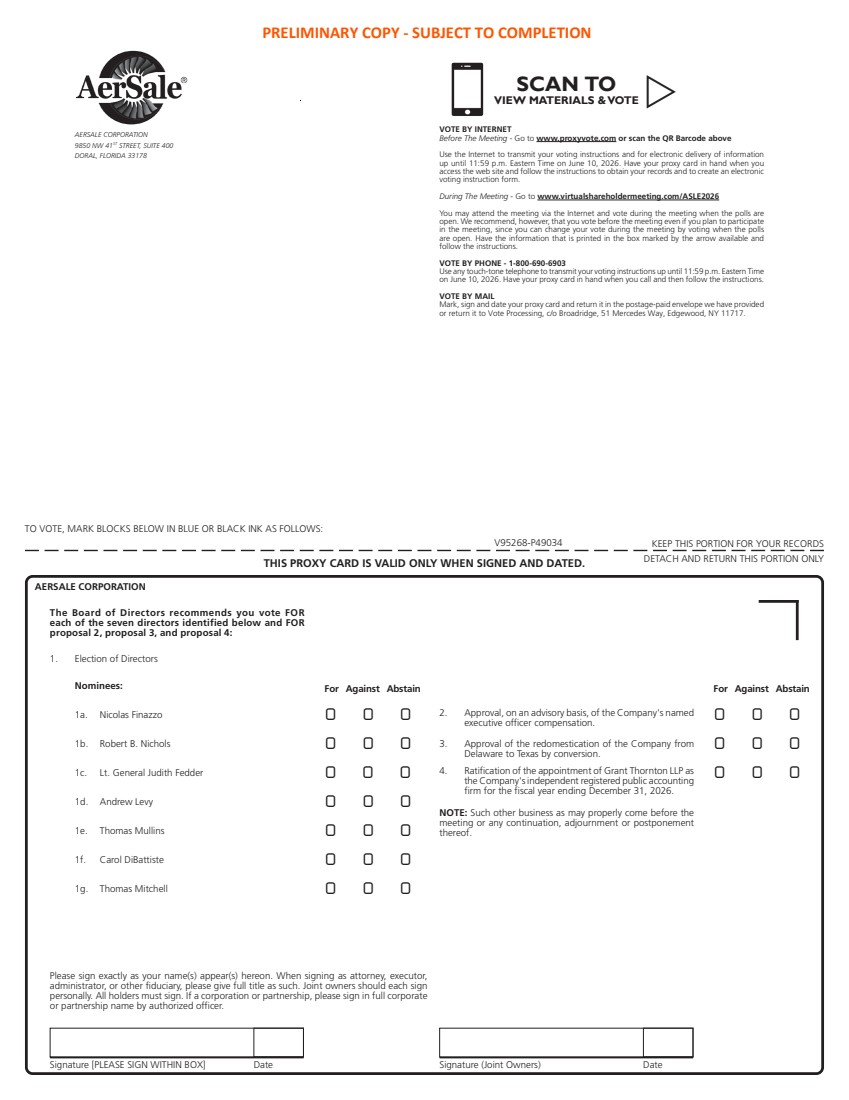
| V95269-P49034 Continued and to be signed on reverse side Important Notice Regarding the Availability of Proxy Materials for the Annual Meeting: The Notice and Proxy Statement and Annual Report are available at www.proxyvote.com. AERSALE CORPORATION THIS PROXY IS SOLICITED ON BEHALF OF THE BOARD OF DIRECTORS OF AERSALE CORPORATION FOR THE ANNUAL MEETING OF STOCKHOLDERS TO BE HELD ON JUNE 11, 2026 The undersigned stockholder(s) of AerSale Corporation hereby appoint(s) Nicolas Finazzo, Martin Garmendia and Paul Hechenberger, or any of them, as proxies, each with the power to appoint his substitute, and hereby authorize(s) them to represent and to vote, as designated on the reverse side of this proxy card, all of the shares of common stock of AerSale Corporation that the stockholder(s) is/are entitled to vote at the Annual Meeting of Stockholders to be held at 10:30 a.m. Eastern Time on June 11, 2026, via a live webcast at www.virtualshareholdermeeting.com/ASLE2026, and any adjournment, continuation or postponement thereof. Such proxies are authorized to vote in their discretion (x) for the election of any person to the Board of Directors if any nominee named herein becomes unable to serve or for good cause will not serve, (y) on any matter that the Board of Directors did not know would be presented at the Annual Meeting of Stockholders by a reasonable time before the proxy solicitation was made, and (z) on such other business as may properly be brought before the meeting or any adjournment, continuation or postponement thereof. This proxy, when properly executed, will be voted in the manner directed herein by the undersigned stockholder(s). If no such direction is made, this proxy will be voted in accordance with the Board of Directors’ recommendations. PLEASE MARK, SIGN, DATE AND RETURN THIS PROXY CARD PROMPTLY USING THE ENCLOSED REPLY ENVELOPE |